Design - Create - Grow

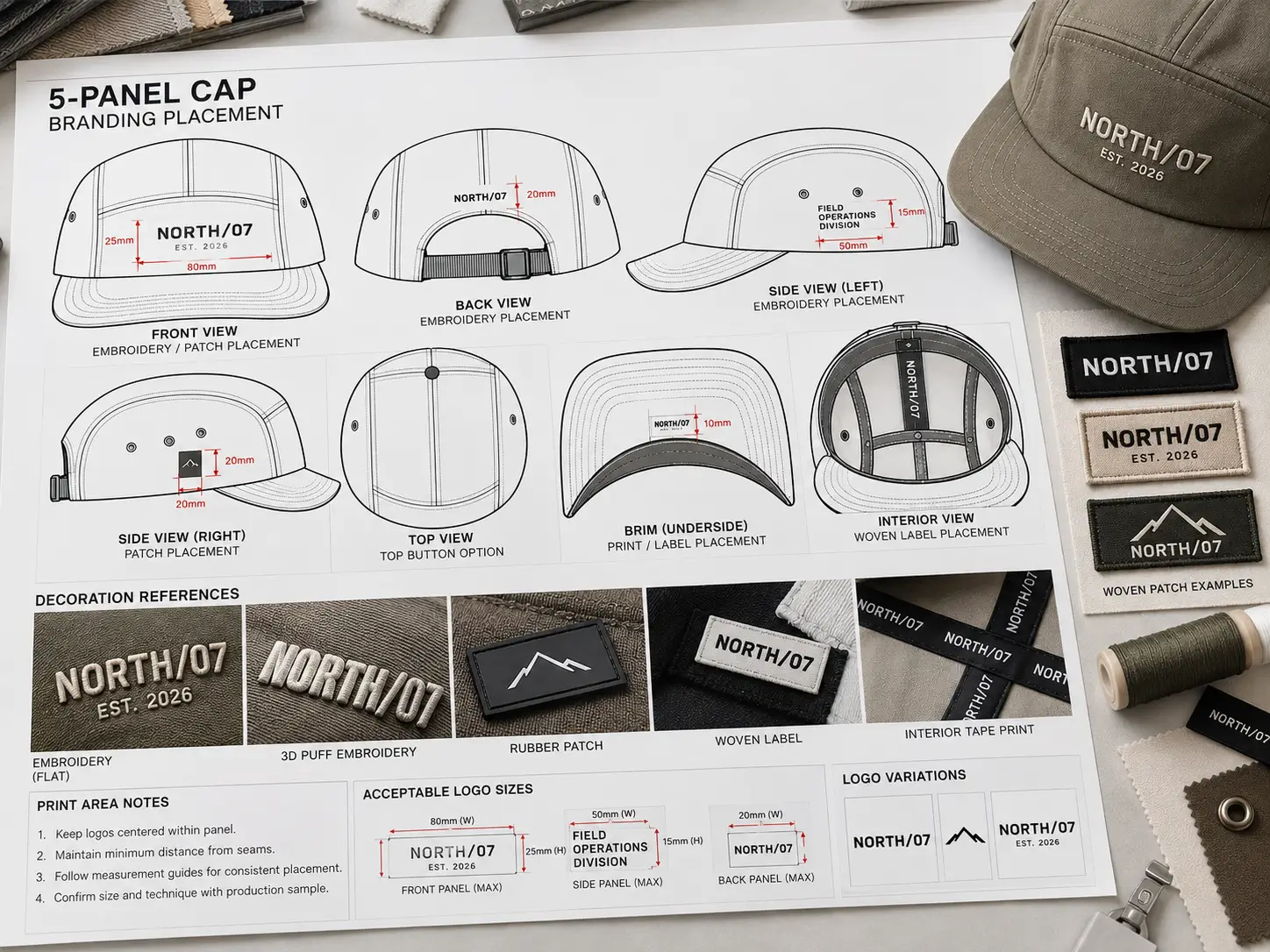

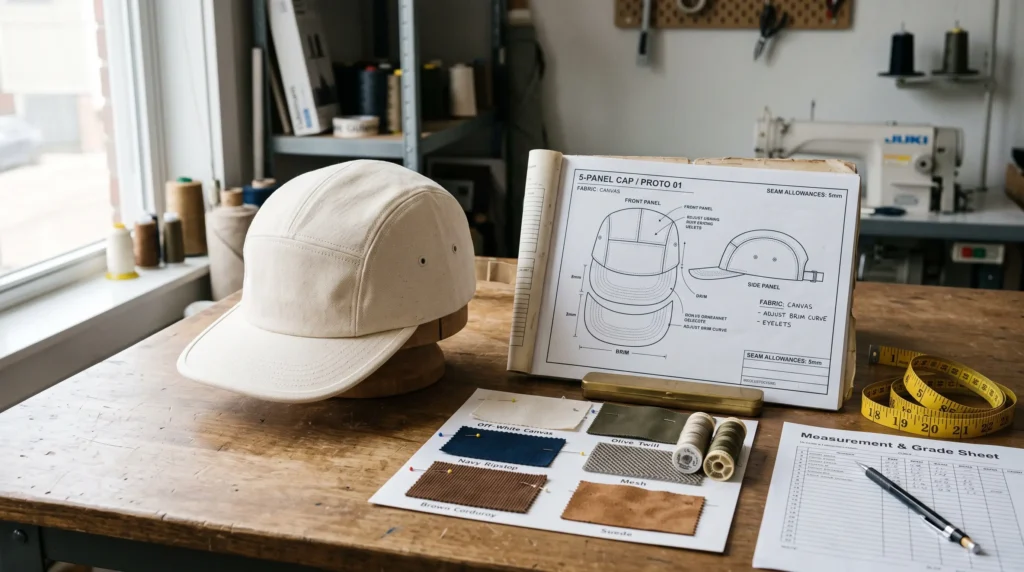
A finished hat concept may still leave a manufacturer with unanswered questions: how many panels form the crown, how should the brim curve, where does the logo sit, and how should the finished piece be measured? A tech pack hat document turns those design decisions into organized instructions for sampling and production.
Headwear needs details that a general apparel specification may not cover: panel layout, crown shape, brim or visor construction, closure system, head circumference, and branding placement. Depending on the style, the pack may also document materials, sizing, labels, packaging, and file delivery.
There is no single universal headwear tech pack format. A 5-panel camp cap, 6-panel cap, trucker cap, bucket hat, beanie, and visor have different construction needs, and manufacturers may use different terminology and workflows. This guide covers the information a manufacturer may need and how to organize it so the details for your particular style are clear.
Quick answer: A hat tech pack is a structured document that communicates how headwear should be constructed, measured, finished, branded, and produced. It may include technical flats, construction details, a materials list, measurements, sizing, colorways, artwork placement, labels, packaging, and revision information; the exact contents depend on the style and manufacturer.
Table of Contents
What Is a Hat Tech Pack?
A hat tech pack is a practical set of product specifications connecting a design concept to manufacturing instructions. It describes the components, construction, dimensions, finishes, and decoration needed to develop a particular headwear style.
Unlike a general apparel tech pack, a cap tech pack may need to show how crown panels join, whether the front is reinforced, how the brim attaches and curves, and how the wearer adjusts the fit. Depending on the product, it may also specify eyelets, a top button, sweatband, seams, labels, and branding. Terms such as crown, brim, visor, and sweatband are commonly used, but a manufacturer may use different terms. Define each point clearly and confirm shared terminology during development.
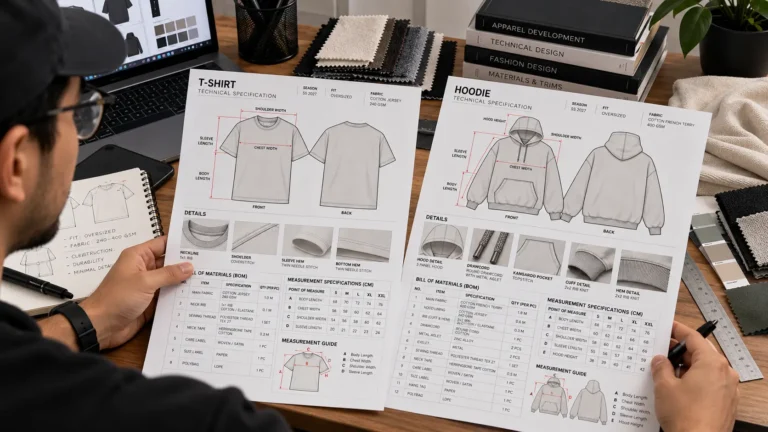
A technical drawing alone rarely communicates every production decision. Flats show shape and construction intent, while callouts, measurements, materials, artwork files, and sample notes explain how to interpret that drawing. For a broader introduction, see What Is a Tech Pack.
What Manufacturers Need From a Headwear Tech Pack
A manufacturer needs to identify the style, understand its components and placement, and know how the sample should be measured and reviewed. Use a checklist suited to the product’s complexity:
- Style name, number, category, version, and sample stage
- Technical flats and construction details
- Materials, trims, and bill of materials (BOM)
- Points of measure, methods, units, and tolerances
- Size or adjustment information
- Colorways and artwork placement
- Labels, packaging, and finishing notes
- Revision history and current approval status
A simple promotional cap may need fewer details than a fitted cap with several sizes, custom reinforcement, and multi-location embroidery. There is no required page count or fixed order; the pack should make the decisions for that style easy to find.
Main Sections in a Hat Tech Pack
1. Cover and style information
Identify the style name and number, brand or client, headwear category, version, date, and sample stage. Add a collection or season if relevant. Update the version and change notes whenever a sample round changes measurements, materials, construction, or artwork, so the manufacturer can identify the current instructions.
2. Technical flats for hats
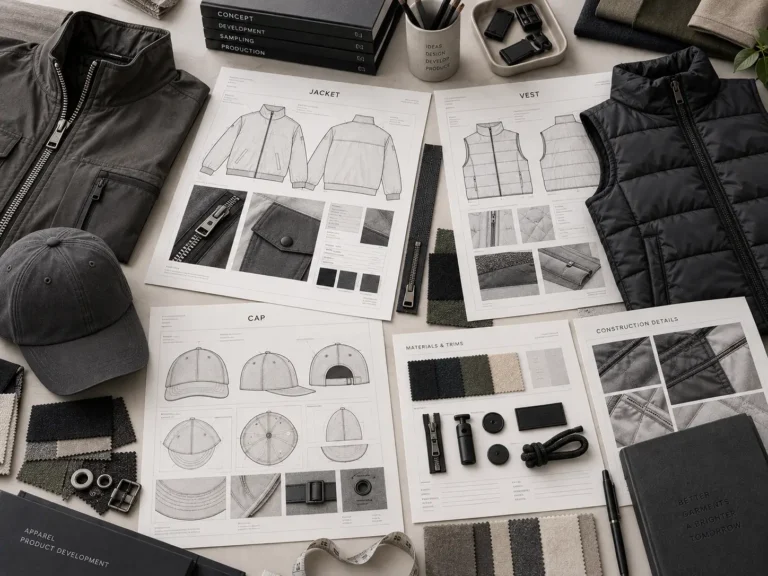
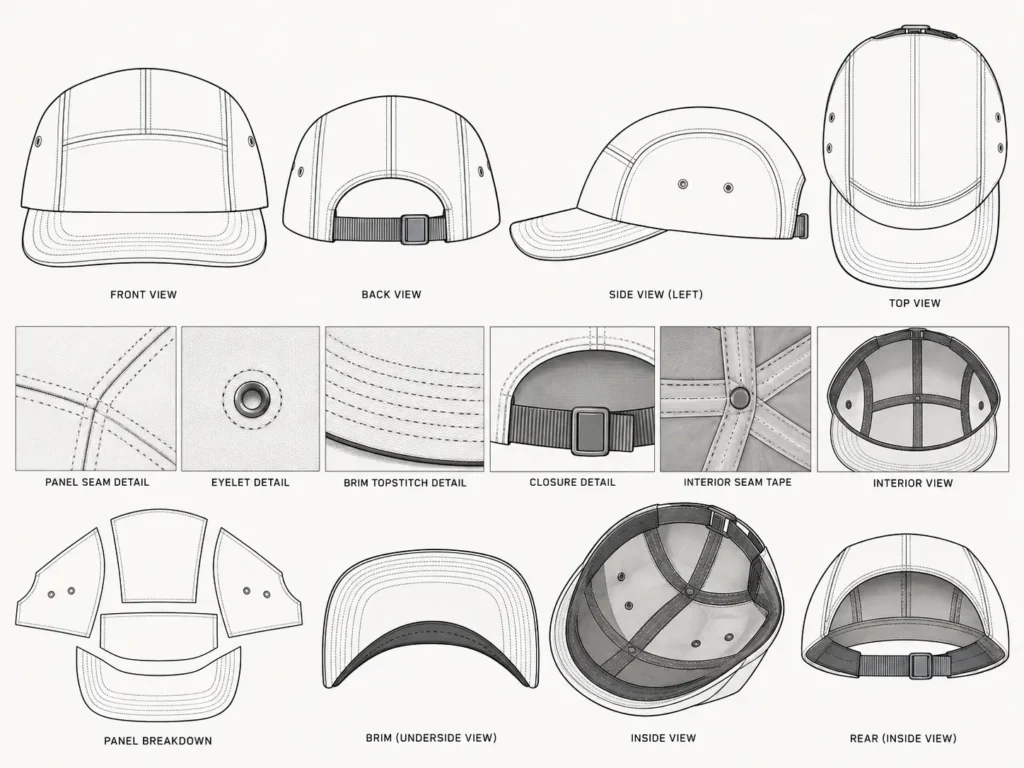
Use production-oriented technical views to communicate the design, not an editorial fashion illustration. Include front and back views, plus side, top, or interior views where they clarify construction. Show relevant seams, crown shape, brim or visor, closure, eyelets, top button, sweatband, and branding areas.
The views needed depend on the product: an interior view may help explain a bucket hat lining, while a back view may be essential for a cap closure. For more about how technical drawings and specifications work together, see What Is Included in a Fashion Tech Pack.
3. Panel and crown construction
For caps, identify the panel count, panel shapes, seam locations, crown height and curvature, front-panel structure, and interior finish where relevant. Note reinforcement or interfacing if the design uses it. In a 5-panel cap, the central front panel arrangement and seam placement strongly influence the silhouette, so make them clear in both the drawing and callouts.
4. Brim or visor specifications
Where applicable, document brim length and width, shape, profile, curvature, stitching, edge finish, layers or components, and attachment to the crown. Small changes can alter the cap’s silhouette. Specify the intended points and measurement method rather than relying on a universal brim standard.
5. Closure and adjustment details
Name the closure type and document its material, hardware finish, dimensions, position, and attachment method. Depending on the style, it may use a strap and buckle, snap closure, hook-and-loop, elastic, another adjustment system, or fitted construction. The closure affects both construction and fit, so make its behavior and adjustment range clear.
6. Materials and bill of materials
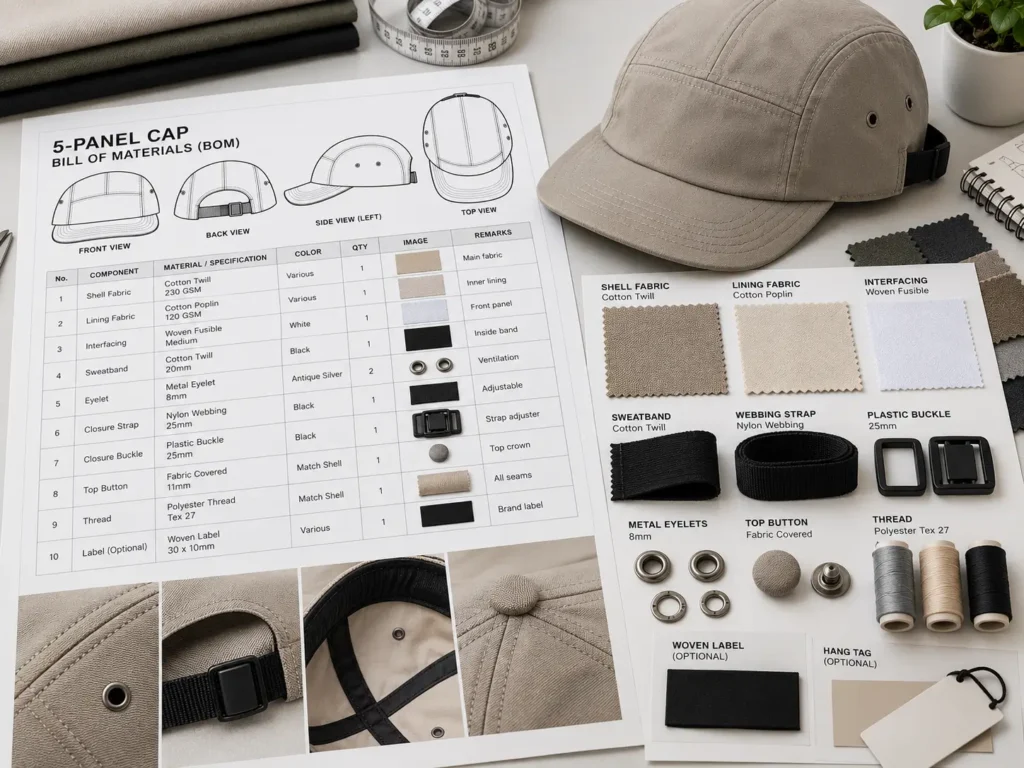
The BOM lists the components needed to construct and finish the product. Depending on the hat, it may include main and secondary fabrics, lining, reinforcement, brim components, sweatband, closure, hardware, thread, eyelets, buttons, labels, hangtags, and packaging.
For each component, specify what is known and useful: material or fiber description, color, finish, weight if relevant, supplier or component reference if applicable, and notes. Do not substitute an assumed industry standard for a specification the manufacturer needs to confirm. See How to Create a Tech Pack for a Clothing Brand for guidance on organizing product information.
7. Measurement specification sheet
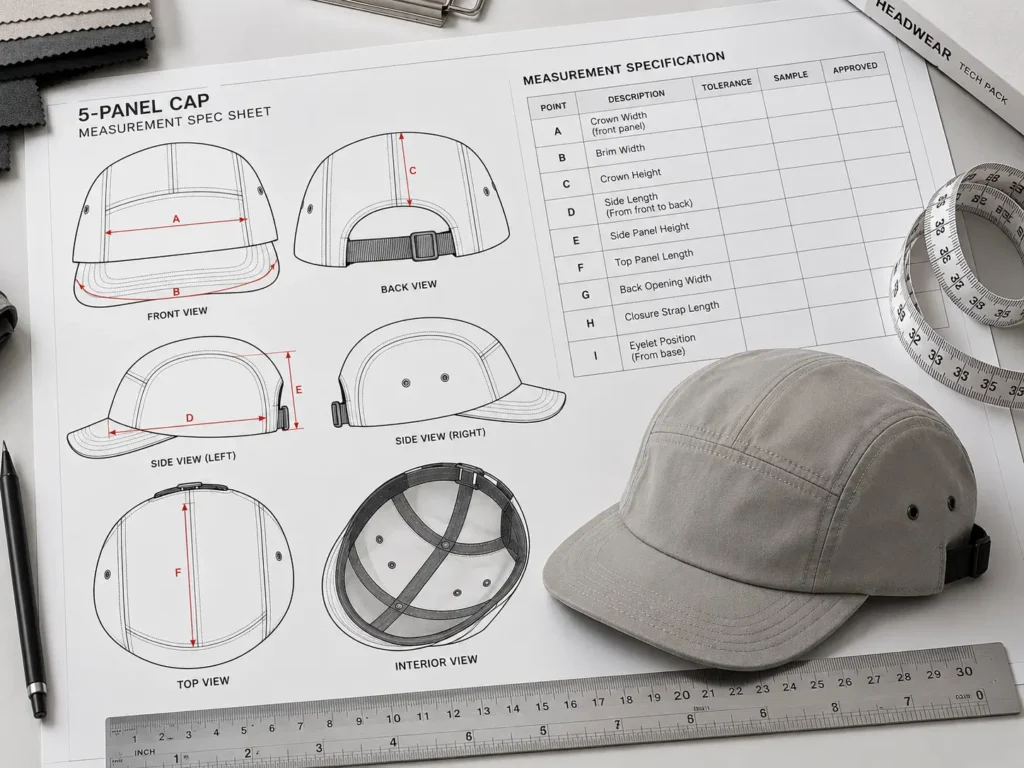
A cap measurement sheet may cover head circumference, finished crown dimensions, crown height, panel dimensions, brim dimensions or profile, closure and sweatband dimensions, and logo placement. Other headwear needs different points of measure.
State the sample or reference size, units, tolerance, and exactly how each measurement is taken. Measuring a finished product and describing its measurement method are separate instructions: both matter if the sample is to be checked consistently. Define points of measure with the manufacturer or pattern and headwear development partner rather than assuming a universal standard.
8. Sizing, fit, and adjustment
Document the base size or reference size, intended head-circumference range, adjustment range, fit notes, tolerances, and size-specific measurements where relevant. Adjustable, fitted, elasticated, stretch, one-size, and multi-size styles may require different specifications.
“One size” does not remove the need to describe fit and adjustment. Headwear grading also depends on the category, construction, closure, and manufacturer’s workflow; it should not be treated as identical to apparel grading.
9. Colorways and branding
Record the colors for the crown, panels, brim or underside, closure, hardware, thread, sweatband, labels, and artwork as relevant. Pantone or another color reference may help, but the appropriate system depends on the material and process, such as dyeing, printing, or decoration.
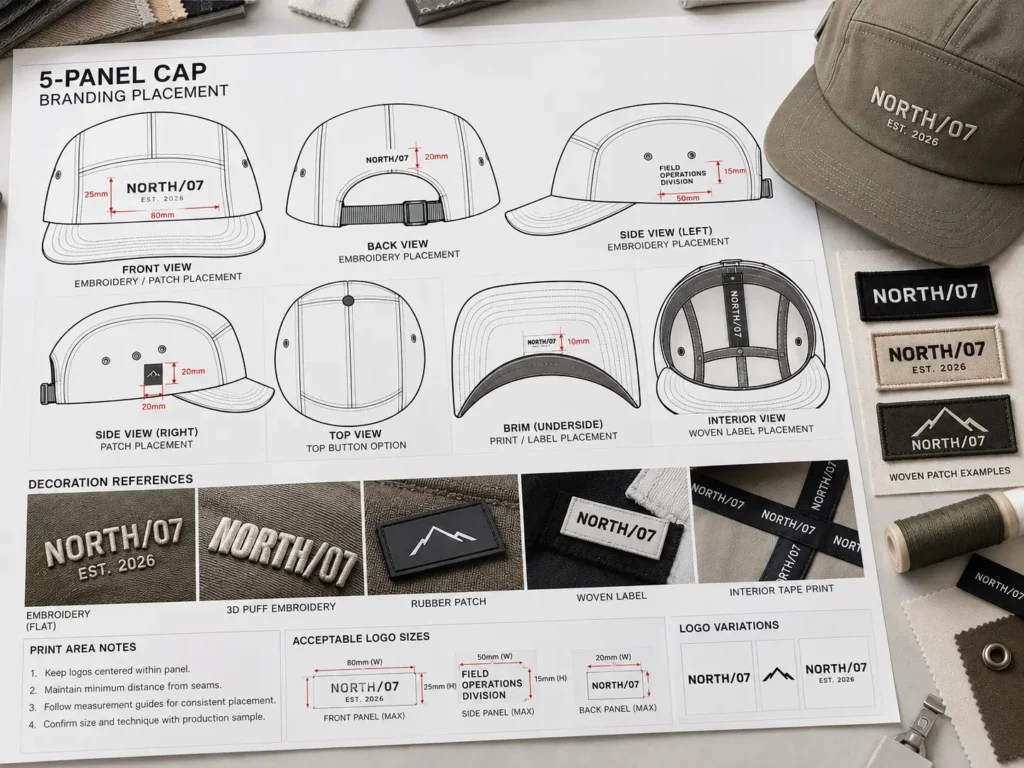
For embroidery, patches, prints, appliqué, heat transfer, or other decoration, specify the method, location, dimensions, orientation, colors, and distance from seams or panel edges. Showing a logo on a tech-pack flat communicates placement; it does not necessarily provide production-ready artwork. A factory or decoration partner may request artwork separately, including an embroidery machine file depending on its equipment and workflow.
10. Labels, packaging, and revisions
Where applicable, document label type, dimensions, material, position, and attachment method, as well as care or origin information. Label and regulatory requirements depend on the target market, product construction, materials, and applicable rules. For example, the FTC’s U.S. Care Labeling Rule expressly excludes hats from its definition of textile wearing apparel; that does not settle every other labeling obligation for a hat. Check the rules relevant to the product and market with an appropriate source or adviser. FTC Care Labeling Rule.
Packaging notes may cover shaping or folding, tissue, polybags, size stickers, hangtags, barcodes, carton requirements, and protection for the brim. These may sit in the tech pack or in separate production documents. Keep revision number, date, sample round, change description, approval status, and updated specifications together.
A Fictional 5-Panel Cap Tech Pack Example
The following fictional example shows one possible structure for a 5-panel camp cap; it is not a factory standard:
- Style overview: category, style ID, version, and sample stage.
- Technical flats: front, back, side, and any useful top or interior view.
- Panel and crown construction: panel layout, seams, shape, and reinforcement.
- Brim and closure: intended shape, construction, strap, and hardware.
- Colorways and branding: color references, logo placement, and decoration method.
- BOM and measurements: components plus defined measurement points and methods.
- Labels, packaging, and revisions: applicable finishing instructions and current approval details.
A dedicated 5-Panel Camp Cap Tech Pack Template can be a structured starting point for that silhouette. It is designed around a 5-panel cap; other hat types may need a different structure.
Hat Tech Pack File Formats: PDF, AI, EPS, SVG, Spreadsheets, and Images
Four things may be delivered separately: the readable tech-pack document, editable source artwork, production artwork for decoration or manufacturing, and manufacturer-specific files requested for a particular workflow. A single file may not serve all four purposes.
| Format | Typical use | Main advantage | Potential limitation | Manufacturer may request it when… |
|---|---|---|---|---|
| Review and sharing | Holds a fixed, readable document layout | May not preserve convenient editability or every production asset | A consistent approval copy is useful | |
| AI | Editable flats, artwork, and layouts | Supports continued vector editing | Requires compatible software and organized linked assets | The factory or designer works in Illustrator |
| EPS | Vector artwork exchange | Can suit some vector workflows | Compatibility and editability vary | A partner requests EPS artwork |
| SVG | Scalable vector artwork | Useful in some digital workflows | Not accepted by every production workflow | The partner’s tools support it |
| Excel or spreadsheet | Measurements and specification data | Easy to organize and compare values | Does not communicate visual construction by itself | The factory exchanges specs in tabular form |
| JPG or PNG | Previews and references | Easy to view | Raster images may not be suitable as production artwork | A visual reference or approved preview is needed |
Adobe documents Illustrator’s supported formats, but that does not mean every manufacturer accepts each format. Confirm the requested deliverables before sending files. Adobe Illustrator supported file formats.
Embroidery assets such as DST or EXP, pattern or cutting files, and other machine- or factory-specific files may be requested separately. Their need and format depend on the manufacturer and production process.
Hat Tech Pack PDF vs. Editable AI File
A PDF can work well as a fixed review document for comments and approvals. An editable AI source file can help a designer continue developing vector flats and layouts. Some teams maintain both, with the shared PDF exported from the current approved source.
Keep source files organized and make sure linked images are available. Do not assume PDF alone is sufficient for production, or that every factory requires the original AI file. A manufacturer may request vector logo art, embroidery artwork, or other production assets separately.
Digital vs. Printable Headwear Tech Packs
Digital packs are easy to share, review on screen, and zoom into for close inspection. Use clear file names and revision numbers, and send a link or attachment the manufacturer can access. Printed copies can help in a sample room, but callouts, dimensions, and page layout need to remain legible at the intended print size.
The digital and printable versions may contain the same core information. Check that the page hierarchy works at screen and print size, and that the files represent the same current revision.
What Do Hat Manufacturers Actually Need?
There is no universal manufacturer submission package. A partner may request a PDF, editable source files, vector or embroidery artwork, a measurement sheet, BOM, reference images, approved sample, packaging instructions, or pattern and production files where applicable.
The request can change from initial inquiry and quoting through design review, sampling, decoration development, sample approval, production, quality control, and packaging. Confirm requirements with the manufacturer early. How to Communicate With Clothing Manufacturers offers related guidance; the existing cap tech pack templates and mockups guide covers a broader template-focused topic.
Which details matter most by hat type?
- 5-panel camp cap: panel arrangement, front seams, brim, closure, and logo placement.
- 6-panel baseball cap: panel construction, center-front details, curved brim, closure, eyelets, and sweatband.
- Snapback: back opening, snap placement, strap dimensions, and adjustment hardware.
- Trucker cap: front panel, mesh back, any foam or lining, closure, and panel transitions.
- Fitted cap: head circumference, size and fit information, sweatband, construction, and reinforcement.
- Bucket hat: crown, brim width and circumference, seams, lining, and any drawcord.
- Beanie or knit cap: knit structure, body dimensions, stretch and fit, yarn or material, cuff, and label placement.
- Visor: headband, visor shape, closure, brim, and interior finishing.
These are areas to consider, not fixed page lists. Document the variables relevant to the actual style.
Common Hat Tech Pack Mistakes
Frequent gaps include missing panel count or seam locations, undefined brim dimensions, unclear closure or fit information, and measurements without a method or tolerance. A pack may also omit materials, reinforcement, eyelets, sweatband, labels, packaging, or the location and method for decoration.
Another common problem is showing artwork without supplying separate production assets when required. Inconsistent colorways, low-quality references, outdated revisions, and cluttered pages can also make decisions harder to review. Headwear shape can be sensitive to construction and measurement details, so make important decisions explicit and review the sample with the manufacturer. Clear documentation can reduce ambiguity, but it cannot guarantee a correct first sample: prototype review, fitting, measurement checks, approval, and communication remain part of development.
Hat Tech Pack Checklist
Before sending the pack, check that it includes the details relevant to this style:
- Style name, number, category, version, and date
- Front, back, side, top, or interior views where useful
- Panel construction, crown, brim or visor, and closure details
- Eyelets, sweatband, top button, and reinforcement where applicable
- Materials, BOM, and colorways
- Artwork placement, decoration method, and separate production files if required
- Measurements with defined methods, units, reference size, and tolerances
- Fit or adjustment information
- Labels, packaging, and finishing notes where applicable
- Revision history, current approval status, clear file names, and manufacturer-specific requirements
How to Choose the Right Structure
Start with the product and identify every decision that could affect its construction, fit, appearance, decoration, or packing. A simple promotional cap may need a concise set of instructions; a fitted cap, heavily embroidered style, multi-color collection, or lined bucket hat may need more views and specifications. A 5-panel camp cap template is relevant when that is the silhouette being developed, not a default for every hat.
The useful question is not how many pages a hat tech pack should have. It is whether the document clearly communicates every production variable that matters for this style.
Frequently Asked Questions
What is a hat tech pack?
It is a technical document that communicates headwear construction, measurements, materials, branding, and production instructions for a particular product.
What should be included in a cap tech pack?
Depending on the style: technical flats, construction notes, materials and BOM, measurements, sizing or adjustment information, colorways, branding, labels, packaging, and revision control.
What measurements are needed for a hat tech pack?
Points of measure depend on the hat. They may include head circumference, crown dimensions, brim or visor dimensions, closure dimensions, and other style-specific measurements. Define how each is taken with the manufacturer.
Do I need a measurement sheet for a hat?
A measurement sheet can make sample review and production checks clearer. Include the points relevant to the product and define their methods and tolerances.
What is a 5-panel cap tech pack?
It is a headwear tech pack organized around a 5-panel cap’s construction and production needs, such as panel layout, crown, brim, closure, materials, measurements, and branding.
Should I send a hat tech pack as a PDF?
A PDF can provide a consistent review document, but the manufacturer may also need editable source files or separate production assets. Confirm the requested formats.
Do manufacturers need the original AI file for a cap?
It depends on the manufacturer and workflow. AI can be useful for editable vector flats and artwork, but it is not universally required.
How many pages should a hat tech pack have?
There is no fixed page count. It depends on the style’s construction, decoration, materials, sizing, packaging, and manufacturer requirements.
Conclusion
A manufacturer-ready headwear tech pack is clear, style-specific documentation—not a universal template. Show the construction through useful technical flats, define measurements and methods, list the materials and trims, and specify how branding, closures, labels, and packaging should be handled where relevant.
Keep file delivery and revision history clear, and confirm the manufacturer’s requirements before sampling. A well-organized pack can reduce ambiguity, but sample review, fitting, measurement checks, and communication still matter.
If you are new to documentation, start with the sections that explain the design and its measurements. If you are developing a 5-panel cap, the 5-Panel Camp Cap Tech Pack Template offers a structured starting point for that specific silhouette.