Design - Create - Grow


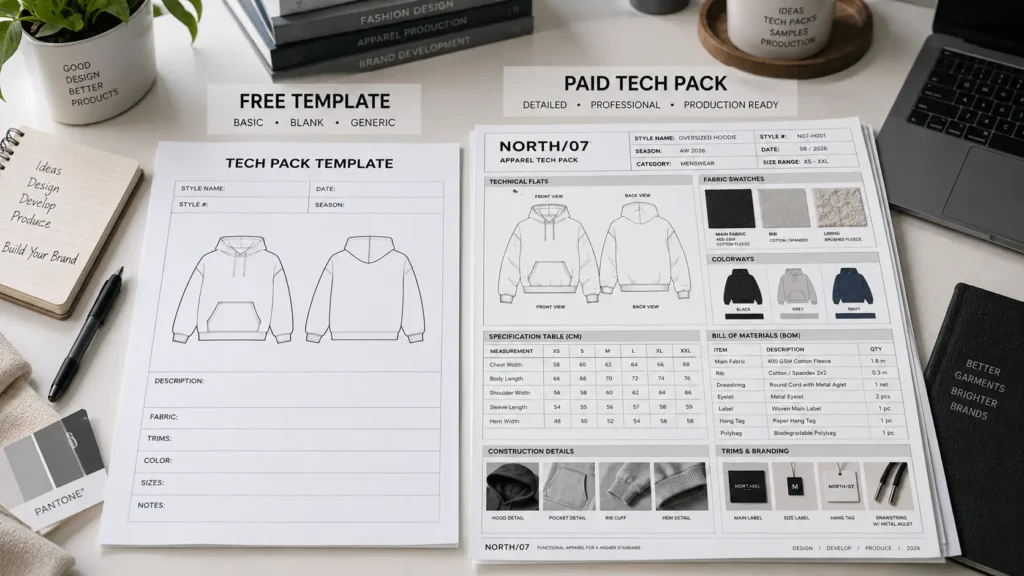
If you’ve typed “tech pack template free” into Google, you’re probably trying to solve a real problem: you need to document a garment clearly, but you’re not sure whether a free download will actually get you there, or whether you should just pay for something more structured.
The honest answer is that “free” covers a lot of ground. Some free tech pack templates are genuinely useful, well-organized starting points. Others are little more than a blank grid with a few labeled boxes.
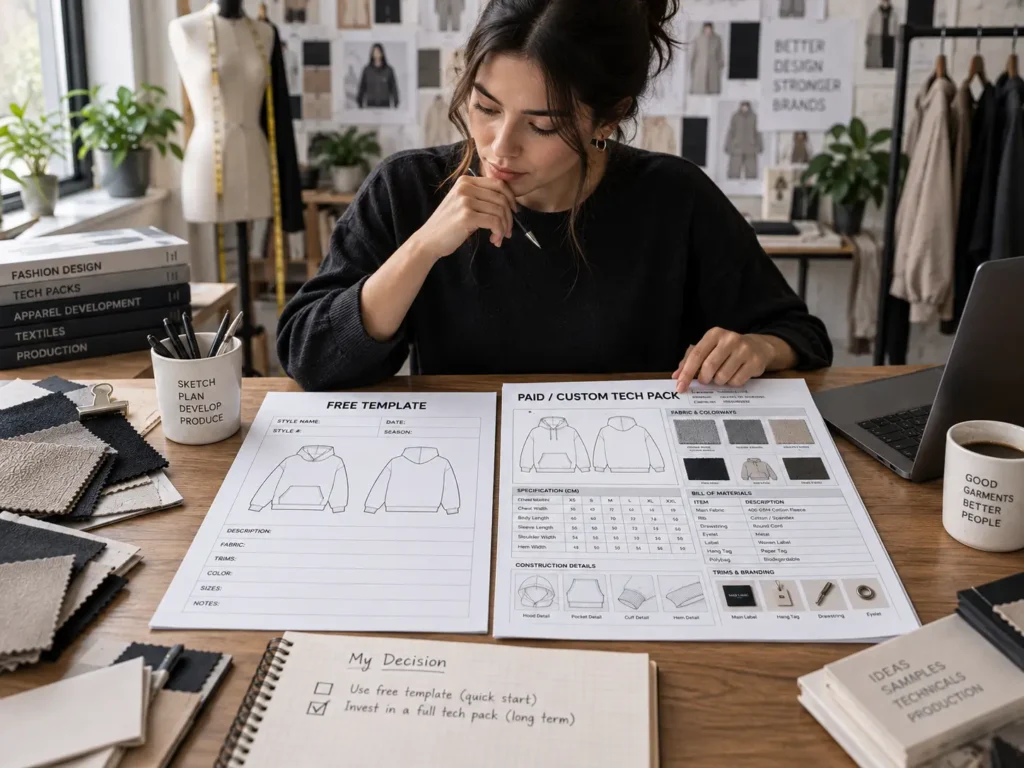
This article compares free and paid tech pack templates on the things that actually matter: page structure, editable files, technical sections, licensing, customization, and how well each option supports communication with a manufacturer. Neither option is automatically better. The right choice depends on what you’re making, who you’re sending it to, and how much setup time you want to spend versus pay for.
Quick answer: A free tech pack template can be useful for learning, practicing technical documentation, building simple internal documents, or testing a garment concept. A paid tech pack template may offer a more structured, editable starting point, but the template itself doesn’t make a garment specification production-ready — you still need to add accurate measurements, materials, construction details, and artwork yourself.
Table of Contents
What Is a Free Tech Pack Template?
A tech pack (technical pack) is the document a designer sends to a factory or sample-maker that specifies exactly how a garment should be constructed. A “free tech pack template” is simply a pre-built version of that document that costs nothing to download.
That said, “free” can describe very different things. It might be a genuinely structured layout built by an experienced technical designer and shared as a teaching resource. It could also be a blank cover page with a couple of placeholder tables, published mainly to generate traffic.
Some free templates come from design schools or educators, some from freelance technical designers, some from generic template marketplaces, and some from software companies showcasing what their tools can do. Quality and scope vary a lot between these sources.
A reasonably built free template may include a basic page structure, a placeholder area for a technical flat (a simple line drawing of the garment), a measurement table, a few BOM (bill of materials) fields, a construction-notes section, a colorway block, and basic labeling fields. Whether all of these are present — and how well they’re organized — depends entirely on the specific template. Free doesn’t automatically mean incomplete, and it doesn’t automatically mean production-ready either.
When Is a Free Tech Pack Template Actually Useful?
A free template earns its place in plenty of real workflows, especially when the goal is learning or early-stage development rather than a factory submission.
It tends to work well for:
- Learning how a tech pack is organized, section by section
- Fashion-school assignments and coursework
- Portfolio pieces meant to demonstrate documentation skills
- Early concept development, before construction details are finalized
- Documenting a simple garment, like a basic tee, where the required sections are minimal
- Internal design notes shared within a small team
- Testing a personal workflow before committing to a system
- Drafting a first version before deciding whether a more structured template is worth paying for
A free template is most useful when you already understand what information a garment needs and you’re using the template mainly as a page framework, or when you’re treating it as a learning exercise rather than a client- or factory-facing document.
Where Free Tech Pack Templates Usually Start to Fall Short
The limitations of free templates aren’t universal, but a few patterns show up often enough to be worth checking for before you build a real document on top of one.
Common gaps include: very basic single-page layouts, no dedicated space for construction details, generic (or missing) technical flats that don’t match your garment, thin measurement-specification fields, no guidance on tolerances, no size-grading structure, a minimal BOM table, weak or nonexistent artwork-placement documentation, limited label and packaging sections, inconsistent formatting between pages, flattened or uneditable files, no revision-history section, and unclear or missing licensing terms.
It’s worth stressing that a template can be free and still well-designed, and a paid template can still be poorly organized. Price alone doesn’t tell you which one you’re looking at — the actual structure and content do.
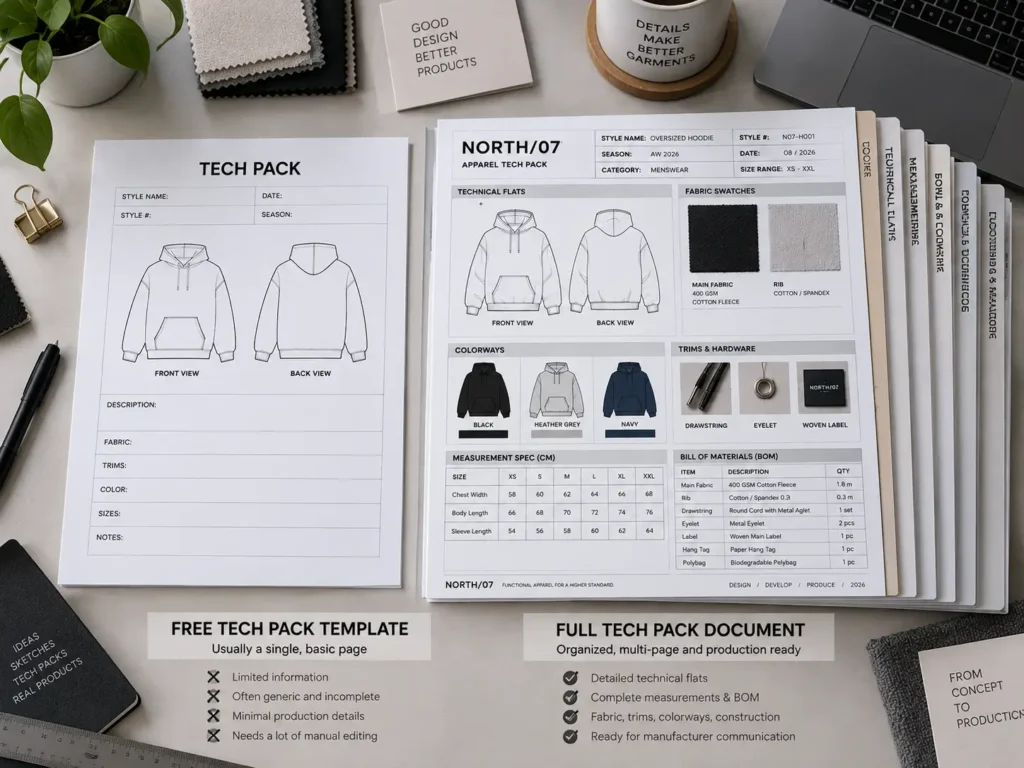
Free vs Paid Tech Pack Templates: What Are You Actually Paying For?
| Feature | Free template | Paid template | What to check before using it |
|---|---|---|---|
| Initial cost | $0 | Typically a few dollars to a larger bundle price | Whether the price reflects the scope you need |
| Page structure | Often basic, sometimes just one page | Often multi-page with a defined structure | Does the layout match your garment’s complexity? |
| Technical flat organization | May be generic or absent | Usually has a dedicated flat-sketch page | Is the flat editable or a locked placeholder? |
| Construction details | Frequently thin or missing | Usually has a dedicated section | Does it prompt for stitch type, seams, finishing? |
| Measurement specifications | Basic table, sometimes no tolerance field | Structured spec sheet, often with grading space | Are points of measure clearly labeled? |
| BOM | Minimal fields | More structured breakdown | Does it cover fabric, trim, hardware, labels? |
| Colorways | Sometimes absent | Usually a dedicated page | Can you show multiple colorways clearly? |
| Artwork placement | Rarely detailed | Often included as a labeled section | Is there room for exact placement and scale? |
| Labels | Basic or missing | Usually included | Does it cover main, size, and care labels? |
| Packaging | Rarely included | Sometimes included | Confirm before assuming it’s covered |
| Revision control | Usually absent | Sometimes included, sometimes not | You may need to add this yourself either way |
| Editability | Varies widely | Usually built with editable layers | Check file type and whether layers are named |
| File formats | Often PDF or flattened image | Often AI, EPS, SVG, PDF, or a mix | Confirm what your software can open |
| Garment specificity | Usually generic | May be generic or garment-specific | Does the template match your silhouette? |
| Licensing | Often unclear | Usually stated on the product page | Read the license before commercial use |
| Customization | Depends on file type | Usually easier due to editable source files | Can you rebuild sections without starting over |
| Manufacturer communication | Depends entirely on content quality | Depends entirely on content quality | Neither guarantees factory acceptance |
| Setup time | Can be significant if the layout is thin | Usually lower, since structure is pre-built | Weigh setup time saved against the cost |
Paying for a template generally buys convenience, structure, consistency, and a more developed starting framework — not automatically correct garment specifications. You still have to fill in the technical content accurately, whichever document you start from.
Free Tech Pack Template vs Professional Tech Pack Template
“Professional” is really a description of quality and organization, not of price. A professionally structured template — free or paid — tends to have a clear information hierarchy (cover page, then flats, then specs, then BOM, then construction, then labels), consistent formatting across pages, room for revisions, and a layout that’s easy to hand off to a factory contact without extra explanation.
A weaker template, even a paid one, might cram too much onto one page, use inconsistent units or terminology, or leave no room to add notes as a sample goes through revisions. When you’re evaluating any template, look past the price tag and check whether the document itself would actually make sense to someone on a factory’s technical team.
What a Production-Oriented Tech Pack Needs Beyond the Template
Whether you start from a free download or a paid layout, the template is only the container. A garment gets production-ready when you fill it in with accurate, garment-specific information — which is really the harder part of the job.
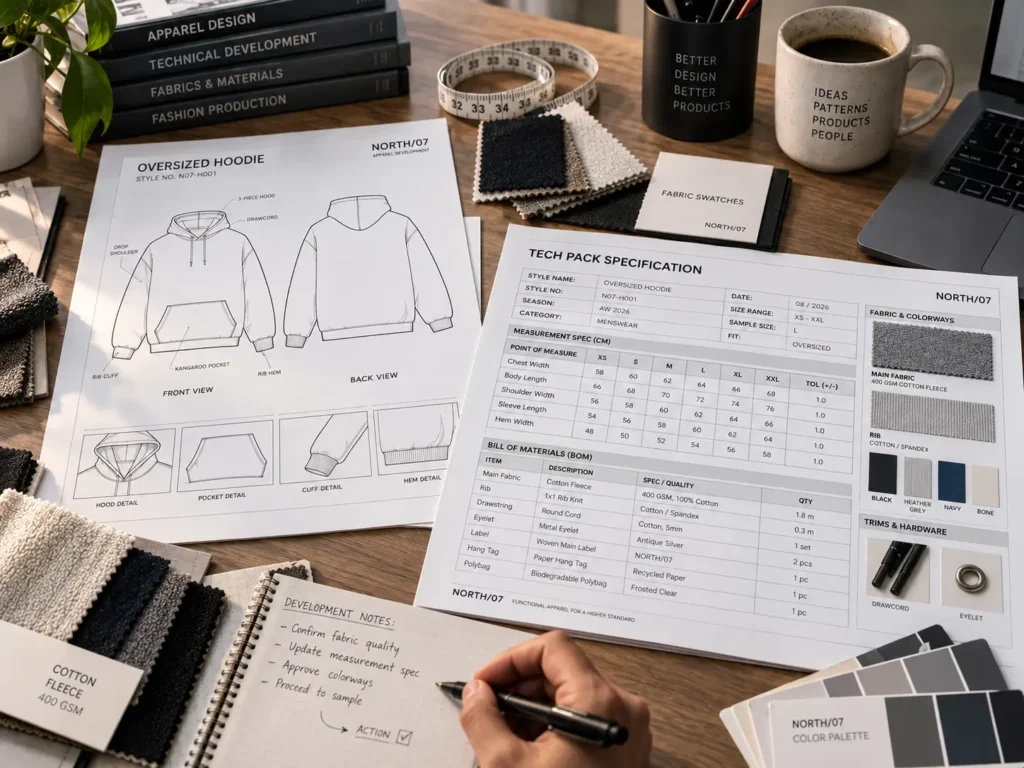
Technical Flats
Front, back, and side views as needed, plus any relevant detail callouts: seams, panels, pockets, closures, ribbing, and construction lines. A generic flat rarely matches your actual garment closely enough to be useful on its own.
Construction Details
Stitch types, seam finishes, hems, collar and cuff construction, zippers, buttons, elastic, drawcords, reinforcement points, and any special construction notes specific to the style.
Materials and BOM
Main fabric, lining, rib, thread, zippers, buttons, labels, hangtags, packaging materials, and any other trims — ideally with supplier and composition details where you have them.
Measurement Specifications
Points of measure (POM), finished garment measurements, sample size, size range, tolerances, and the units you’re using. Tolerance and unit consistency matter more than people expect; a missing tolerance is one of the more common causes of sampling confusion.
Colorways and Artwork
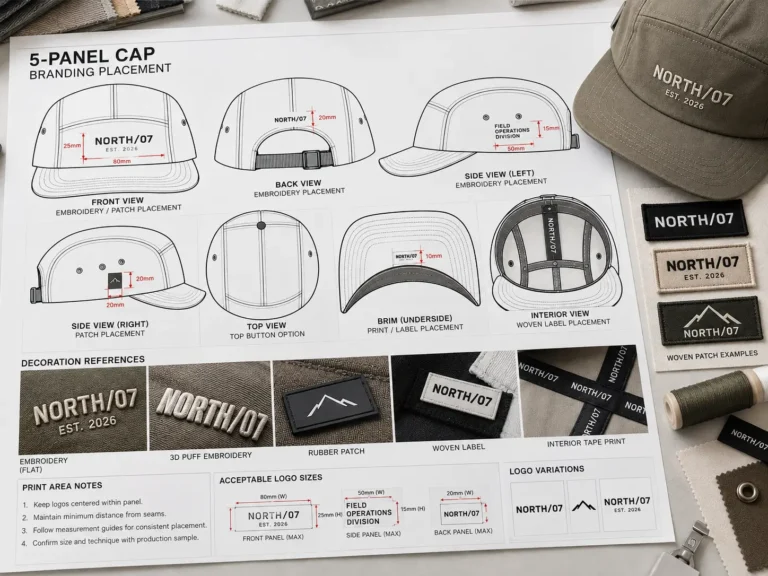
Body colors, contrast colors, and thread colors where relevant, plus decoration details: print placement, embroidery, heat transfer, appliqué, or other methods, documented with location and scale.
Labels and Packaging
Main label, size label, care label, and country-of-origin information where applicable, along with folding, polybagging, hangtag, and carton or barcode details where relevant. Care labeling requirements can vary by country and product type. See FTC Care Labeling Rule.
Revision History
Version number, date, description of the change, sample round, approval status, and comments. This section becomes more valuable the more revisions a style goes through, and it’s one of the easier sections to skip when a template doesn’t prompt for it.
No template, free or paid, fills these sections in for you. That work comes from garment-specific knowledge, pattern development, and communication with whoever is producing the sample.
Free Tech Pack Template PDF vs Editable Template Files
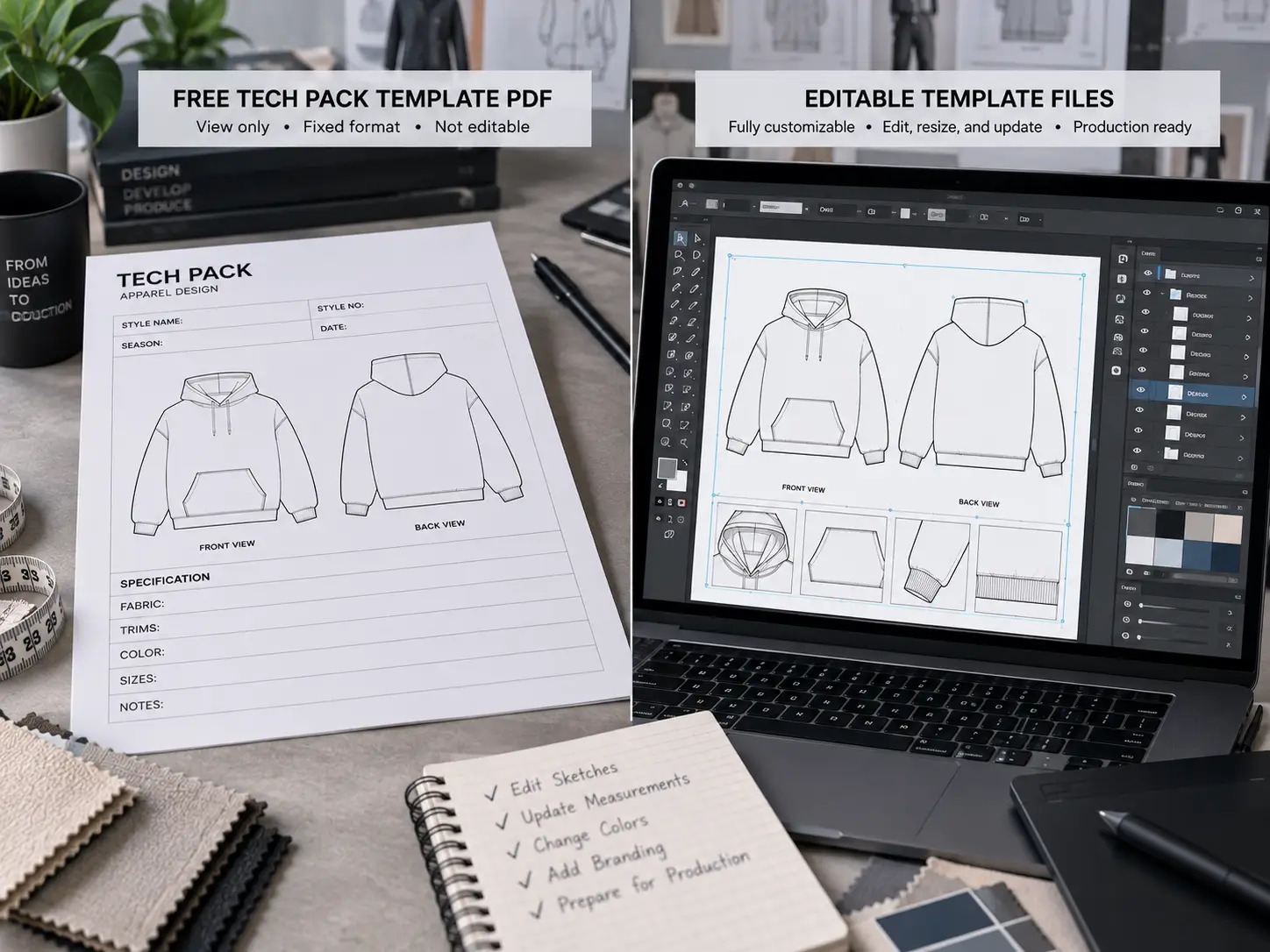
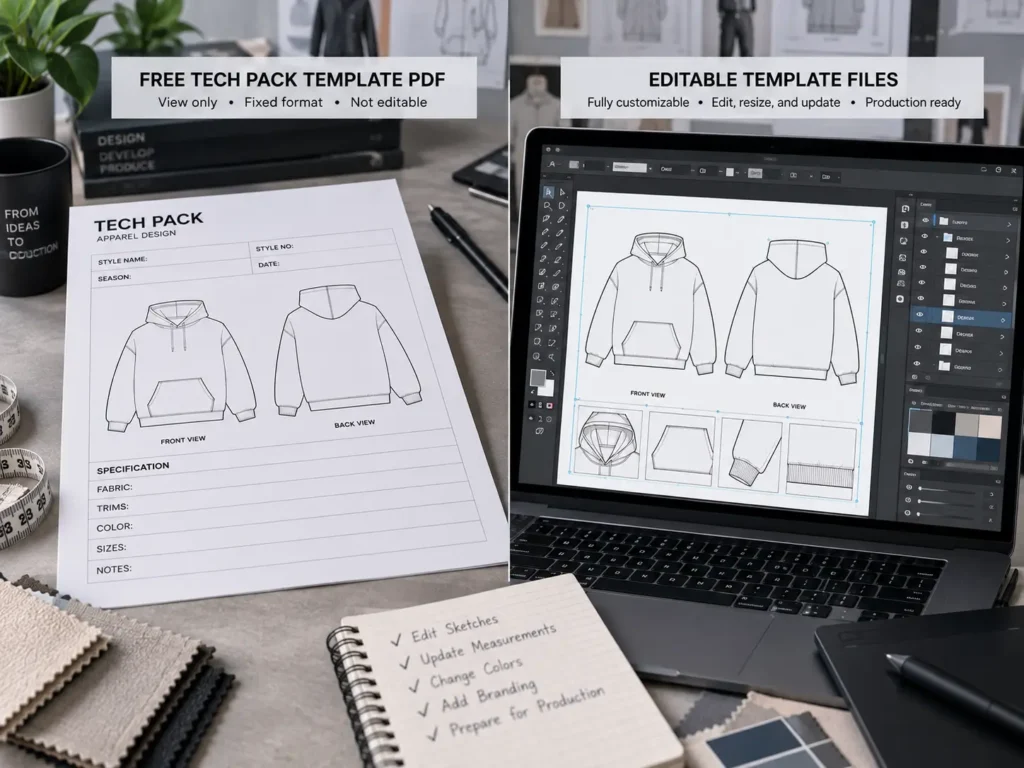
A PDF is a fixed, readable document — good for sharing a finished tech pack, printing it, or sending it for review, since it displays consistently regardless of what software the recipient has. What a PDF usually isn’t is easy to edit repeatedly, unless it was built with fillable fields.
Editable source files — AI (Adobe Illustrator), EPS, SVG, or a spreadsheet format like Excel — are what you’d typically use while the document is still in progress: updating a measurement, swapping a flat sketch, or adjusting a colorway.
Illustrator’s native format and EPS are widely used in apparel design specifically because they preserve vector artwork at any scale. See Adobe Illustrator supported file formats.
Neither format is inherently superior — they serve different stages of the same process. A free PDF-only template can be limiting once you need to revise it repeatedly, simply because there’s more manual rework involved. A free or paid template with editable source files tends to make revisions faster. Before modifying or redistributing any third-party free template, check its license — free doesn’t automatically mean you’re allowed to alter and reuse it commercially.
Why a Paid Template May Be Worth $9.99
This is a practical cost question, not a sales pitch: for many designers, the main value of a paid template isn’t the content it supplies — it’s the setup work it removes. Building a multi-page document with a technical flat area, spec table, BOM, colorway page, and construction section from a blank canvas takes real time, and it’s easy to end up with inconsistent formatting between pages if you’re building it as you go.
A low-cost template can make sense if you expect to produce multiple revisions of the same style, or if you’d rather start from an organized layout than a blank page. On the other hand, a designer who already has a working Illustrator or spreadsheet system probably doesn’t need to buy one — building your own gives you full control over the structure.
The Fashion Tech Pack Template from S.i. Graphics is currently listed at $9.99 and serves as a low-cost paid entry point. According to its current product page, it’s a universal, garment-adaptable layout — not tied to one silhouette — with a technical flat sketch page, measurement spec sheet, BOM, colorway page, construction-details page, and a logo/label placement guide, delivered as editable AI, EPS, SVG, and PNG files with a commercial license.
Buying it gives you that structure already built; it doesn’t supply your garment’s actual measurements, materials, or construction notes, and it doesn’t guarantee a factory will accept the finished document without its own review.
Start With a Low-Cost Tech Pack Structure
For designers who want a more structured starting point than a blank document, the S.i. Graphics Fashion Tech Pack Template is a low-cost paid option for building and organizing apparel technical documentation.
Free vs Paid: A Practical Decision Framework
“I’m learning how tech packs work.”
A free template is often enough here. The goal is understanding structure and terminology, not producing a factory-ready file.
“I need a basic internal document for one simple garment.”
Consider how much technical detail the garment actually requires. A simple tee needs less than a structured jacket — a free template may cover it if you fill it in carefully.
“I’m preparing documentation for a real manufacturer.”
Completeness and technical accuracy matter more than whether the template was free or paid. Check the factory’s own format preferences and required files before finalizing anything.
“I’m developing several garments.”
Consistency across styles starts to matter. A reusable, structured template — whether that’s a paid single template or a broader system like the Complete Tech Pack Library covering multiple garment categories — can reduce rework as your line grows.
“I already know Illustrator and Excel well.”
Building a custom system may make more sense, since you control the exact structure and can tailor it precisely to your workflow.
“I want to save setup time.”
A structured paid template can be a practical trade — you’re paying to skip the layout work, not to skip the technical thinking.
How to Evaluate Any Free Tech Pack Template Before Using It
Before building a real document on top of any free template, check it against this list:
- Does it have front and back technical-flat areas?
- Can you clearly identify the garment style from the layout?
- Is there a measurement-specification section?
- Are points of measure easy to document clearly?
- Is there room for tolerances?
- Is there a bill of materials (BOM)?
- Is there space for construction notes?
- Can you document multiple colorways?
- Can you specify artwork placement precisely?
- Are labels (main, size, care) covered?
- Is there any form of revision control?
- Can the file actually be edited, or is it a flattened image?
- Is the file quality acceptable for both screen review and printing?
- What software does it require?
- Does the license allow commercial or client use?
- Can the layout be adapted to your specific garment?
- Can you export the final document in a format your manufacturer accepts?
Inspect the actual template rather than assuming “free” means complete — the only way to know what you’re getting is to open it and check each section.
Free Tech Pack Template vs Building Your Own From Scratch
| Approach | Cost | Setup effort | Control | Consistency | Learning value | Best use |
|---|---|---|---|---|---|---|
| Free template | $0 | Varies — can require heavy rework | Limited to the template’s structure | Depends on the source | High if you study its structure | Learning, simple garments, first drafts |
| Paid template | Low to moderate | Usually lower — structure is pre-built | Moderate — you can still adapt it | Generally consistent, page to page | Moderate | Repeated use, multiple revisions, saving setup time |
| Custom, built from scratch | Your time | Highest | Full control | Depends on your own discipline | Very high | Designers with specific, ongoing documentation needs |
None of these is universally best. A free template reduces blank-page setup but may need substantial modification. A paid template usually reduces repetitive layout work. Building from scratch gives you maximum control but means maintaining the whole system yourself.
Example: Turning a Basic Free Template Into a More Complete Tech Pack
The following is a fictional walkthrough, not a real product or production outcome.
Imagine a basic free template for an oversized T-shirt that includes only a cover area, a front/back flat placeholder, a simple measurement table, and a short BOM list. On its own, that’s a starting skeleton, not a finished tech pack.
To move it toward something a factory could actually use, a designer would typically add: a style number and version/date, construction callouts (like a topstitched neck rib and a specific hem finish), sleeve and hem construction notes, colorway information, exact artwork placement and scale, fabric composition and weight, measurement tolerances, a defined size range, label specifications, packaging instructions, and a revision-history log as sample rounds happen.
None of these specifics come from the template — they come from the actual garment-development process: pattern decisions, fabric sourcing, and sample fittings. A template only gives you somewhere to record them consistently.
Are Free Tech Pack Templates Good Enough for Manufacturers?
The honest answer is that it depends on the content, not the price. A free template can absolutely work as the framework for a manufacturer-facing document, as long as it lets you document every piece of required information clearly and accurately.
A paid template isn’t automatically more acceptable to a factory just because it cost money — factories care about clarity and completeness, and many have their own preferred submission formats regardless of what template you started with.
Depending on the manufacturer and product, you may need to submit more than a single tech pack file: PDFs for review, AI or EPS files for print-ready artwork, SVG for simpler vector graphics, a spreadsheet for grading, separate artwork files, patterns, or physical reference samples.
Confirm submission requirements directly with your manufacturer rather than assuming one file type covers everything — see our guide on How to Communicate With Clothing Manufacturers for more on that process.
Common Mistakes When Using Free Tech Pack Templates
- Choosing a template purely because it’s free, without inspecting its content
- Assuming every necessary section is already included
- Using a visually attractive template that’s technically thin
- Leaving out measurement tolerances
- Writing unclear or ambiguous points of measure
- Mixing measurement units inconsistently
- Skipping fabric and trim details in the BOM
- Omitting construction notes entirely
- Failing to document artwork placement precisely
- Not recording revisions as the sample changes
- Working from an outdated version of the document
- Ignoring the template’s licensing terms
- Sending only a PDF when a manufacturer needs editable or additional source files
- Assuming any template is automatically “manufacturer-approved”
- Confusing a blank template with a completed tech pack
- Using a layout that can’t realistically be adapted to the garment
- Underestimating how long it will take to rebuild a weak template’s structure
How Much Should You Pay for a Tech Pack Template?
There’s no universal market rate here — pricing varies based on scope, garment specificity, included file formats, editability, and the provider. A low-priced, generic template can be entirely appropriate for a simple, single-garment workflow.
A more comprehensive multi-garment system will typically cost more, reflecting the added coverage.
The more useful comparison isn’t “cheap vs expensive” — it’s what the template actually gives you relative to the time it would take you to build or adapt the same structure yourself. The Fashion Tech Pack Template is currently listed at $9.99, based on its live product page at the time of writing; check the current price before purchasing, since listed prices can change.
When You Should Stay With a Free Template
A free template is a legitimate choice, not a compromise, when:
- You’re still learning how tech packs are structured
- You’re practicing for a portfolio or class assignment
- You’re in early concept development, before details are locked
- You’re documenting a genuinely simple garment
- You need internal notes rather than a factory-facing document
- You’re testing your workflow before investing in anything
When Paying for a Tech Pack Template May Make Sense
Paying for a more structured template tends to make more sense when:
- You want a more organized starting structure than a blank page
- You’re preparing for multiple sample revisions
- You want consistent page layouts across a growing line
- You’re tired of rebuilding the same tables and sections repeatedly
- You need editable source files, not just a flattened PDF
- You’d rather spend your time on garment development than document formatting
- You want a reusable template for repeated projects
Build Your First Structured Tech Pack
If you have outgrown blank documents and want a structured starting point for apparel technical documentation, the S.i. Graphics Fashion Tech Pack Template provides a low-cost paid option to consider.
What About Free Tech Pack Templates for Specific Garments?
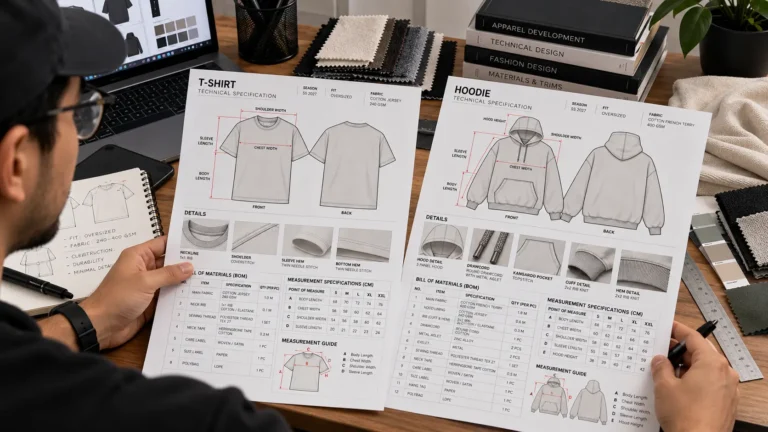
Garment-specific documentation is often more demanding than a generic layout suggests. A basic T-shirt might need relatively simple technical flats and a short construction section. A hoodie adds drawcord, ribbing, and pocket construction details. Pants introduce waistband and closure specifications. Outerwear and performance garments often need more detailed construction notes, additional trims, and sometimes testing or performance documentation.
A generic free template can provide useful structural bones, but it may still require significant garment-specific technical work to be genuinely complete. If you’re working on a specific silhouette, a garment-specific starting point can save time — see our T-Shirt Tech Pack Template and Hoodie Tech Pack Template for Factory Production for examples of that approach. There’s no single universal template that covers every requirement for every garment type.
Frequently Asked Questions
What is the best free tech pack template?
There isn’t one universal best option. Evaluate any candidate on completeness, editability, licensing, and how well it fits your specific garment before relying on it.
Is there a free tech pack template I can use for manufacturing?
A free template can be used for manufacturer-facing documentation if it lets you record the required technical information clearly and accurately. The template itself doesn’t guarantee factory acceptance — content and clarity do.
Where can I find a free clothing tech pack template?
Free templates show up across design communities, educational resources, and template marketplaces. Check licensing, completeness, editability, and overall quality before using any of them for real work.
Is a paid tech pack template worth it?
It depends on how much setup time it saves you and whether its structure fits your workflow. Paying for a template isn’t automatically the better choice — it’s a trade-off between cost and time.
What should a free tech pack template include?
At minimum, look for technical-flat areas, a measurement-specification section, a BOM, colorway space, construction notes, and label fields. Not every free template includes all of these.
Can I use a free tech pack PDF for a factory?
A PDF can work well for sharing and review, but your manufacturer may also need editable source files or additional production assets, depending on their workflow.
Can I make a tech pack for free?
Yes — using a free template, Illustrator, a spreadsheet, or another tool you already own. The harder part is usually supplying accurate, garment-specific technical information, not the cost of the document itself.
What is the difference between a free and paid fashion tech pack template?
The differences typically show up in structure, editability, scope, licensing clarity, and how much setup work is already done — not in price alone. A structured, paid template can reduce the layout work; a free one can still work well if it’s complete and you understand what to fill in.
Conclusion
“Tech pack template free” usually means one of two things: a genuinely useful starting layout, or a bare-bones page that needs significant work. Neither free nor paid templates are automatically right for every situation.
A few things are worth remembering: free templates can be genuinely useful for learning, practice, and simple garments; paid templates tend to offer more structure and less setup time, not automatically correct content; template quality depends on structure, completeness, editability, and licensing, not price; and either option still requires you to supply accurate, garment-specific information yourself.
If you want a lower-effort starting point, the Fashion Tech Pack Template is a low-cost paid option worth a look. And whichever document you use, verify the finished tech pack against your garment’s actual requirements — and your manufacturer’s specific submission format — before sending it out. For more on what a complete document should contain, see What Is Included in a Fashion Tech Pack.