Design - Create - Grow


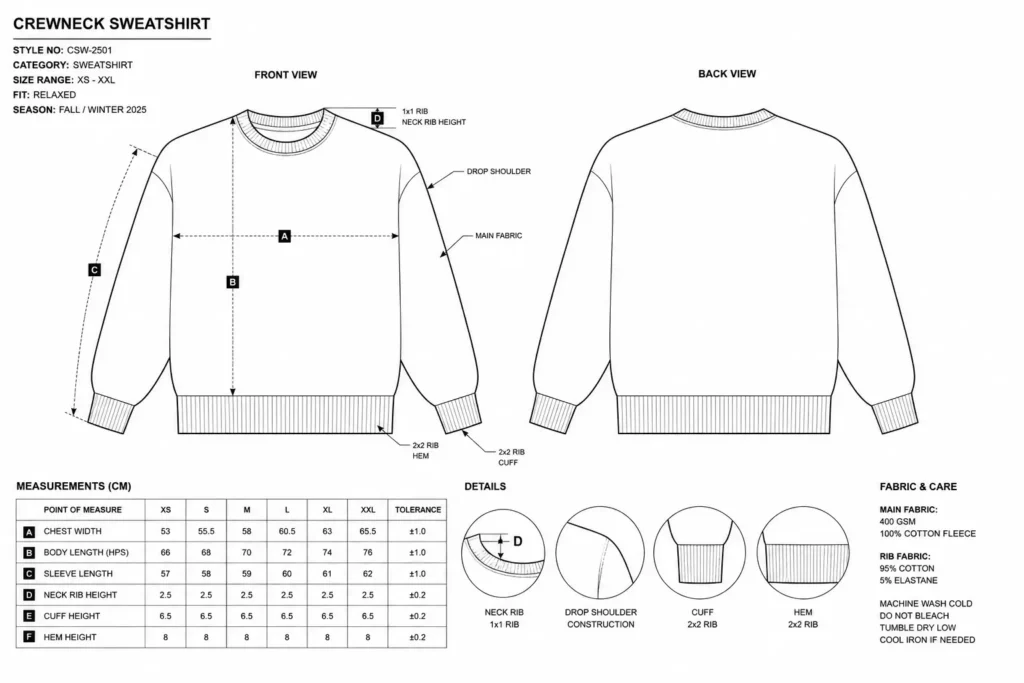
Your factory just shipped back the first sample of your crewneck sweatshirt, and it’s wrong. The neckline is stretched out, the fabric feels thinner than the heavyweight fleece you specified, and the ribbing ratio doesn’t match your reference photo. If this sounds familiar, you’re not alone — it’s one of the most expensive mistakes in cut-and-sew production, and it usually comes down to one missing document: a professional sweatshirt tech pack template.
A detailed sweatshirt tech pack template is the single most critical step in avoiding costly manufacturing errors. Without one, you’re relying on verbal descriptions and reference photos — and hope doesn’t survive contact with a factory production floor.
Factories reject a significant share of first samples for reasons that have nothing to do with skill: undefined GSM, no ribbing ratio, vague seam callouts. Streetwear brands lose real money — sample fees, freight, weeks of calendar time — chasing corrections a clear spec sheet would have prevented on round one.
This guide covers everything you need to build (or buy) a production-ready crewneck spec file: GSM selection for heavyweight fleece and French terry, ribbing specs for collars and cuffs, flatlock stitching and coverstitch construction, and graded measurement charts your factory can cut patterns from immediately. By the end, you’ll know exactly how to eliminate the guesswork, cut your sampling rounds, and launch a crewneck that fits and feels the way you designed it — the first time, not the fourth.
⚡Quick Answer: To manufacture crewnecks correctly, you need an accurate sweatshirt tech pack template detailing fabric weight (350–500 GSM), ribbing ratio (1×1 vs. 2×2), construction seam types (flatlock/coverstitch), and a graded measurement chart. For a ready-to-send factory file, grab the S.i. Graphics Crewneck Tech Pack Template ($14.99) or the complete Tech Pack Library .
What Is a Sweatshirt Tech Pack & Why Do You Need One?
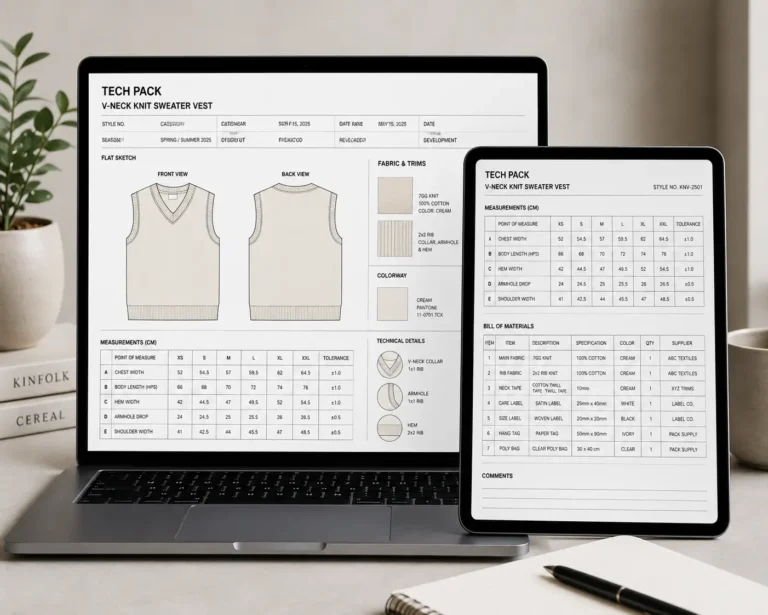
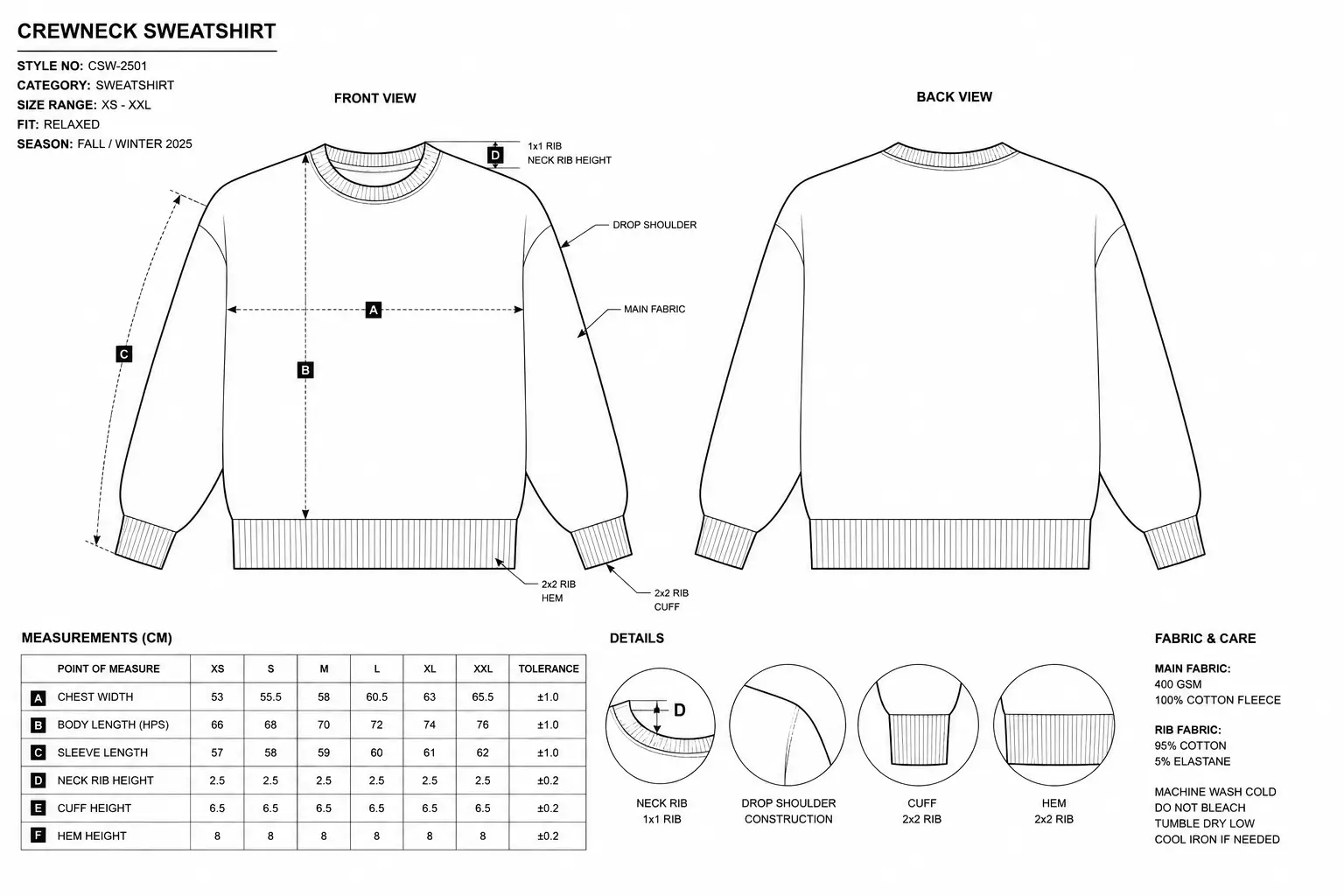
A sweatshirt tech pack is a factory-ready document that defines every measurable detail of a garment — fabric, construction, trims, and grading — in one file so a manufacturer can cut, sew, and finish the product without guessing. It’s the manufacturing blueprint that turns a design sketch into a repeatable, sourceable product.
For most overseas and domestic cut-and-sew factories, a sweatshirt tech pack template functions as a legally binding production contract. Once a factory signs off, any deviation — wrong GSM, incorrect ribbing, missized garments — becomes a documented quality claim you can hold them accountable for.
Most tech packs are delivered as editable AI (Adobe Illustrator), PDF, or XLS files, so designers can update flat sketches while merchandisers update the BOM and measurement tables in the same document.
Key benefits of using this template:
- ✓ Accurate sizing across every graded size in your range
- ✓ Fewer sample rounds, since factories aren’t guessing at intent
- ✓ Predictable, quotable costs because trims and fabric are fully specified
- ✓ Written protection against factory miscommunication and quality disputes
- ✓ Faster onboarding when switching between domestic and offshore production
Real-world example: A streetwear brand producing a limited 300-unit crewneck drop needs the same precision as a luxury cut-and-sew label producing a full size run — the difference is scale, not accuracy. Whether you’re working with a local sample house or an offshore factory, the tech pack keeps both sides accountable.
DIY Tech Packs vs. Ready-Made Tech Pack Templates
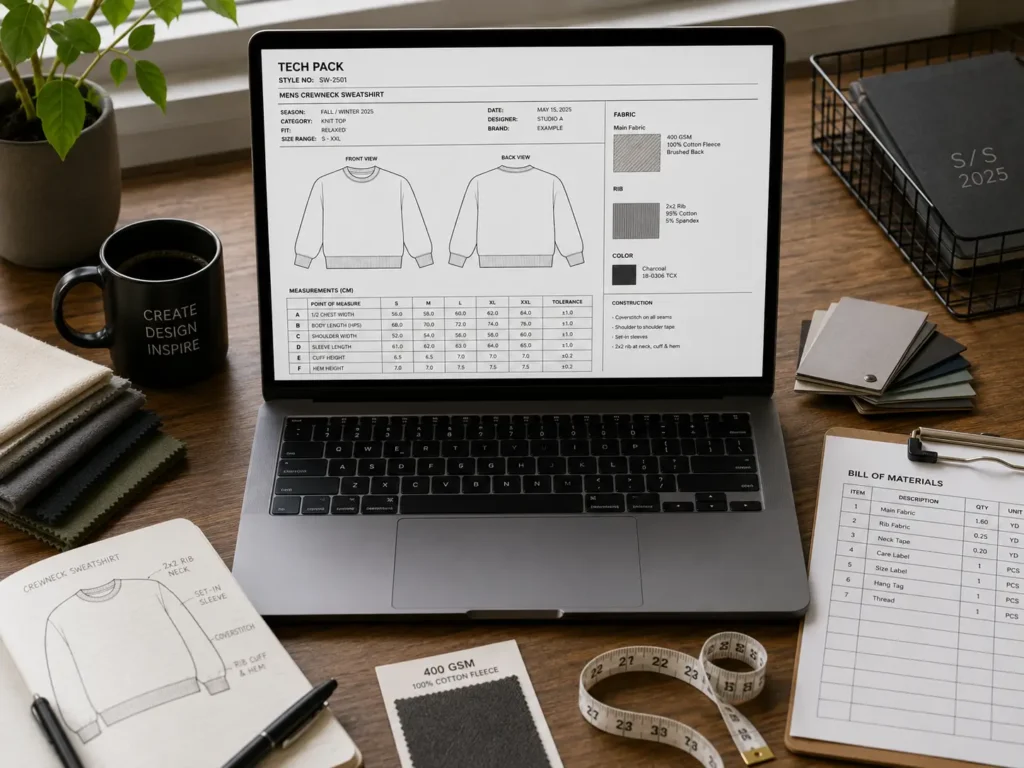
Building a spec sheet from scratch in Excel and Illustrator is possible, but it’s rarely efficient — especially for founders juggling design, sourcing, and sampling at the same time. A pre-formatted sweatshirt clothing production template gives you the technical structure factories already expect, without the trial and error of building layout conventions from zero.
DIY works fine for a basic single-color screen-printed tee where fit tolerance is loose. It falls apart fast on a crewneck sweatshirt, where accurate crewneck sweater manufacturing specs — ribbing ratio, seam type, and GSM — directly affect hand-feel, drape, and fit, and are easy to omit if you don’t already know what factories check for.
| Comparison Point | DIY (Excel/Illustrator) | Ready-Made Template |
|---|---|---|
| Technical accuracy | Depends on your experience | Pre-verified by industry standards |
| Time to complete | 10–20+ hours | 1–3 hours to customize |
| Factory readability | Inconsistent formatting | Standardized, factory-familiar layout |
| Measurement points | Often incomplete | Pre-built POM (points of measure) |
| Graded spec tables | Manual, error-prone | Pre-formatted grading tables |
| Commercial readiness | Requires QA before use | Production-ready out of the box |
A specialized sweatshirt clothing production template built specifically for crewnecks — not a generic garment blank — already accounts for collar ribbing callouts, drop-shoulder seam allowances, and fleece-specific GSM ranges. That specificity is what prevents the second and third sampling round that generic templates, or fully custom-built files, tend to trigger.
If you’re producing a single simple item as a one-off, DIY is a reasonable starting point. If you’re launching a crewneck as part of a real product line — one you intend to reorder — investing in a purpose-built sweatshirt tech pack template pays for itself in the first sample round it saves.
Top 7 Tech Pack Templates & Resources for Crewneck Sweatshirts
Not every crewneck tech pack template on the market is built around real crewneck sweater manufacturing specs for streetwear-weight fleece or oversized fits. Here’s an honest breakdown of the top options, including where generic templates fall short.
1. S.i. Graphics Crewneck Sweater Sweatshirt Tech Pack Template — Best Overall for Streetwear
Price: $14.99
Built specifically for cut-and-sew crewneck production, this template includes pre-filled GSM recommendations, ribbing callouts, and a factory-ready BOM sheet — details generic garment blanks leave you to figure out on your own.
What’s included:
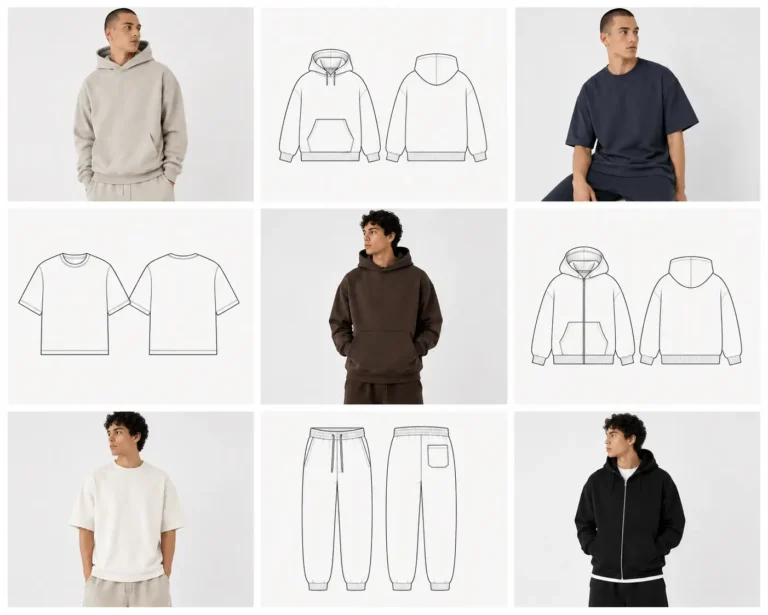
- Editable Adobe Illustrator vector flat sketches (front/back)
- Pre-filled factory Bill of Materials (BOM)
- Graded measurement spec table (POM)
- Ribbing, seam, and stitch callouts optimized for heavyweight fleece
- Trim and label placement guide
Best for: Streetwear brand founders producing their first (or fifth) crewneck run who need factory-ready files without building specs from zero.
Pros:
- ✓ Pre-filled GSM and ribbing specs specific to crewnecks
- ✓ Editable AI source files for full customization
- ✓ Factory-familiar layout reduces sampling rounds
- ✓ Includes graded spec table across standard size ranges
Cons:
- ✗ Requires basic Illustrator familiarity to fully customize
- ✗ Single-silhouette focus (crewneck only)
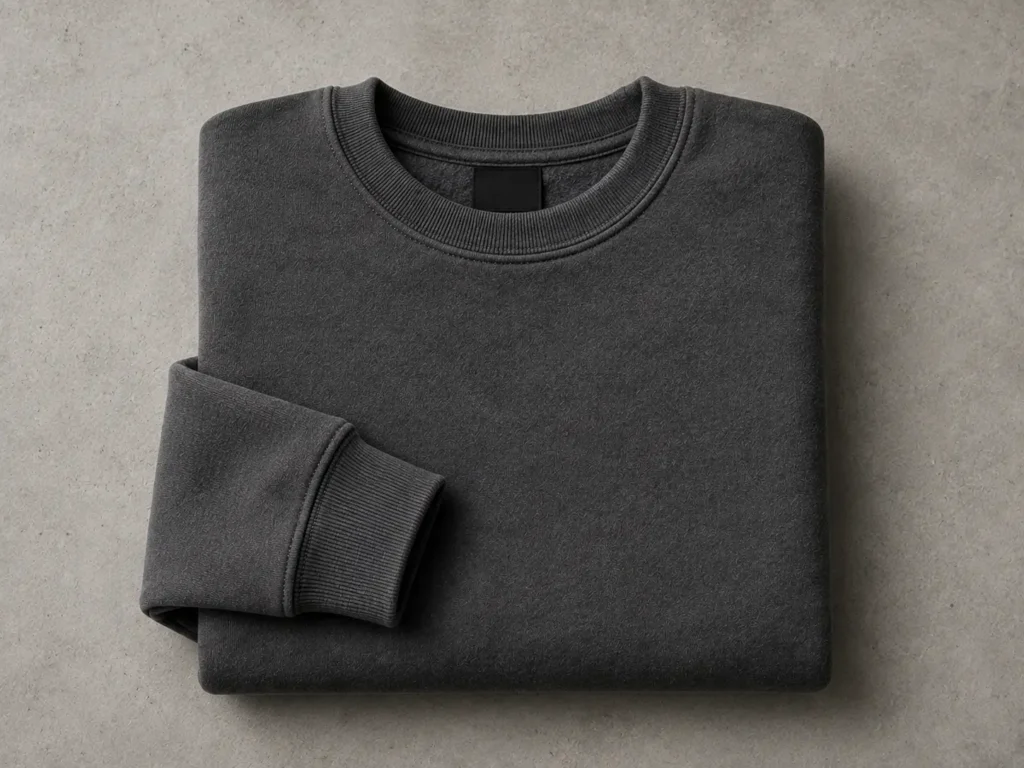
2. S.i. Graphics Complete Tech Pack Library — Best Value / Most Comprehensive Collection
Price: $29.99
If you’re launching more than one silhouette, this bundle applies the same sweatshirt clothing production template standard across crewnecks, hoodies, tees, joggers, jackets, and accessories, so every SKU ships to factories in a consistent format.
What’s included:
- Full crewneck, hoodie, tee, jogger, and jacket tech packs
- Editable AI vector flats for every garment
- BOM sheets and graded spec tables for each style
- Consistent factory-ready formatting across the whole line
Best for: Founders launching a multi-garment collection who want consistent, factory-ready documentation across every SKU instead of piecing together separate files from different sources.
Pros:
- ✓ Significant cost savings versus buying templates individually
- ✓ Consistent formatting across your entire line
- ✓ Covers streetwear staples beyond just crewnecks
- ✓ One-time purchase, unlimited reuse across seasons
Cons:
- ✗ Higher upfront cost if you only need one garment type
- ✗ Still requires customization per style and factory
3. Techpacker Crewneck Standard Spec Builder — Best Web-Based Builder
Price: $29.00/mo
Techpacker is a browser-based platform for building tech packs collaboratively. It suits teams that need cloud collaboration and revision tracking rather than a static file.
What’s included:
- Cloud-based spec builder with revision history
- Basic garment templates, including crewneck styles
- Collaboration tools for teams and factories
- PDF export for factory sharing
Best for: Small teams that need multiple people editing tech packs simultaneously and prefer software over static files.
Pros:
- ✓ Real-time collaboration between designers and merchandisers
- ✓ Cloud storage, no lost files
- ✓ Revision tracking with factory comments
Cons:
- ✗ Recurring monthly cost adds up over a full season
- ✗ Generic templates need heavy customization for crewneck-specific ribbing and GSM details
4. Maker’s Row Apparel Production Spec Sheet — Best Basic Layout
Price: $19.00
A general-purpose apparel spec sheet covering the basics of a sweatshirt clothing production template, though not built with crewneck-specific ribbing or fleece weight ranges in mind.
What’s included:
- Basic flat sketch placeholder
- General measurement point table
- Simple BOM section
Best for: Founders producing basic woven or simple garments who need a general starting layout rather than crewneck-specific detail.
Pros:
- ✓ Simple, easy-to-understand layout
- ✓ Affordable one-time cost
Cons:
- ✗ Lacks streetwear-specific crewneck details (ribbing ratios, fleece GSM ranges)
- ✗ Requires significant manual editing to make factory-ready
5. S.i. Graphics Basic Tech Pack Starter — Best Budget Option for Beginners
Price: $9.99
A stripped-down starter template for founders testing their first small-batch run before investing in the full crewneck package.
What’s included:
- Vector outline flat sketch (front/back)
- Essential spec lines (chest width, body length, sleeve length)
- Basic fabric and trim notes section
Best for: First-time founders sampling a small batch run who need something more structured than a blank page but don’t yet need full grading tables.
Pros:
- ✓ Extremely low cost to get started
- ✓ Clean, factory-readable base layout
- ✓ Easy upgrade path to the full crewneck template later
Cons:
- ✗ No graded measurement chart included
- ✗ Limited construction and stitch-type callouts
6. Open-Source Blank Spec Sheet PDF — Best Free Option
Price: Free ($0)
A genuinely free, blank spec sheet circulated across independent design communities — a fine starting point only if you already know how to draft flat sketches and build measurement points yourself.
What’s included:
- Blank PDF spec sheet layout
- Empty measurement point table
- No pre-built vector artwork
Best for: Founders with existing Illustrator skills who want a free structural layout and plan to build every technical detail themselves.
Pros:
- ✓ Completely free
- ✓ No software lock-in
Cons:
- ✗ Requires you to build vector flats and GSM/ribbing specs manually from scratch
- ✗ No crewneck-specific guidance — high risk of missing critical callouts
7. Crafty Fashion Tech Pack Studio Pack — Best for Alternative Fits
Price: $24.00
A solid single-silhouette template with a non-standard crewneck fit block, useful for an alternative or cropped fit outside the typical streetwear silhouette.
What’s included:
- Vector flat sketch for one alternative crewneck fit
- Basic measurement table
- Fabric and trim notes section
Best for: Designers building a specific alternative fit (cropped, boxy, or fitted) outside the standard oversized streetwear block.
Pros:
- ✓ Covers a niche fit block other templates skip
- ✓ Clean vector artwork
Cons:
- ✗ Higher price point for a single silhouette and single fit
- ✗ Less streetwear-specific GSM/ribbing guidance than dedicated streetwear templates
💡 Pro Tip: Always request a fabric swatch card before finalizing your GSM specs. A 400 GSM French Terry feels drastically different from a 400 GSM brushed-back fleece — weight alone doesn’t tell you the hand-feel.
Essential Manufacturing Specs for Crewneck Sweatshirts
Beyond having a template, you need to understand the crewneck sweater manufacturing specs that separate a premium garment from a flimsy one. Here’s what to specify and why it matters.
Fabric Weight (GSM):
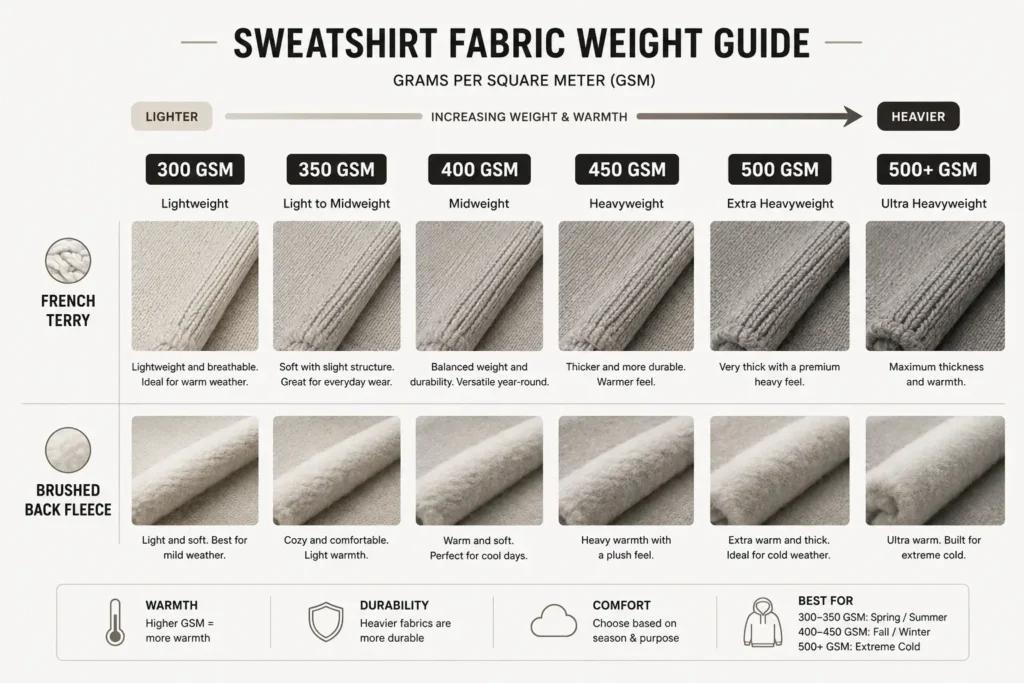
- 300 GSM — light-to-standard weight, suited for warmer climates or layering pieces
- 400 GSM — heavyweight, the streetwear industry standard for structured, substantial crewnecks
- 500+ GSM — ultra-heavy, used for luxury streetwear where drape and density signal premium quality
Fabric Types:
- French Terry — looped-back interior, breathable, lighter drape, common in warmer-weather sweats
- Brushed Back Fleece — napped interior for extra warmth and a plush hand-feel, standard for cold-weather crewnecks
💡 Pro Tip: Specify a 2% to 5% elastane blend in your collar ribbing specs to prevent crewneck necklines from sagging after washing.
Ribbing Specs:
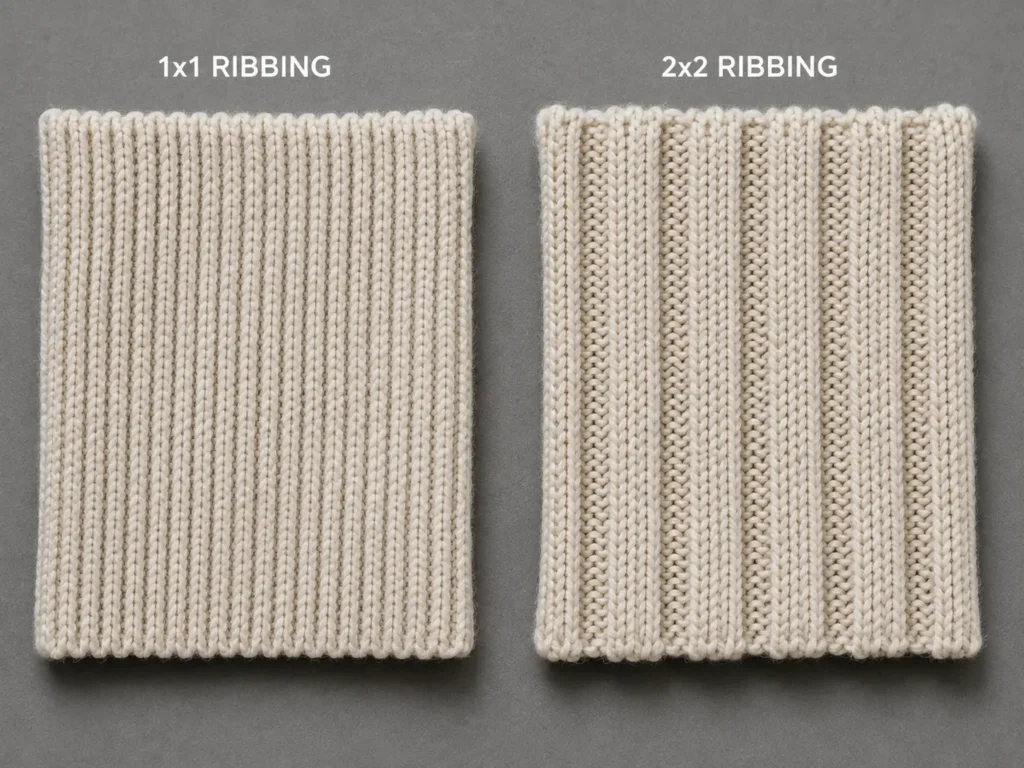
- 1×1 ribbing — tighter, thinner rib pattern, common on slimmer-fit crewnecks
- 2×2 ribbing — wider rib pattern with more recovery, standard for oversized streetwear collars, cuffs, and hems
Seam & Stitching Specs:
- Flatlock stitching — flat, durable seam finish common on shoulder and side seams of heavyweight garments
- 2-needle coverstitch — used for hems and cuffs, gives a clean finish with stretch recovery
- Overlock internal seams — reinforces raw edges inside the garment to prevent fraying
ASTM standards for seam and stitch types
Construction Details:
- Half-moon back neck patch for structure and branding real estate
- Herringbone neck tape to prevent collar stretch-out over repeated washes
- Drop-shoulder vs. raglan sleeve — drop-shoulder for oversized streetwear silhouettes, raglan for a more athletic fit
If/Then decision rules:
- If building an oversized streetwear crewneck, then specify: 420+ GSM French Terry, 2×2 heavy ribbing, drop-shoulder seams, and flatlock stitching.
- If building a slim, lightweight crewneck, then specify: 300–340 GSM French Terry, 1×1 ribbing, and coverstitch hems.
- If building a luxury cut-and-sew crewneck, then specify: 500+ GSM brushed fleece, 2×2 elastane ribbing, and reinforced overlock internal seams.
💡 Pro Tip: Include a ±0.5 inch seam tolerance allowance in your graded measurement sheet to protect against factory claims of acceptable defect rates.
Every one of these crewneck sweater manufacturing specs belongs directly inside your production file — not in a separate email thread the factory has to cross-reference.
Frequently Asked Questions
What is included in a sweatshirt tech pack template?
A complete crewneck spec file includes vector flat sketches (front/back), a Bill of Materials (BOM), a graded measurement spec sheet across your size range, and construction notes covering seam type, stitch type, and ribbing details. Some templates also include labeling and colorway specifications.
What fabric weight (GSM) should I use for a high-quality crewneck sweatshirt?
Most streetwear crewnecks use 380–450 GSM heavyweight fleece or French terry for a substantial, premium hand-feel — a core part of any solid set of crewneck sweater manufacturing specs. Lighter 300 GSM works for warm-climate pieces, while 500+ GSM is reserved for ultra-premium, luxury streetwear drops.
What software do I need to edit a crewneck sweatshirt tech pack?
Most professional templates are delivered as editable Adobe Illustrator (AI) files for the flat sketches, paired with Excel (XLS) or PDF for the BOM and measurement tables. Free alternatives can open AI files, though often with formatting quirks.
What’s the difference between 1×1 ribbing and 2×2 ribbing on a crewneck collar?
1×1 ribbing alternates a single knit and purl stitch, producing a thinner, tighter rib common on slim-fit crewnecks. 2×2 ribbing alternates two knit and two purl stitches, creating a wider, more elastic rib with better recovery — the standard choice for oversized streetwear collars, cuffs, and hems.
How much does it cost to have a factory produce custom crewneck sweatshirts?
Costs vary by GSM, order quantity, and factory location, ranging from a few dollars per unit at high volume overseas to significantly more for small-batch domestic runs. A complete tech pack helps factories quote accurately instead of padding prices for ambiguity.
Can I send a sweatshirt tech pack template directly to overseas manufacturers?
Yes — a properly formatted sweatshirt clothing production template is built for exactly that. Most overseas factories expect AI or PDF flat sketches paired with an Excel-based BOM and measurement sheet, so a factory-ready file can go straight into their sampling queue without reformatting.
What stitching type is best for streetwear crewnecks: flatlock vs. coverstitch?
Flatlock stitching suits structural seams (shoulders, side seams) on heavyweight fleece because it lies flat and resists bulk. Coverstitch suits hems and cuffs where stretch recovery matters. Most crewneck tech packs specify both, applied to different seam locations.
What is the difference between French Terry and Brushed Fleece for sweatshirts?
French Terry has a looped interior texture, is more breathable, and drapes lighter — good for warmer climates. Brushed Back Fleece has a napped, brushed interior for extra warmth and a plush hand-feel, making it the more common choice for cold-weather, heavyweight streetwear crewnecks.
How do I measure a crewneck sweater to build a graded measurement spec sheet?
Measure flat, laid-out garments at key points of measure (POM): chest width, body length, sleeve length, neck rib height, and hem width. Repeat across every size, then apply consistent grading increments — typically 1–2 inches per size jump.
What is a Bill of Materials (BOM) in a sweatshirt tech pack?
A Bill of Materials (BOM) lists every physical component used to build the garment — fabric, GSM, ribbing, thread, labels, hangtags, and packaging — along with supplier details. It’s the factory’s shopping list and cost reference in one document.
Conclusion
A crewneck sweatshirt only turns out the way you designed it when the factory has zero room to guess. Every fabric, ribbing, seam, and measurement decision belongs inside a proper sweatshirt tech pack template before your first sample.
Key takeaways for locking down your crewneck sweater manufacturing specs:
- Specify GSM and fabric type explicitly — “heavyweight” means nothing without a number attached
- Define your ribbing ratio (1×1 vs. 2×2) and elastane blend for every collar, cuff, and hem
- Call out exact seam and stitch types (flatlock, coverstitch, overlock) for every construction point
- Build a graded measurement spec sheet before requesting your first sample, not after the third rejection
Don’t send raw sketches or moodboard references to a factory and hope for the best — a precise, factory-ready sweatshirt tech pack template is what separates a one-and-done sample from months of costly revisions.
Ready to move forward? Grab the Crewneck Sweater Sweatshirt Tech Pack Template for your next production run, or the Complete Tech Pack Library if you’re launching a full collection. Founders who document their specs precisely are the ones who launch cut-and-sew collections that actually match what they designed.