Design - Create - Grow


If you’ve searched for tech pack samples, you’ve probably run into vague definitions instead of an actual example. You know a tech pack is some kind of technical document, but it’s hard to picture what one really contains until you see how the pages are organized.
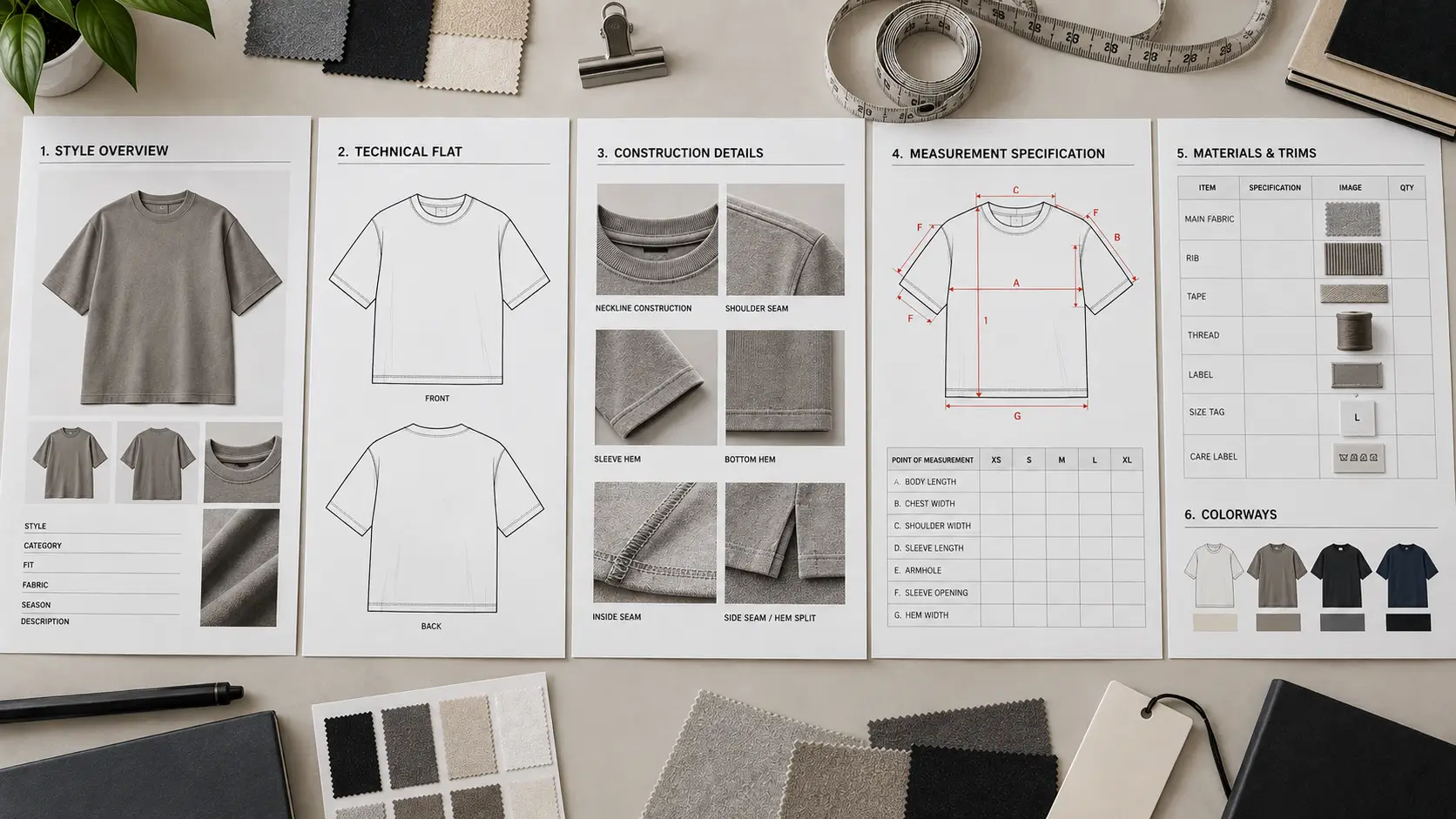
This article walks through a representative clothing tech pack example, section by section, so you can see how technical flats, construction details, colorways, artwork placement, a bill of materials (BOM), measurements, labels, packaging, and revision history typically come together.
One clarification before we start: in this article, “tech pack samples” refers to examples of technical documentation — not physical garment samples used for fitting or approval. We’ll return to that distinction shortly.
The exact page order and level of detail in any clothing tech pack example can vary by garment, manufacturer, and production method. Rather than handing you a template to copy exactly, this walkthrough will help you evaluate any tech pack sample you come across and understand what each page is actually communicating.
Quick answer: A professional tech pack sample is an example of how garment specifications are organized into clear technical documentation for design, sampling, and production communication. Depending on the garment, a clothing tech pack example may show technical flats, construction details, colorways, artwork placement, a BOM, measurement specifications, grading, labels, packaging, and revision information.
Table of Contents
What Is a Tech Pack Sample?
In apparel development, “tech pack sample” usually means an example page or full document that shows how a technical specification is laid out — not a physical piece of fabric or a manufactured garment. People search for examples before building their own documentation because it’s much easier to organize information once you’ve seen how it’s typically structured.
Here’s the distinction in plain terms:
Tech pack sample: A sample of technical documentation — flats, specs, callouts, tables.
Physical garment sample: A manufactured garment used for fitting, construction, material, or approval purposes during development.
This article focuses on the first meaning. Looking at a complete documentation example is more useful than looking at an isolated fashion sketch, because a tech pack example shows you the full information hierarchy: what comes first, what gets called out visually, and what belongs in a table instead of a drawing.
What Does a Professional Tech Pack Look Like?
There isn’t one universal visual format for a professional tech pack — formats vary by brand, garment, and manufacturer relationship. That said, well-organized technical documentation tends to share several characteristics:
- Clear style identification (name, number, or reference)
- Consistent page structure from one style to the next
- Technical flats drawn to scale
- Numbered construction callouts
- Organized specification tables
- Clearly labeled measurement charts with consistent units
- Material and trim information
- Defined colorways
- Artwork placement details
- Revision control
- Readable typography and logical page numbering
Professional quality in a tech pack comes from clarity and completeness, not decoration. A tech pack is production documentation, not a fashion presentation — the goal is that a factory can read it without needing to ask clarifying questions.
Tech Pack Example: Page-by-Page Walkthrough
The structure below reflects a common, illustrative workflow for organizing a clothing tech pack. Actual page order and inclusion can vary by garment and manufacturer.
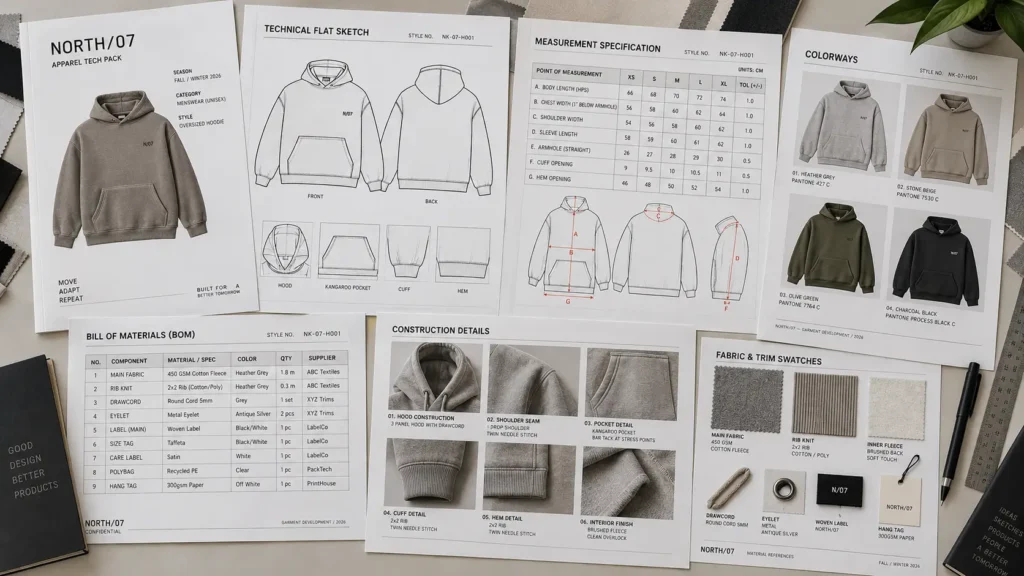
1. Style Overview / Cover Page Example
A cover page typically identifies the style name, style number, garment category, brand or designer, season or collection reference (where applicable), version/date, and sample stage or document status.
When evaluating an example cover page, ask: Can you identify the garment immediately? Is the version clear? Is the information organized without unnecessary decoration? Not every manufacturer requires a formal cover page, but it’s a useful anchor for the rest of the document.
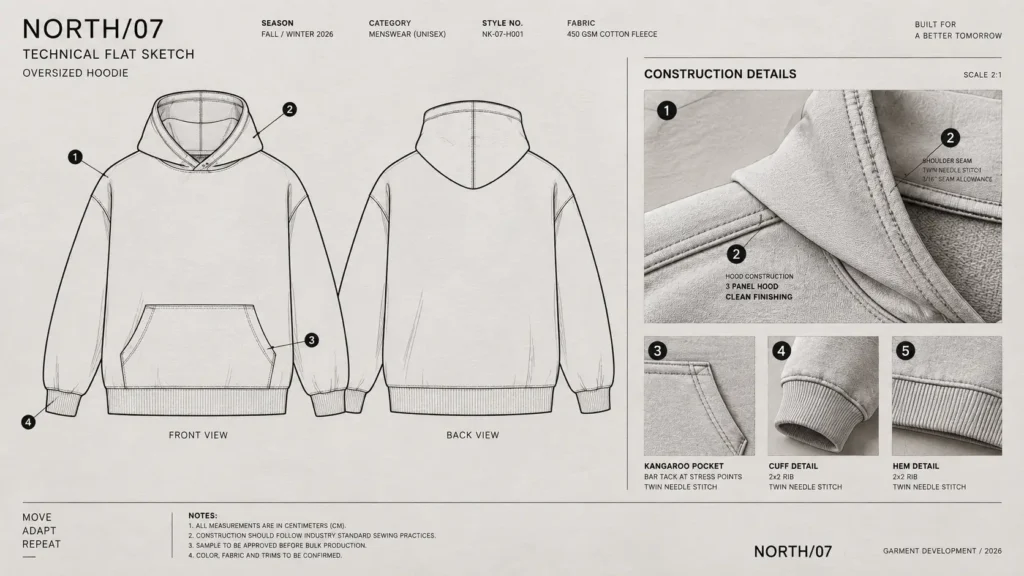
2. Technical Flat Example
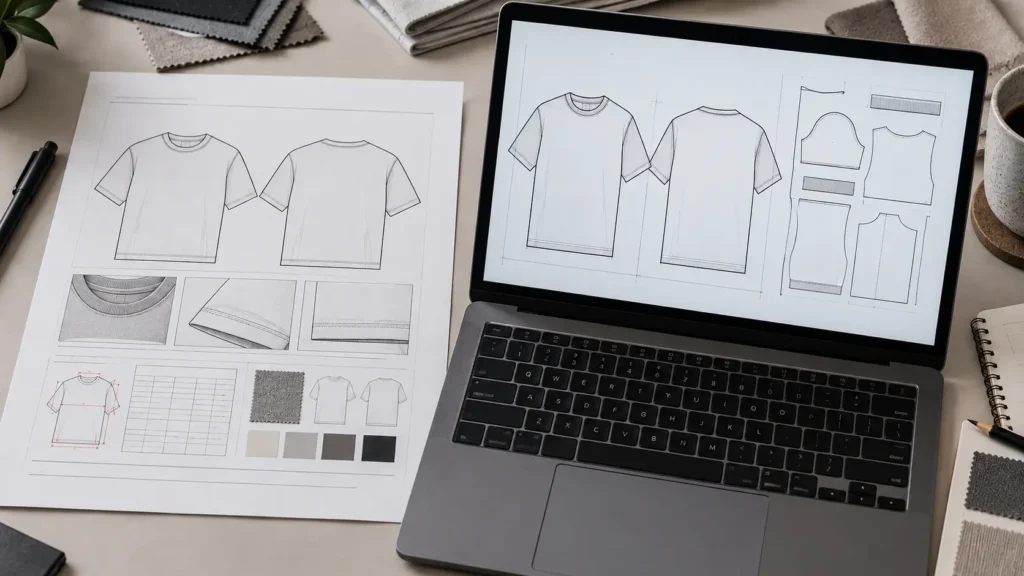
A technical flat is a scaled, proportionate line drawing showing the garment from the front, back, and sometimes the side — including seams, panels, pockets, collars, cuffs, closures, ribbing, and other construction lines.
Read More: What Is a Tech Pack
A useful technical flat communicates construction and design intent with clean, accurate proportions. It is not meant to function as a fashion illustration — its job is to show exactly how the garment is built.
3. Construction Detail Example
This page typically shows enlarged, numbered callouts for specific construction points: neck construction, seam types, hems, sleeve cuffs, pockets, zippers, buttons, drawcords, elastic, or reinforcement.
Numbered callouts connect the visual flat to written construction instructions elsewhere in the document. The value of a construction page comes from specificity — vague labels like “standard seam” are far less useful than a numbered reference tied to a written note.
4. Colorway Example
Colorway pages show how a style will be produced in different color combinations: body color, contrast color, trim color, thread color where relevant, artwork color, and color references such as Pantone codes where appropriate.
A professional example makes differences between colorways easy to scan at a glance. The exact color-reference system used can depend on the fabric, dyeing method, printing method, and the manufacturer’s own standards.
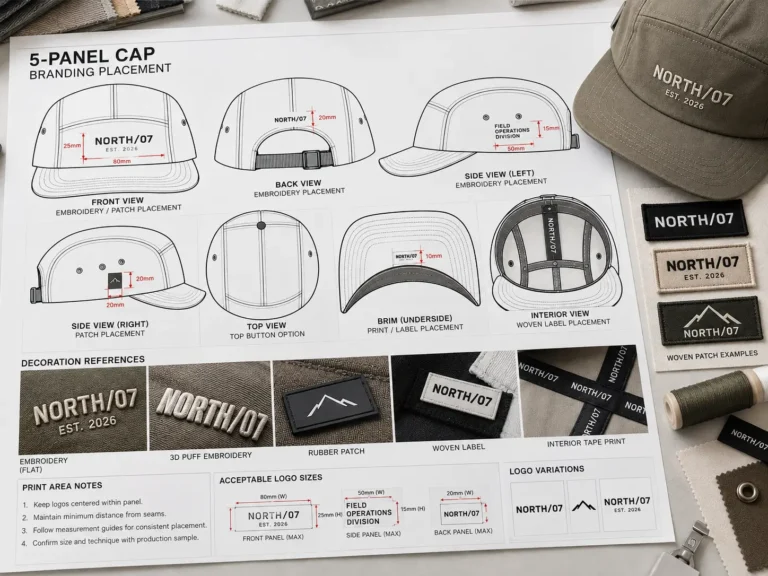
5. Artwork Placement Example
This page usually shows front and back graphic placement, sleeve artwork if applicable, print dimensions, placement measurements, and details for the decoration method — embroidery, appliqué, heat transfer, screen printing, or another technique.
It’s worth noting that artwork placement information inside a tech pack is different from the separate production-ready artwork file itself. A placement diagram tells the factory where and how large the artwork goes; it doesn’t necessarily replace the vector or print-ready artwork file.
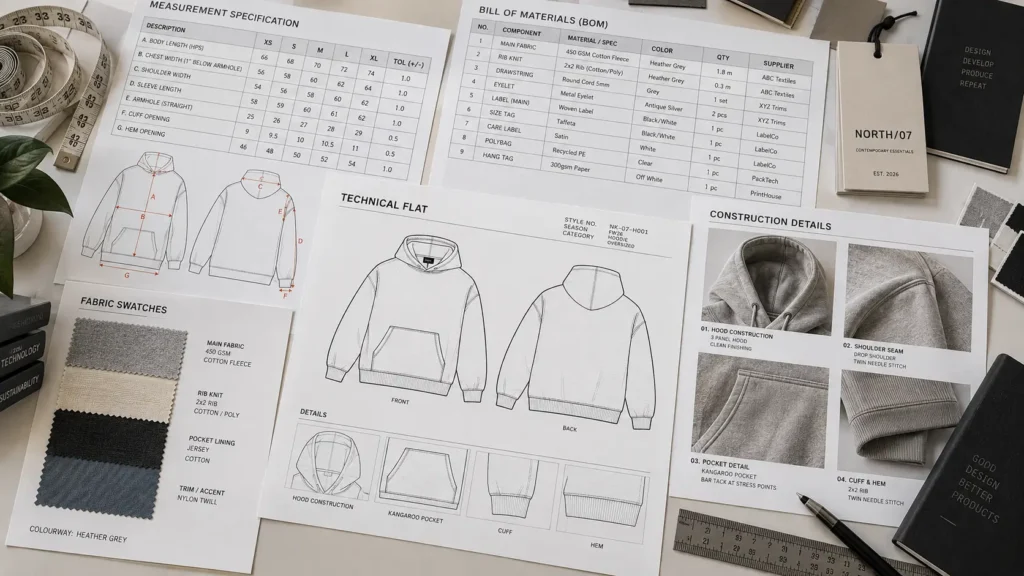
6. BOM Example
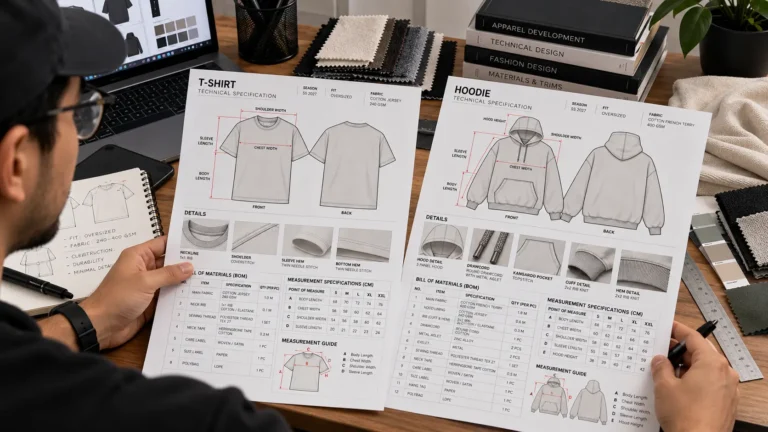
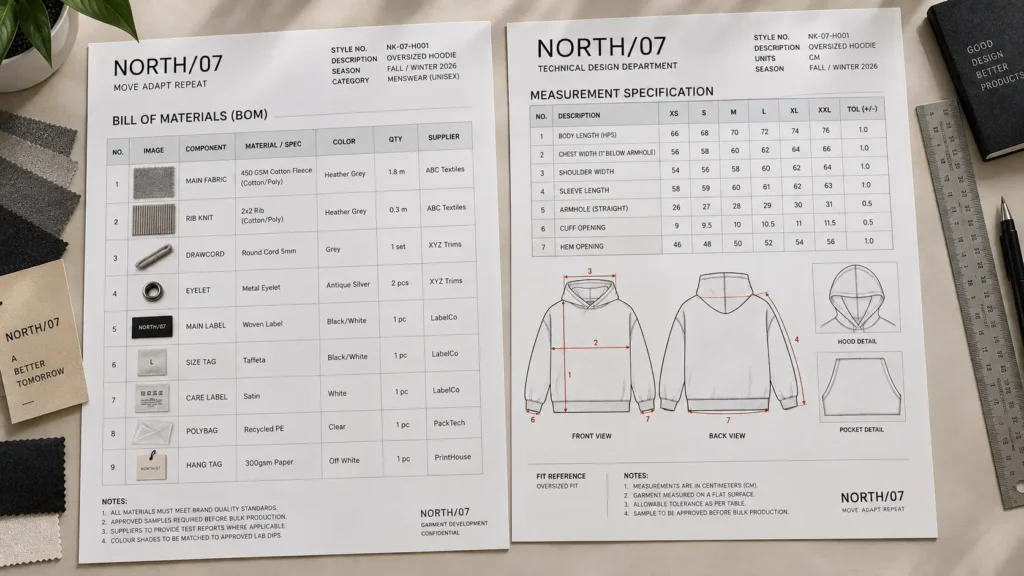
The Bill of Materials lists every component that goes into the garment: main fabric, secondary fabric, lining, ribbing, thread, zippers, buttons, labels, hangtags, packaging, and other trims — often organized by component, material, description, placement, color, and quantity or usage where appropriate.
A clear BOM prevents a factory from guessing at material choices, which is one of the most common sources of costly production errors.
Read More: What Is Included in a Fashion Tech Pack
7. Measurement Specification Example
A measurement spec sheet lists points of measure (POM), finished measurements, the sample or base size, the size range, measurement units, and tolerances where applicable.
When evaluating a measurement example, look for consistent units and clearly defined measurement points. Ambiguity here is one of the fastest ways to get a sample back that doesn’t fit as expected.
8. Grading / Size Specification Example
Grading pages extend the base measurements across a size range, sometimes with grade rules and fit notes. Depending on the project, grading may be handled within the tech pack, by the pattern maker, or by the manufacturer — there’s no single required approach.
9. Labels and Branding Example
This section typically covers the main label, size label, care label, branding placement, label dimensions, and attachment method. Legal labeling requirements vary by market and product type, so specific wording and required information should be verified with the appropriate regulatory authority for the market you’re selling into rather than assumed from a template.
10. Packaging / Finishing Example
Packaging pages may cover folding method, polybagging, size stickers, hangtags, barcode information, and carton requirements. Depending on the brand’s workflow, this information may live inside the tech pack or in a separate production document.
11. Revision History Example
A revision log tracks version number, date, description of the change, sample round, approval status, and comments. This becomes especially important once specifications start changing during development — without it, it’s easy to lose track of which version is current.
T-Shirt Tech Pack Example: A Simple Garment Walkthrough
To make this concrete, here’s a simplified, fictional example for a Crew Neck / Boxy Oversized T-Shirt. The details below are illustrative only — not specifications for an actual product.
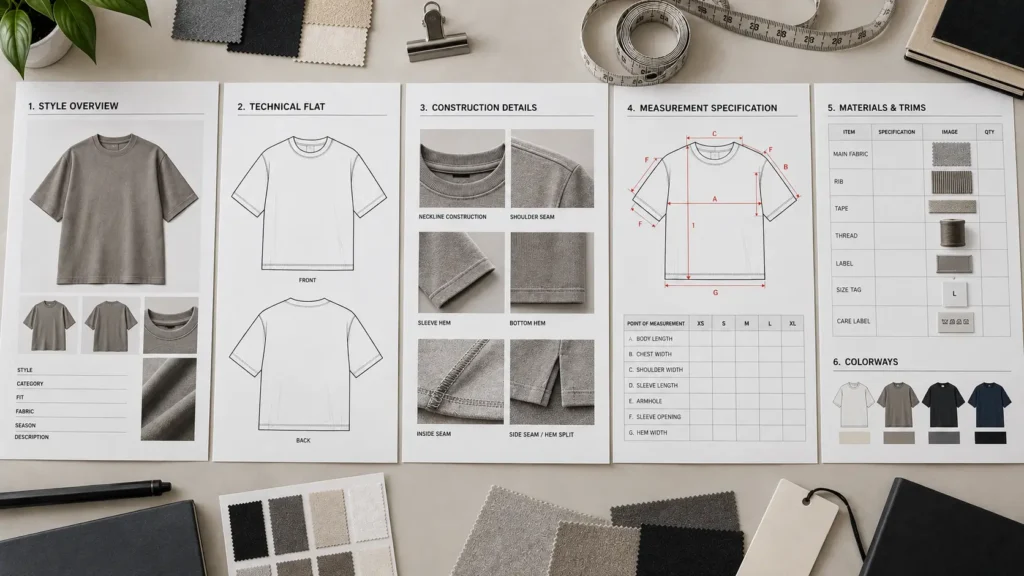
- Style overview
- Front and back technical flats
- Construction details (neckline, hem, sleeve)
- Colorways
- Artwork placement (if applicable)
- Bill of Materials
- Measurement specification
- Grading / size information
- Labels and packaging
- Revision history
A basic tee generally needs fewer construction callouts than a jacket or a garment with hardware, but there’s no fixed rule that every t-shirt tech pack must have exactly ten pages — the right structure depends on the garment and how the manufacturer prefers to receive information.
What to Look for in a Professional Tech Pack Example
Use this as a practical evaluation checklist:
- Clear style identification
- Consistent technical flats
- Useful, specific construction callouts
- Clearly defined measurements with consistent units
- Tolerances stated where applicable
- Organized BOM
- Clearly labeled colorways
- Accurate artwork placement details
- Logical page hierarchy
- Readable tables
- Revision information
- Consistent terminology throughout
- Correct file and version naming
A visually polished document can still be technically weak if it’s missing production-critical information — the visual quality and the technical completeness are two separate things to check.
Tech Pack Example PDF vs. Editable Source File
You’ll typically encounter tech pack examples in a few different formats, each suited to a different stage:
- PDF is useful for viewing and sharing a fixed, uneditable version — good for factory submission or client review.
- AI (Adobe Illustrator) preserves editable technical flats and page layouts, useful when you need to update specs yourself.
- EPS or SVG files may be used for vector artwork that needs to move between design tools.
- Spreadsheet formats can be useful for structured measurement or BOM data that needs sorting or calculation.
- JPG/PNG files are typically used for reference images or quick previews rather than working files.
Not every manufacturer requires or accepts the same formats, so it’s worth confirming preferences with your factory before finalizing a delivery format.
How a Tech Pack Example Changes by Garment Type
A basic t-shirt example generally needs fewer construction callouts than a hoodie, and a hoodie needs fewer than a pair of pants with a waistband, fly, and pockets. Outerwear and graphic-heavy garments tend to require more detailed artwork placement and material specification pages, and complex fashion garments may need additional construction pages for details like linings, closures, or multi-panel construction.
None of these garment types require a fixed page count — the level of detail should match the complexity of what’s being built.
Read More: T-Shirt Tech Pack Template
Read More: Hoodie Tech Pack Template for Factory Production
Real Tech Pack Samples vs. Generic Template Examples
It’s worth distinguishing between a few different things you might encounter when searching for examples: a generic template demonstration, a real documentation example from a specific brand or resource, a fictional illustrative example (like the t-shirt walkthrough above), a manufacturer-specific tech pack format, and a physical garment sample.
When reviewing any example, check whether it actually demonstrates production-relevant information — clear measurements, construction callouts, material specs — rather than just looking polished. A template that shows real structure is more useful than one that simply looks professional.
Common Problems You Can Spot in a Weak Tech Pack Example
Watch for these warning signs:
- Missing front or back views
- Unclear or non-proportionate technical flats
- No construction callouts
- Missing points of measure
- Unclear or inconsistent measurement units
- No tolerances where they’d be expected
- Unidentified or unclear colorways
- Vague artwork placement information
- Missing BOM
- Unclear label specifications
- No revision history
- Inconsistent layouts across pages
- Outdated document versions still in circulation
- Overcrowded pages that reduce readability
Spotting these issues in someone else’s template is good practice for catching them in your own documentation before it reaches a factory.
Tech Pack Samples Checklist
Use this as a quick reference when reviewing any tech pack example:
- Style identification
- Version and date
- Technical flats
- Construction details
- Colorways
- Artwork placement
- BOM
- Fabric information
- Trim information
- Measurement specifications
- Points of measure
- Tolerances
- Size range
- Grading information (where applicable)
- Labels
- Packaging
- Revision history
- File naming and current version
- Manufacturer-specific requirements
Where to Find Professional Tech Pack Samples
Good sources for examples include professional apparel technical templates, real documentation examples from your own past approved tech packs, garment-specific templates, and formats your manufacturer has previously accepted. Use these to understand structure and communication patterns rather than copying them without adapting to your own garment and factory relationship.
Build Your Own T-Shirt Tech Pack From a Professional Starting Structure
Create a Crew Neck / Boxy Oversized T-Shirt Tech Pack
If you’re developing a basic or oversized t-shirt, a garment-specific tech pack template can give you a structured starting point for organizing technical flats, measurements, construction details, and other production information.
Build a Complete Collection of Tech Pack Documentation
Organize Multiple Garments in One Tech Pack Library
If you’re developing multiple apparel styles, a tech pack bundle can provide a broader starting point for organizing technical documentation across different garments.
Frequently Asked Questions
What is a tech pack sample?
It’s an example of technical documentation used to communicate garment specifications — not a physical garment used for fitting or approval.
What should a professional tech pack example include?
Common sections include a style overview, technical flats, construction details, colorways, artwork placement, a BOM, measurement specifications, grading, labels, packaging, and revision history — though not every tech pack includes all of these.
What does a clothing tech pack example look like?
Typically a multi-page document with scaled technical drawings, numbered construction callouts, specification tables, and consistent formatting focused on clarity over decoration.
What should a t-shirt tech pack example contain?
At minimum, front and back technical flats, construction details, measurements, a BOM, and colorway information — with labels and packaging often included as well.
Can I use a tech pack example as a template?
Yes, as a structural starting point, but it should be adapted to your specific garment, materials, and manufacturer’s requirements rather than used as-is.
What should I look for in a tech pack example PDF?
Readability, logical organization, complete technical information, clear version control, and consistent units and terminology.
Is a tech pack sample the same as a garment sample?
No. A tech pack sample is documentation; a garment sample is a physical, manufactured piece used for fitting and approval.
How many pages should a professional tech pack example have?
There’s no fixed page count — it depends on the garment’s construction complexity and the workflow between the brand and the manufacturer.