Design - Create - Grow


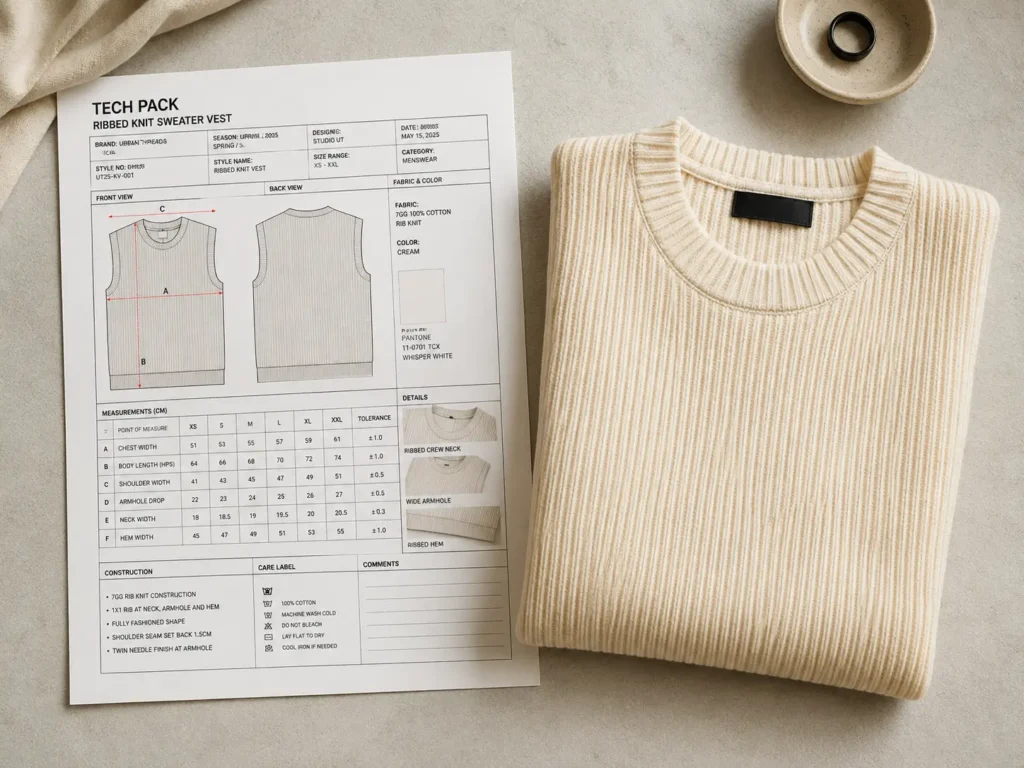
Ever sent measurements to a knitwear factory and gotten back a sample that fits nothing like what you pictured? If you’ve tried to build a knit sweater vest tech pack from scratch, you already know how unforgiving knitwear specs can be.
Cut-and-sew garments forgive small errors. Knitwear does not. A missing rib tension note, an undefined gauge, or a vague shoulder drop measurement is often enough to get your sample rejected — or worse, delivered wrong and unsellable. Independent brands lose real money here: sample fees, freight, and weeks of back-and-forth with a factory that’s guessing at your intent.
This is exactly why a proper knit sweater vest tech pack matters so much for anyone serious about production.
In this guide, we’ll walk through what belongs in a professional tech pack, how ribbing and gauge specs actually affect fit, how size grading works for oversized streetwear silhouettes, and where to get factory-ready specs without the guesswork. By the end, you’ll know how to avoid the sampling mistakes that cost most first-time brands hundreds — sometimes thousands — of dollars, and how to get production-ready specs in your inbox today instead of in three weeks.
⚡ Quick Answer: The easiest way to produce a professional streetwear knit vest is by using an editable knit sweater vest tech pack template. Skip weeks of technical sketching and send production-ready specs directly to your manufacturer for just $14.99.
What Is a Knit Sweater Vest Tech Pack & Why Streetwear Brands Need One
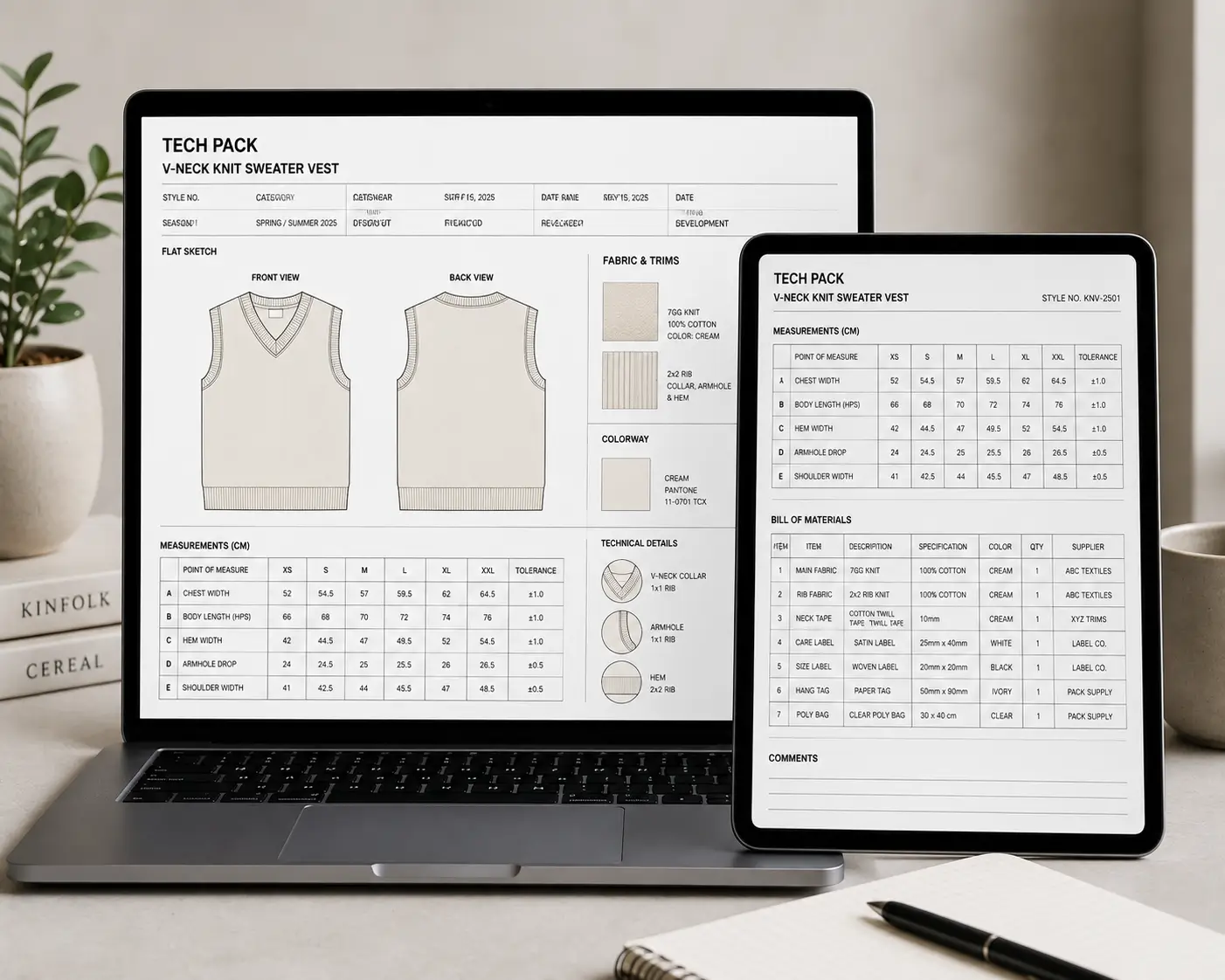
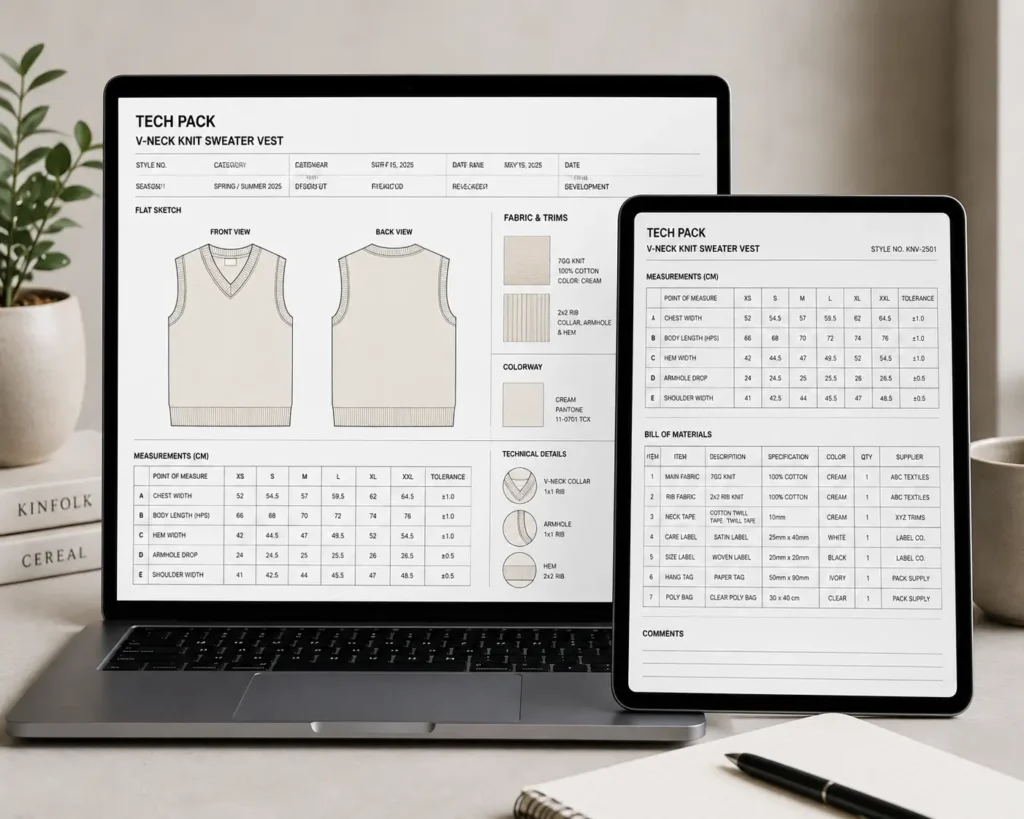
A knit sweater vest tech pack is a technical document set that gives a knitwear factory everything needed to produce a v-neck or crew-neck knit vest: flat sketches, measurement points, yarn and gauge specs, ribbing details, colorways, and a bill of materials — all in one file a factory can quote and produce from directly.
Unlike a t-shirt or fleece crewneck, a knit vest isn’t cut from flat fabric — it’s constructed loop by loop on a knitting machine, which changes almost everything about how you spec it. Where a cut-and-sew tech pack calls out fabric weight and seam type, a knitwear tech pack has to define:
- Yarn composition and gauge (e.g., 7-gauge cotton vs. 12-gauge acrylic blend), which controls thickness, stretch, and drape
- Ribbing structure at the collar, armholes, and hem — typically 1×1 or 2×2 rib — which determines whether openings hold their shape or sag
- Drop shoulder and armhole depth, since knit vests are almost always sleeveless and rely on precise shoulder-to-armhole ratios for a clean streetwear silhouette
- Shrinkage allowance, because knit fabric behaves differently after washing than woven fabric
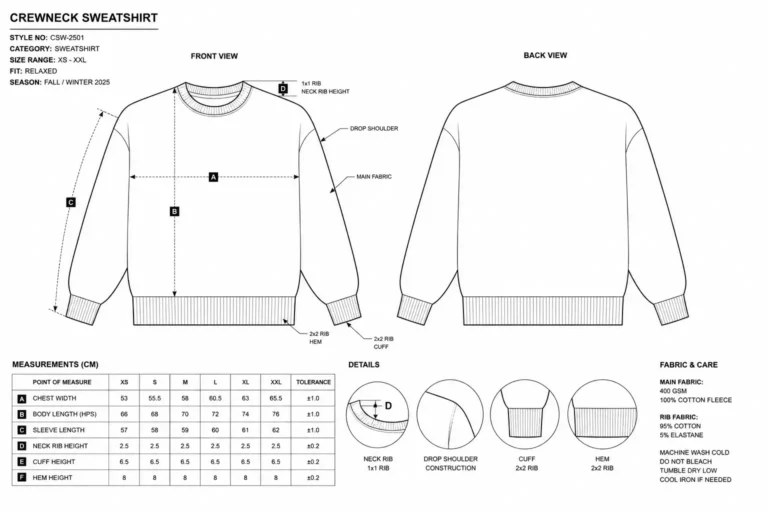
Factories typically want this delivered as an editable Adobe Illustrator (AI) file for adjustments, a flattened PDF for factory-floor reference, and PNG exports for quick visual approval over email.
A complete knit sweater vest tech pack gets you:
- ✓ Accurate first samples, instead of “close enough” guesses
- ✓ Fewer revision rounds, which means fewer sample fees
- ✓ Exact cost estimates from your factory, since yarn and gauge drive the quote
💡 Here’s the part most brands miss: the knit vest is still a low-competition, high-margin item in streetwear. Everyone’s tech pack library is full of hoodie and tee specs — very few have a clean, ready-to-send knitwear tech pack for a vest, which means less competition on the retail floor and more room to price it as a statement piece.
DIY Tech Packs vs. Professional Vector Templates
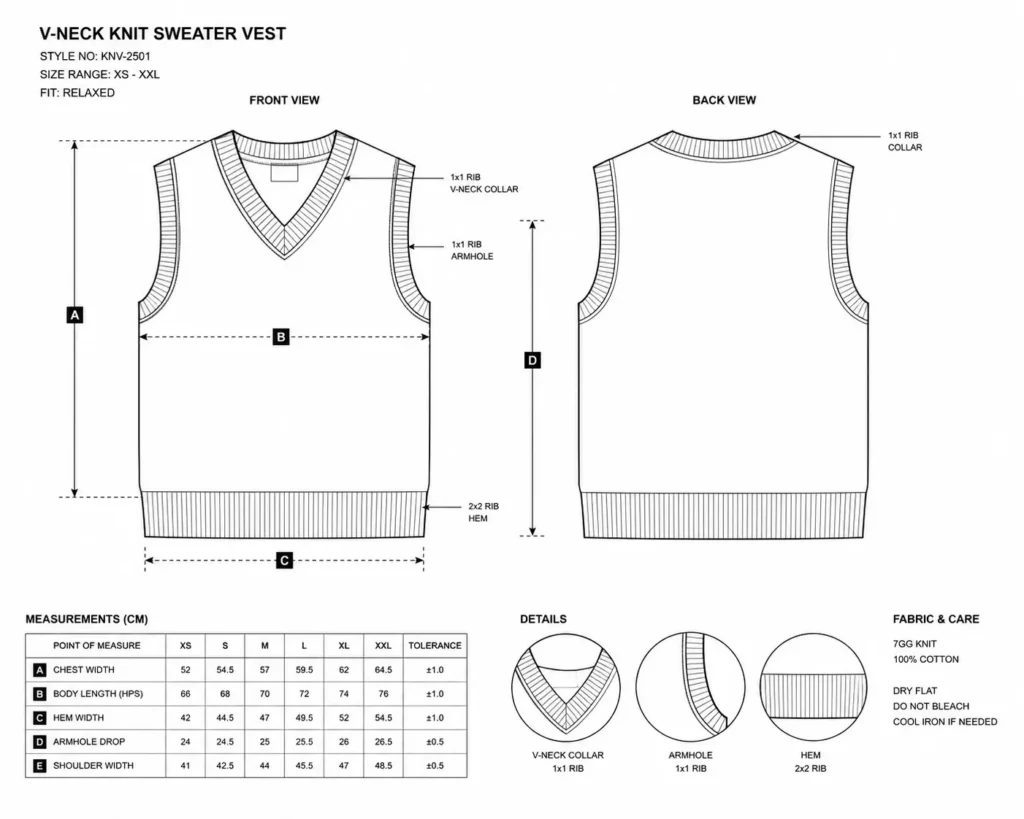
Building a tech pack from scratch is possible — plenty of designers do it in Illustrator with a ruler and a lot of patience. But if you’ve never specced knitwear before, the failure points in a DIY sweater vest clothing template are predictable and expensive.
The most common DIY errors:
- Guessing at shoulder drop instead of measuring from an existing sample
- Leaving gauge and yarn weight blank, so the factory picks for you
- Undefined rib tension, which leads to armholes and hems that flare or sag
- No bill of materials, so cost quotes come back wildly inconsistent between factories
A pre-made sweater vest clothing template solves most of this by starting from specs that have already been tested against a real factory pattern, rather than specs built from theory. You’re not reinventing the measurement logic — you’re customizing proven numbers to your fit and brand.
Here’s how the two approaches actually compare:
| Criteria | DIY Specs From Scratch | S.i. Graphics Tech Pack ($14.99) | Freelance Tech Designer ($150+) |
|---|---|---|---|
| Flat Sketch Precision | Inconsistent, depends on skill | Factory-tested vector flats | High, but varies by designer |
| Measurement Specs Included | Often incomplete | Full point-of-measure chart | Full, custom to your brief |
| BOM Template Included | Rarely | Yes | Sometimes, ask upfront |
| Production-Ready | Only after multiple revisions | Yes, out of the box | Yes, after 1-2 rounds |
| Turnaround Time | Days to weeks | Instant download | 1-2 weeks |
| Cost | Free (but costly in sample fees) | $14.99 | $150-$300 per style |
For a first-time brand, the math is straightforward: a single wasted sample often costs more than a sweater vest clothing template, and a wasted round-trip with an overseas factory costs you weeks you don’t get back.
Best Tech Pack Solutions for Knit Sweater Vests
S.i. Graphics V-Neck Knit Sweater Vest Tech Pack Template — $14.99 | Best Overall
This is the direct-match option: a complete knit sweater vest tech pack built specifically for a v-neck streetwear silhouette, ready to send to a factory the same day you download it. It includes fully editable vector flats, a full point-of-measure chart, ribbing callouts, and a bill of materials, so you’re not starting from a blank page or guessing at industry-standard measurements. It’s the fastest path from concept to a factory-ready quote.
What’s included:
- Editable Adobe Illustrator (.ai) and flattened PDF files
- Front and back vector flat sketches with callouts
- Full v-neck vest manufacturing specs, including gauge and ribbing notes
- Size grading chart (XS-XXL)
- Bill of Materials (BOM) sheet
Best for: Independent streetwear brands ready to send specs to a factory this week.
Pros:
- ✓ Instant download, no waiting on a freelancer’s calendar
- ✓ Factory-tested measurement logic, not guesswork
- ✓ Fully editable — swap colorways, branding, and yarn specs
- ✓ Lowest cost entry point into professional knitwear specs
Cons:
- ✗ Built for a v-neck silhouette — crew-neck styles need separate adjustment
- ✗ Still requires you to input your own brand’s colorways and yarn source
S.i. Graphics Complete Tech Pack Library — $69.99 | Best Value for Full Collections
If you’re launching more than one style, the Complete Tech Pack Library covers a full apparel tech pack template library — hoodies, tees, pants, and vests — instead of buying each one individually. It’s built for brands prepping a multi-piece drop rather than a single product, and it keeps your spec formatting consistent across the whole line.
What’s included:
- Full library of streetwear tech pack templates (hoodie, tee, sweatpant, vest, and more)
- Vector flats and measurement charts for each style
- BOM sheets across the collection
- Editable AI and PDF files
Best for: Brands planning a full seasonal drop instead of a single item.
Pros:
- ✓ Significant savings versus buying each template individually
- ✓ Consistent spec formatting across your whole line
- ✓ Covers most core streetwear categories in one purchase
Cons:
- ✗ Higher upfront cost if you only need one style right now
- ✗ Overkill if the vest is your only planned product
Generic Vector Flat Sketches (Freepik / Stock Packs) | Best Budget / Basic Option
Stock flat sketch packs are cheap and easy to find, and they’re fine for early moodboards or pitch decks. But they’re not built as a real knitwear tech pack — they’re illustrations, not manufacturing documents, and a factory can’t quote or produce from them as-is.
What’s included:
- Generic vector flat sketches (no brand-specific customization)
- Limited or no measurement callouts
Best for: Early concept visuals, not factory submission.
Pros:
- ✓ Very low cost
- ✓ Fast to find and download
Cons:
- ✗ No gauge, yarn, or rib tension specs
- ✗ Not production-ready — factories will still need a real spec sheet
Freelance Technical Designer (Upwork / Fiverr) | Best Custom Option
A freelance technical designer can build fully bespoke v-neck vest manufacturing specs to your exact measurements and fit preferences. It’s the most flexible option on this list, and also the most expensive and slowest to turn around.
What’s included:
- Custom flat sketches to your exact spec
- Custom point-of-measure chart
- Revisions based on your feedback
Best for: Brands with a very specific, unusual fit that a template can’t cover.
Pros:
- ✓ Fully bespoke to your exact fit and brand requirements
- ✓ Direct back-and-forth with the designer
Cons:
- ✗ $150-$300 per style, and prices climb with revisions
- ✗ 1-2 week turnaround, sometimes longer
S.i. Graphics Streetwear Starter Pack Bundle | Best for Beginners Launching a Brand
For a brand just getting started, this bundle pairs core apparel tech pack template files with the essential vector assets — logo placement guides, label templates, and packaging mockups — needed to launch fast without piecing everything together from different sources.
What’s included:
- Core streetwear tech pack templates
- Branding and label placement guides
- Essential launch-ready vector assets
Best for: First-time founders setting up their brand’s technical library from zero.
Pros:
- ✓ Covers both product specs and brand assets in one purchase
- ✓ Good starting point before scaling into a full collection
- ✓ Saves time piecing together assets from multiple sources
Cons:
- ✗ Less specialized than a single-style tech pack if you only need one product
How to Customize Your V-Neck Vest Manufacturing Specs for Production
Once you’ve got a template in hand, the real work is adapting it to your brand and your specific factory. Here are the four areas that matter most.
1. Colorways & Pantone References Don’t send a factory an RGB screenshot and hope for the best. Reference actual Pantone TPX or TCX codes for each colorway, and note which colors apply to the body versus the ribbing if you’re doing a two-tone vest.
2. Yarn Composition & Gauge Selection This is the single biggest lever in knitwear pricing and hand-feel. A 7-gauge 100% cotton yarn gives you a heavier, more structured vest suited to fall/winter drops, while a 12-gauge acrylic blend produces a lighter, finer-knit vest that works better for transitional seasons. Specify this clearly in your v-neck vest manufacturing specs — factories will quote very differently depending on gauge and fiber content.
3. Branding Placement Decide early whether your logo is a woven main label, a side-neck tag, or chest embroidery/jacquard knitted directly into the panel. Jacquard branding needs to be specified before knitting begins, not added afterward, so this decision affects your production timeline more than the others.
4. Size Grading Expansion Most templates ship with a base garment size spec chart, but you’ll likely need to expand or adjust it for your target size range, especially if you’re producing an oversized streetwear fit rather than a true-to-size vest.
💡 Pro Tip: Send your tech pack as both an editable AI file and a flattened PDF so manufacturers can print physical spec sheets for factory floor workers.
When communicating with offshore factories, keep your notes short and specific rather than descriptive — “2×2 rib, 1.5 inch hem” communicates faster and more accurately across a language barrier than a paragraph of explanation. If you’re unsure how a factory will interpret a callout, ask for a lab dip or knit-down swatch before committing to a full sample run.
💡 Pro Tip: When specifying knitwear, always specify the rib structure (e.g., 2×2 rib hem and armholes) to avoid your factory delivering loose or flared openings.

Frequently Asked Questions
Q1: What is included in a professional knit sweater vest tech pack?
A complete tech pack includes front and back vector flat sketches, a point-of-measure chart, yarn and gauge specs, ribbing callouts, colorway references, branding placement, a size grading chart, and a bill of materials (BOM).
Q2: What vector software do I need to edit a sweater vest clothing template?
Most templates are built in Adobe Illustrator, which lets you edit measurements, colorways, and branding directly. A flattened PDF version is also useful for quick review or printing, but Illustrator is what you’ll need to make real edits.
Q3: How do I specify yarn gauge and weight in my v-neck vest manufacturing specs?
State the gauge as a number (e.g., 7-gauge, 12-gauge) alongside the fiber content and blend ratio (e.g., 100% cotton, or 80/20 cotton-acrylic). Gauge determines stitch density and thickness, so factories need this number, not just a general “chunky knit” description.
Q4: Can I use this tech pack for jacquard patterns or custom embroidery?
Yes, but jacquard patterns need to be planned before production since they’re knitted directly into the fabric rather than added afterward. Embroidery and chest logos can typically be added after the base vest is knitted, giving you more flexibility on timing.
Q5: Why are knitwear tech packs different from standard t-shirt tech packs?
A t-shirt tech pack specs a pre-made fabric that’s cut and sewn, while a knitwear tech pack has to define how the fabric itself is constructed — gauge, yarn, and ribbing all need to be specified because the knitting machine is building the fabric and garment at the same time.
Q6: Do factories accept PDF format tech packs, or do they require Adobe Illustrator files?
Most factories are comfortable with a PDF for reference and quoting, but they’ll often ask for the editable AI file once production begins, since it lets their team make quick adjustments without emailing back and forth over small changes.
Q7: How does size grading work for oversized streetwear knit vests?
Oversized grading typically adds more room across the chest and body length per size jump than a true-to-size chart would, while keeping shoulder and armhole proportions relatively controlled so the silhouette doesn’t look sloppy. Your garment size spec chart should reflect the drop-shoulder proportions specific to your fit, not a standard fitted-garment grade.
Q8: Is it better to build a sweater vest tech pack from scratch or use a pre-made template?
For most independent brands, a pre-made template is faster and cheaper than building specs from scratch, since it starts from measurement logic that’s already been tested against real factory patterns. Building from scratch only makes sense if your fit is highly unusual or you already have in-house technical design experience.

Conclusion & Next Steps
The knit sweater vest is still an underused piece in most streetwear lineups, and that gap is exactly the opportunity. With the right knit sweater vest tech pack, you can move from concept to factory-ready specs in a single afternoon instead of a multi-week back-and-forth.
Here’s what to remember:
- Knitwear specs are unforgiving — gauge, ribbing, and yarn composition need to be exact, not approximate
- A validated sweater vest clothing template saves real money by cutting down on wasted samples and revision rounds
- The knit vest category is still low-competition, giving early brands room to price it as a statement piece rather than a basic
If you’re ready to send specs to your factory this week, start with the V-Neck Knit Sweater Vest Tech Pack ($14.99). If you’re prepping a full collection, the Complete Tech Pack Library covers your entire drop in one purchase.
Factory-ready specs aren’t a luxury reserved for bigger brands — they’re one download away.