Design - Create - Grow


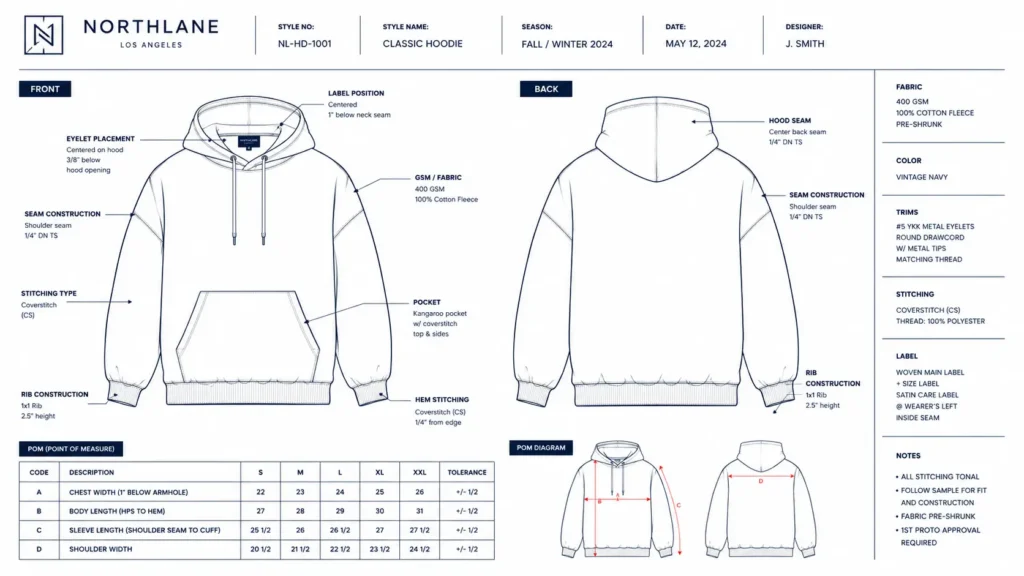
Have you ever sent a sketch or a rough spec sheet to an overseas factory — only to receive a sample that looks nothing like what you envisioned? Wrong shoulder width. Wrong GSM. Drawstring eyelets in the wrong position. It’s an expensive, demoralizing moment that every clothing brand founder dreads.
The fix is a proper hoodie tech pack template — and it’s non-negotiable if you’re serious about manufacturing.
A hoodie tech pack template gives your factory a complete, unambiguous production blueprint. Without one, you’re burning money on bad samples, extended lead times, and frustrating back-and-forth with your manufacturer. In this guide, you’ll learn exactly what goes into a factory-ready tech pack — from measurements and GSM to stitching specs and label placement — and we’ll show you the best templates to get you into production faster.
⚡Quick Answer: The key to flawless factory production is a comprehensive hoodie tech pack template that dictates precise measurements, GSM, stitching type, and label placement. Without it, factories fill in the gaps themselves — and rarely in your favor.
What Is a Hoodie Tech Pack?
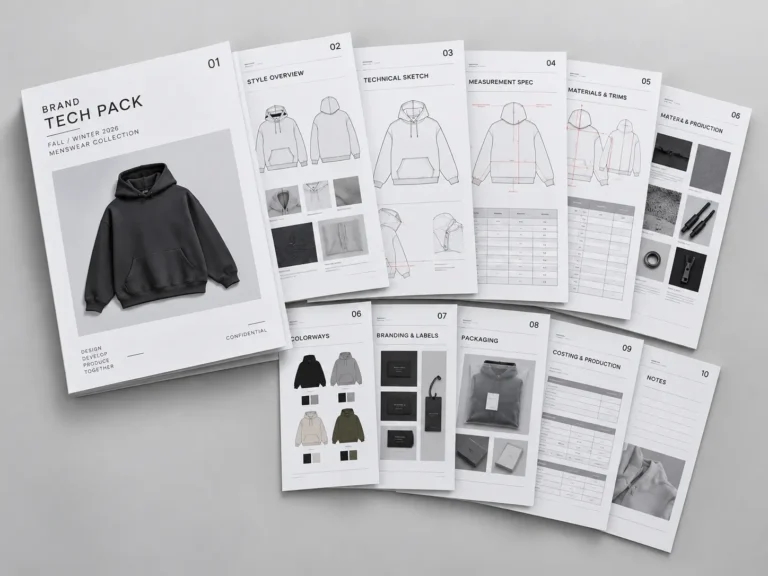
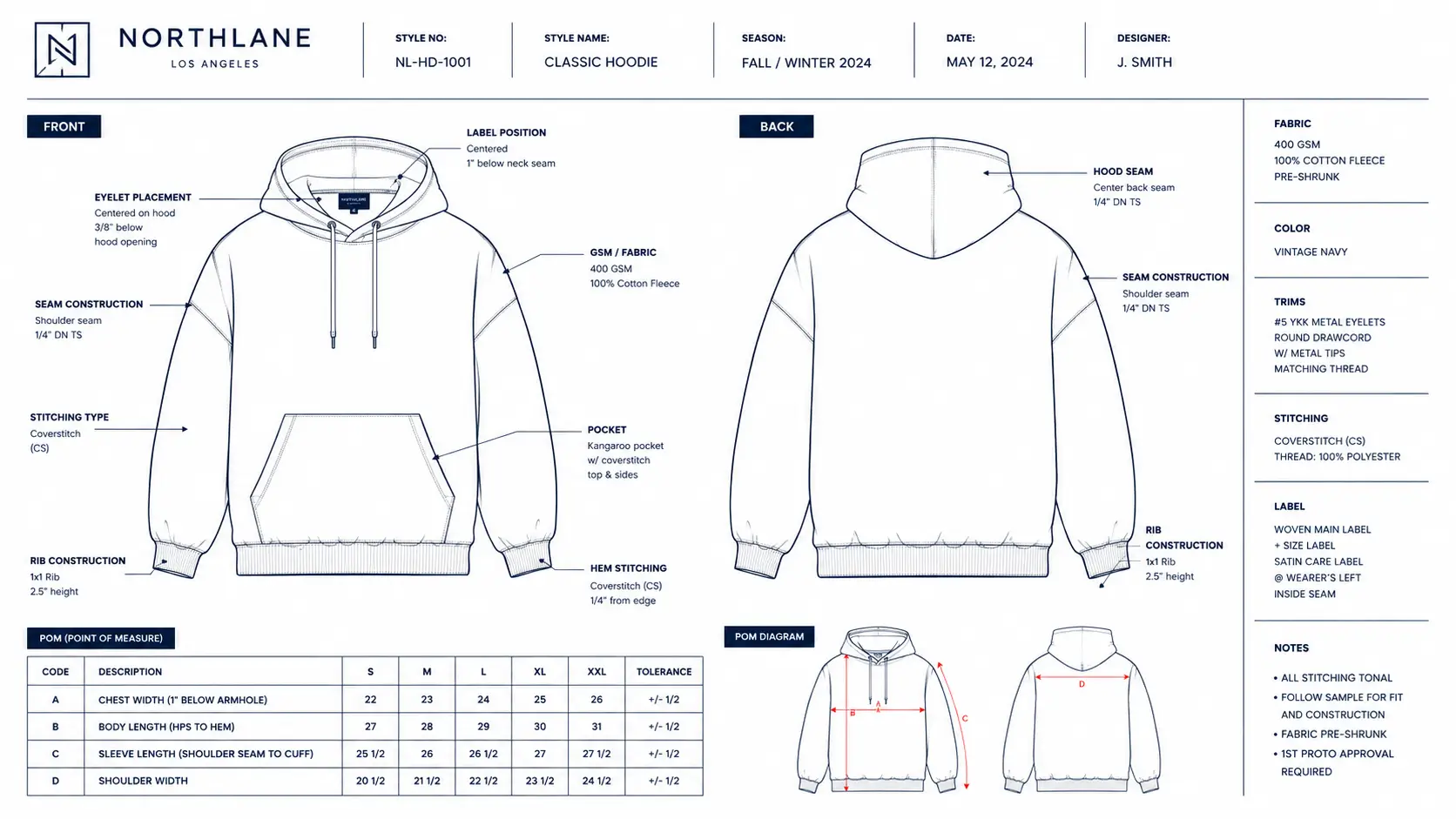
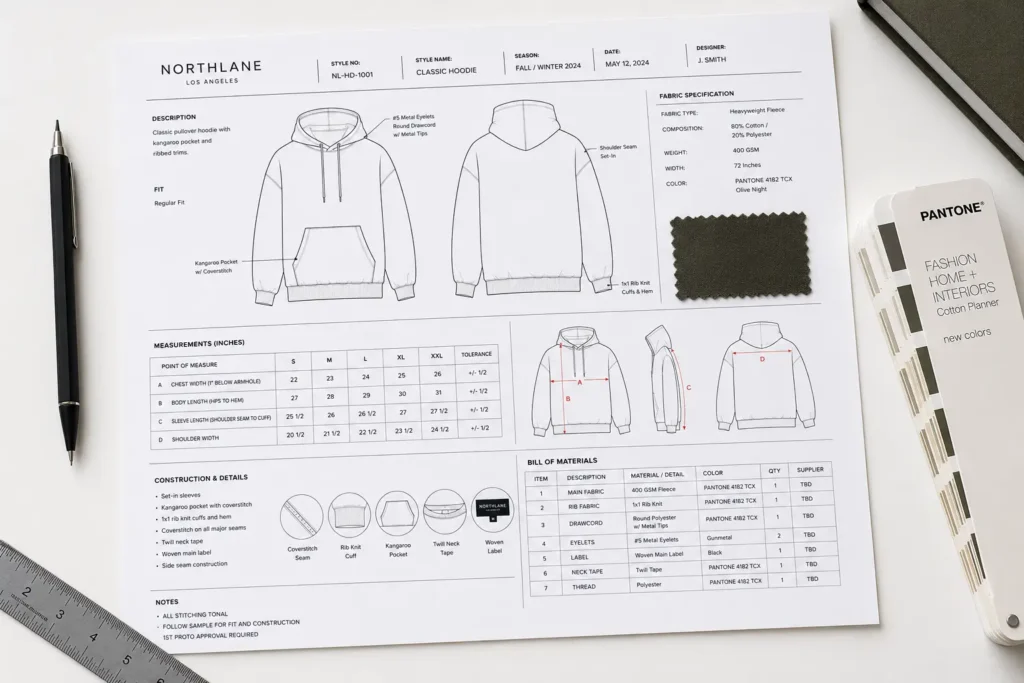
A hoodie tech pack is a blueprint document that communicates every construction detail of your hoodie to a clothing factory — including measurements, fabric specifications, stitching methods, hardware, and label placement — so manufacturers can produce accurate samples and final goods without guesswork.
Think of it as the instruction manual for your garment. Every detail that lives in your head — the fabric weight, the ribbing on the cuffs, where the wash tag sits, the exact shoulder drop — needs to be captured in writing, with callouts and diagrams that any factory can act on.
Factories require tech packs because:
- They cannot read minds, and assumptions lead to errors
- Multiple departments (cutting, sewing, quality control) reference the same document
- It establishes a legal and creative reference point for disputes
- Accurate sample pricing depends on knowing the true material and construction complexity
Core components of a hoodie tech pack include:
- Bill of Materials (BOM) — every fabric, trim, hardware, and label itemized
- Points of Measure (POM) chart — a size-graded measurement table
- Construction details — seam types, stitching specs, and assembly sequence
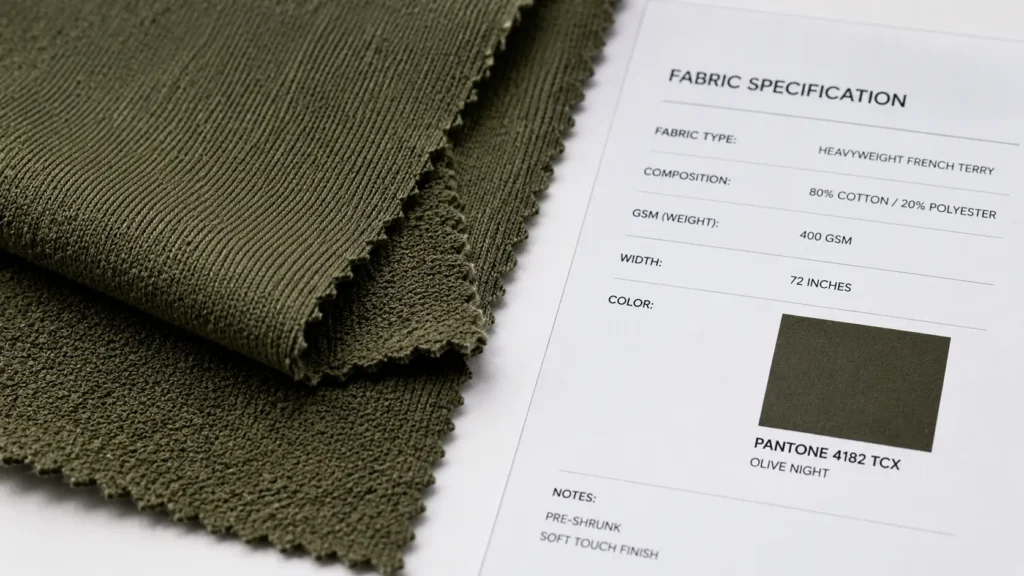
- Fabric and GSM specifications
- Colorway and Pantone TCX references
- Label and packaging instructions
What a Proper Hoodie Tech Pack Includes
Not all tech packs are created equal. A thorough hoodie tech pack template goes well beyond a flat sketch. Here’s what factories actually need to see:
Measurements & Grading
Accurate measurements are the foundation. Your POM (Points of Measure) chart should list every critical dimension: chest width, body length, sleeve length, sleeve opening, hood height, hood width, front rise, and more. Each measurement needs to be graded across your full size run — typically XS through 2XL or 3XL.
💡Factory Pro Tip: Always specify your fabric shrinkage tolerance in your tech pack. If you’re using 400 GSM heavy loopback French terry, shrinkage can reach 5–8% after the first wash. If your factory doesn’t account for this, your XL becomes a M after laundering.
Why this matters: Without a graded spec sheet, factories default to their own block patterns — which almost never match your brand’s intended silhouette.
Fabric & GSM
GSM (grams per square meter) is the universal language of fabric weight. You must specify it explicitly. A vague instruction like “heavy cotton” tells a factory almost nothing. Instead, specify:
- Fabric composition (e.g., 80% cotton / 20% polyester)
- Construction type (e.g., loopback French terry, fleece-back jersey, waffle knit)
- GSM (e.g., 400 GSM for heavyweight, 280 GSM for midweight)
- Pantone TCX color references for dyeing accuracy
This is especially critical for oversized hoodie manufacturing specs, where the wrong fabric weight can make the garment collapse under its own drape rather than hold its intended structure.
Stitching & Construction
Stitching specs tell the factory exactly how the garment is assembled. You need to specify:
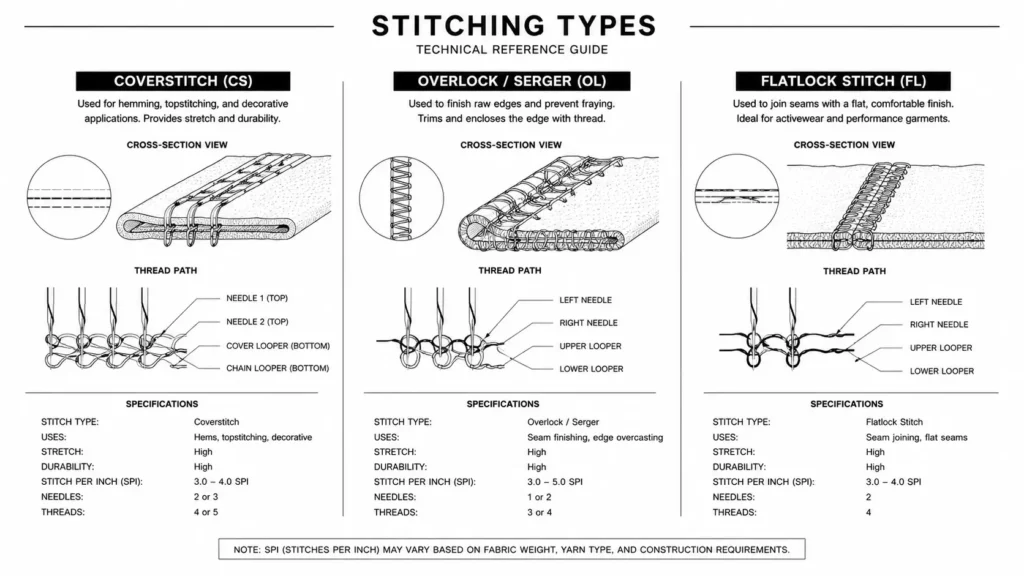
- Coverstitch for hem finishing on sleeves, cuffs, and hem band
- Overlock (serger) for seaming panels together
- Flatlock stitch for a clean, flat seam on premium or athleisure styles
- Chainstitch for the main body seam on heavyweight styles
- SPI (stitches per inch) — typically 7–9 SPI for hoodies
- Thread color, referencing your Pantone or thread brand codes
Without stitching specs, factories default to whatever is fastest for them — not what’s best for your brand.
Label Placement & Hardware
Your tech pack must include a diagram showing:
- Neck label position and method (sewn-in woven label vs. heat transfer vs. screen-printed tonal label)
- Wash care label placement (typically left side seam, 3–4″ from hem)
- Drawstring type (flat, round, cord) and color
- Eyelet size, material (metal vs. fabric-covered), and spacing from center front seam
- Cuff and waistband ribbing specifications (rib weight, fold-over width, and whether ribbing is same-fabric or separate)
💡Factory Pro Tip: Specify eyelet placement in millimeters from the center seam and from the top of the hood channel. A vague “at the top of the hood” instruction routinely results in eyelets that are off-center or sitting too high or low.
Top Hoodie Tech Pack Templates for Your Brand
You don’t need to build a tech pack from scratch. These professionally designed templates from S.i. Graphics are factory-tested, instantly downloadable, and priced for brand founders — not enterprise fashion houses.
1. S.i. Graphics Pullover Hoodie Tech Pack Template — Best for Classic Brand Essentials
⭐ Best for Classic Brand Essentials
This is the pullover hoodie tech pack that independent brand founders have relied on to communicate with manufacturers cleanly and professionally. It covers every spec your factory needs for a standard kangaroo-pocket pullover: full POM chart, fabric and GSM callouts, stitching details, hardware specs, and label placement diagrams.
Price: $14.99
What’s Included:
- Editable Adobe Illustrator (.AI) and PDF files
- Full Points of Measure (POM) chart with size grading
- Fabric, GSM, and BOM (Bill of Materials) section
- Stitching and construction callouts
- Label and hardware placement diagram
Best for: Brands launching essentials-focused collections, basics-first streetwear labels, or anyone producing a standard-fit pullover hoodie.
- ✓ Factory-tested and approved format
- ✓ Immediately editable — no design experience required
- ✓ Includes detailed POM chart covering 15+ measurement points
- ✓ Covers both fabrication and trim specs in one document
- ✓ Affordable at just $14.99 — a fraction of what a freelance TD would charge
- ✗ Designed for standard shoulder construction — not ideal for extreme drop-shoulder silhouettes
- ✗ Adobe Illustrator required for full editing capability
2. S.i. Graphics Drop Shoulder Hoodie Tech Pack Template — Best for Modern & Skater Aesthetics
👕 Best for Modern & Skater Aesthetics
The drop shoulder silhouette has become a staple of contemporary streetwear, and it demands a different set of manufacturing specs than a traditional set-in sleeve hoodie. This template is purpose-built for drop shoulder construction, with callouts specifically addressing the extended shoulder seam position, sleeve cap adjustment, and body width specs that make this silhouette work.
Price: $14.99
What’s Included:
- Editable AI and PDF files optimized for drop shoulder construction
- Drop shoulder-specific POM chart with sleeve drop measurements
- Construction callouts for the extended shoulder seam
- GSM and fabric spec section
- Hardware and label placement diagrams
Best for: Skate brands, Gen-Z streetwear labels, and any brand building a relaxed, contemporary collection.
- ✓ Purpose-built for drop shoulder construction — not a generic template adapted post-hoc
- ✓ Includes shoulder drop measurement callouts rarely found in generic templates
- ✓ Clear construction diagrams factories can act on immediately
- ✓ Works seamlessly with heavyweight (380–480 GSM) and midweight (260–320 GSM) fabrics
- ✗ Not suited for set-in sleeve or raglan constructions
- ✗ Best results with Adobe Illustrator for full customization
3. S.i. Graphics Unisex Oversized Hoodie Tech Pack Template — Best for Premium Streetwear Brands
🔥 Best for Premium Streetwear Brands
Oversized silhouettes carry a specific set of manufacturing challenges — fabric drape, shoulder extension, extended body length, and cuff-to-sleeve proportion all behave differently at exaggerated dimensions. This unisex oversized hoodie manufacturing specs template accounts for all of it. It’s built for brands targeting the premium end of the streetwear market where fit precision and quality signaling matter.
This is where the secondary keyword “pullover hoodie tech pack” meets oversized execution — a document that handles both the silhouette complexity and the construction rigor your factory needs.
Price: $14.99
What’s Included:
- Editable AI and PDF files designed for oversized unisex proportions
- Extended POM chart covering oversized-specific measurement points
- Fabric weight recommendations for optimal drape at oversized dimensions
- Stitching specs for heavyweight seaming
- Drawstring, eyelet, and label placement callouts
Best for: Premium streetwear brands, unisex collections, brands targeting fashion-forward consumers who prioritize silhouette.
- ✓ Accounts for the unique proportion challenges of oversized construction
- ✓ Unisex sizing guidance included
- ✓ Built for heavyweight fabrics (400–500+ GSM)
- ✓ Detailed drawstring and eyelet placement specs
- ✓ Instantly downloadable — start editing within minutes of purchase
- ✗ May require modification for extremely niche oversized proportions (e.g., ultra-cropped boxy styles)
- ✗ Not designed for slim or fitted silhouettes
4. S.i. Graphics Complete Tech Pack Library — Best Value / Most Comprehensive
💰 Best Value · Most Comprehensive
If you’re building a full collection — or you know you’ll be producing multiple garment categories — the Complete Tech Pack Library is your most efficient investment. It includes all three hoodie style templates plus additional garment tech packs, giving you the complete toolkit to take an entire line from concept to factory.
Price: $69.99
What’s Included:
- 4 S.i. Graphics best seller tech pack templates
- Additional garment tech pack templates for other styles in your collection
- Editable AI and PDF files for every template
- Full POM charts, BOM sections, stitching callouts, and label specs across all styles
Best for: Brand founders launching a full collection, technical designers managing multiple styles, and anyone who wants one comprehensive factory toolkit at the best per-unit price.
- ✓ Covers every major hoodie silhouette in one purchase
- ✓ Massive cost saving vs. buying individual templates
- ✓ Consistent format across all templates — factories appreciate the standardization
- ✓ Ideal for building a long-term brand production infrastructure
- ✓ Includes garment styles beyond hoodies for full collection coverage
- ✗ More templates than a brand needs if launching a single-SKU product
A Note on Free & Subscription-Based Alternatives
There are free tech pack templates available online, and platforms like Adobe Illustrator template marketplaces or subscription-based PLM (Product Lifecycle Management) tools do exist. Here’s the honest picture:
Free templates are typically generic, lack streetwear-specific silhouette callouts, and rarely include the detailed POM charts or BOM sections that factories actually need. You’ll spend more time adapting them than using them.
Subscription PLM platforms (like Techpacker or BlindThread) offer more features but charge monthly fees that rarely make sense for independent brand founders launching their first collections. At $40–$100+/month, the cost adds up fast.
At $14.99 per template or a bundle price for everything, the S.i. Graphics templates represent the clearest value proposition for founders who need professional, factory-ready documentation without the overhead.
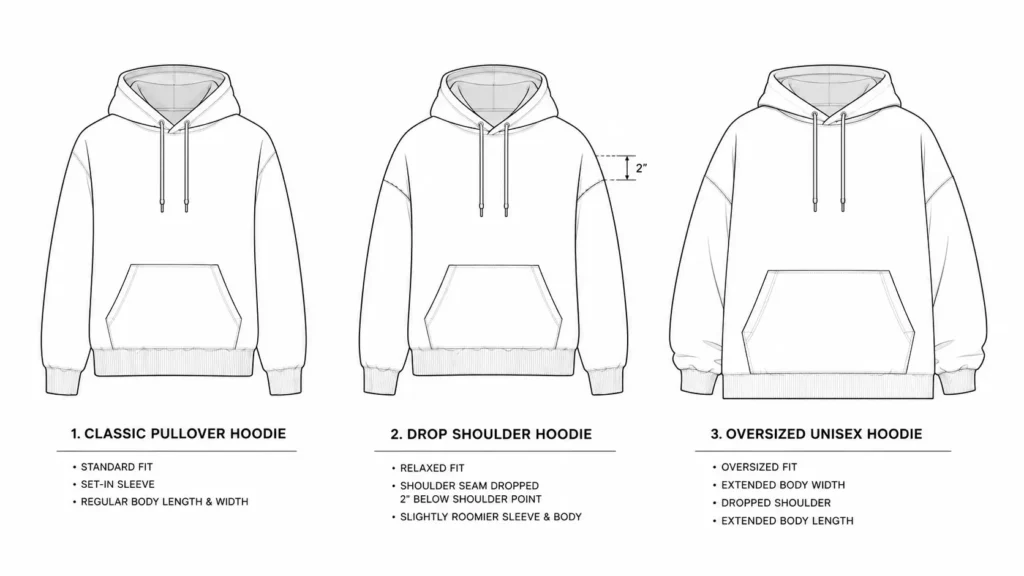
Hoodie Template Comparison Table
| Feature | Pullover Hoodie | Drop Shoulder Hoodie | Oversized Hoodie |
|---|---|---|---|
| Silhouette | Classic set-in sleeve | Extended shoulder seam | Relaxed, exaggerated proportions |
| Shoulder Seam | Standard at shoulder point | Dropped 1–3″ past shoulder | Extended or drop construction |
| Fit | Relaxed-standard | Loose / relaxed | Oversized / boxy |
| Ideal GSM | 280–380 GSM | 320–460 GSM | 380–500+ GSM |
| Best For | Essentials, basics, everyday wear | Skate, Gen-Z, modern streetwear | Premium streetwear, unisex collections |
How to Choose the Right Hoodie Tech Pack Template
With three solid options (plus the bundle), the right choice comes down to three factors:
Your Brand’s Silhouette
The most important decision. Each template is purpose-built for a specific silhouette, and using the wrong one means you’ll be fighting the document to communicate the right specs.
- Choose the Pullover Hoodie template if your fit is a traditional, set-in sleeve construction with a standard or slightly relaxed profile.
- Choose the Drop Shoulder template if: ✓ You want a relaxed, modern streetwear silhouette, ✓ You are targeting a Gen-Z demographic, ✓ Your designs feature extended shoulder seams or kimono-adjacent sleeve construction.
- Choose the Oversized Hoodie template if: ✓ You’re building a premium streetwear line, ✓ Your hoodie intentionally exceeds standard proportions in body width and length, ✓ You’re producing in 400 GSM or heavier fabric.
Your Factory’s File Format Requirements
Most professional factories and sourcing agents accept Adobe Illustrator (.AI) and PDF formats. All S.i. Graphics templates are delivered in both formats. If your factory requires a specific format outside of these (e.g., CAD-native files), confirm with them before purchasing any template.
Your Collection Scope
Launching a single hero product? Pick the one template that matches your silhouette.
Launching a full hoodie range? The Mega Bundle saves money and gives you a consistent documentation format across all styles — which factories genuinely appreciate.
If you’re still unsure: start with the Mega Bundle. At bundle pricing, the per-template cost is lower than buying individually, and having all three gives you flexibility as your brand grows.
Frequently Asked Questions
What GSM should I use for a high-quality hoodie?
GSM depends on the weight category and end use you’re targeting. For a lightweight, year-round hoodie, aim for 250–300 GSM — typically a midweight cotton-poly jersey or French terry. For a classic midweight streetwear hoodie, 320–380 GSM is the sweet spot — heavy enough to feel premium, light enough to remain wearable in most climates. For a truly heavyweight, cold-weather hoodie with significant structure, specify 400–500+ GSM using heavy loopback French terry or a brushed-back fleece. Always communicate GSM explicitly in your tech pack — never leave it to factory interpretation.
How do I specify stitching in my tech pack?
Stitching should be specified by stitch type, SPI (stitches per inch), and application location. The most common types for hoodies are:
- Coverstitch: Used for cuffs, hem band, and sleeve hem finishing. Creates a clean, two-row top-stitch look on the right side.
- Overlock (serger stitch): Used for panel seaming — joins front/back body, sets sleeves, attaches hood panels.
- Flatlock stitch: A premium alternative to overlock for visible seams, often used in athleisure or premium streetwear for a flat, clean interior.
Specify thread color with Pantone thread codes or a matching system your factory uses, and note SPI (7–9 SPI is standard for hoodies).
What’s the difference between a drop shoulder and an oversized hoodie?
These terms are often confused. A drop shoulder hoodie has a specific construction feature: the shoulder seam falls below the natural shoulder point — typically 1–3 inches — creating a relaxed, modern aesthetic while the body itself may remain relatively standard in width. An oversized hoodie refers to the overall silhouette: the body is intentionally wider, longer, and more voluminous than standard sizing, regardless of where the shoulder seam sits. You can have an oversized hoodie with a standard shoulder seam, or a drop shoulder hoodie with a body width that isn’t dramatically different from standard. Many premium streetwear styles combine both features.
Do I need Adobe Illustrator to use a tech pack template?
For full editing capability, yes — Adobe Illustrator is the industry standard for tech pack files, and the S.i. Graphics templates are delivered in .AI format. However, every template also includes a PDF version, which you can annotate and share with factories if you don’t have Illustrator access. For most editing tasks (updating measurements, swapping colors, adding notes), the PDF version with annotation tools works for basic needs. For custom illustration edits or silhouette adjustments, Illustrator is the right tool. Adobe offers a monthly subscription to Illustrator if you don’t already have it.
How many sizes should I include in my grading chart?
At minimum, include 5 sizes: S, M, L, XL, XXL. This covers the majority of retail markets and gives factories enough data to interpolate adjacent sizes if needed. If you’re targeting a streetwear or unisex market, consider extending to XS on the low end and 3XL on the high end to capture the full range of your customer base. Your grading increments (the difference in measurements between each size) should be consistent — typically 1 inch / 2.54 cm per size on chest width, with proportional adjustments on other POM points. If you’re producing oversized styles, confirm your grading increments with a technical designer, as oversized garments sometimes use compressed grading to keep proportions intentional.
Will a tech pack template guarantee my factory gets the sample right?
A well-completed tech pack template dramatically reduces errors, but it doesn’t guarantee a perfect first sample — no document can replace the role of a skilled sampling team and a clear QC process. What a tech pack does guarantee is that your factory has every piece of information they need to attempt production accurately. If a sample comes back wrong despite a thorough tech pack, you have documented evidence of the correct spec — which makes revisions faster, reduces arguments, and protects you in dispute resolution. The most common remaining source of error is inadequately specified details (e.g., listing “drawstring” without specifying diameter, material, and length). Use the S.i. Graphics templates precisely because they prompt you to fill in those often-overlooked details.
Can I use the same tech pack template for multiple colorways?
Yes — and this is one of the most practical advantages of a well-structured template. Once your construction specs, measurements, and hardware details are locked in, duplicating the file and updating Pantone TCX color references for each colorway is straightforward. Your BOM (Bill of Materials) section will need to reflect the specific fabric color for each version, but the structural specs remain constant. Most brands maintain one “master” tech pack per style and create colorway-specific variants from it.
What’s a BOM and why does it matter?
A BOM (Bill of Materials) is the itemized list of every material, trim, and hardware component in your garment. For a hoodie, this includes: shell fabric (with GSM, composition, and supplier reference), ribbing fabric, drawstring cord, eyelets, zipper (if applicable), sewing thread, neck label, wash care label, hang tag, and packaging. The BOM matters because it tells your factory exactly what to source, and it’s what production and costing teams use to price your garment accurately. Missing items from your BOM leads to factories substituting components without telling you — often with cheaper alternatives.
Conclusion
If there’s one thing experienced technical designers know, it’s this: you cannot guess your way through factory communication. Every measurement that isn’t written down becomes an assumption. Every assumption becomes a sampling error. And every sampling error costs you time, money, and momentum.
A solid hoodie tech pack template removes the guesswork from the equation. Specify your GSM. Define your stitching. Diagram your label placement. Grade your measurements. Give your factory everything they need — and you’ll get production-ready samples faster, with fewer costly revisions.
The S.i. Graphics templates are factory-tested, immediately editable, and priced so that any brand founder can access professional-grade documentation from day one.
Choose the right template for your silhouette and start building:
→ Pullover Hoodie Tech Pack Template — $14.99
→ Drop Shoulder Hoodie Tech Pack Template — $14.99
→ Unisex Oversized Hoodie Tech Pack Template — $14.99
→ Complete Tech Pack Library — Best Value for Full Collections
Your factory is waiting. Give them everything they need to get your hoodie right.