Design - Create - Grow


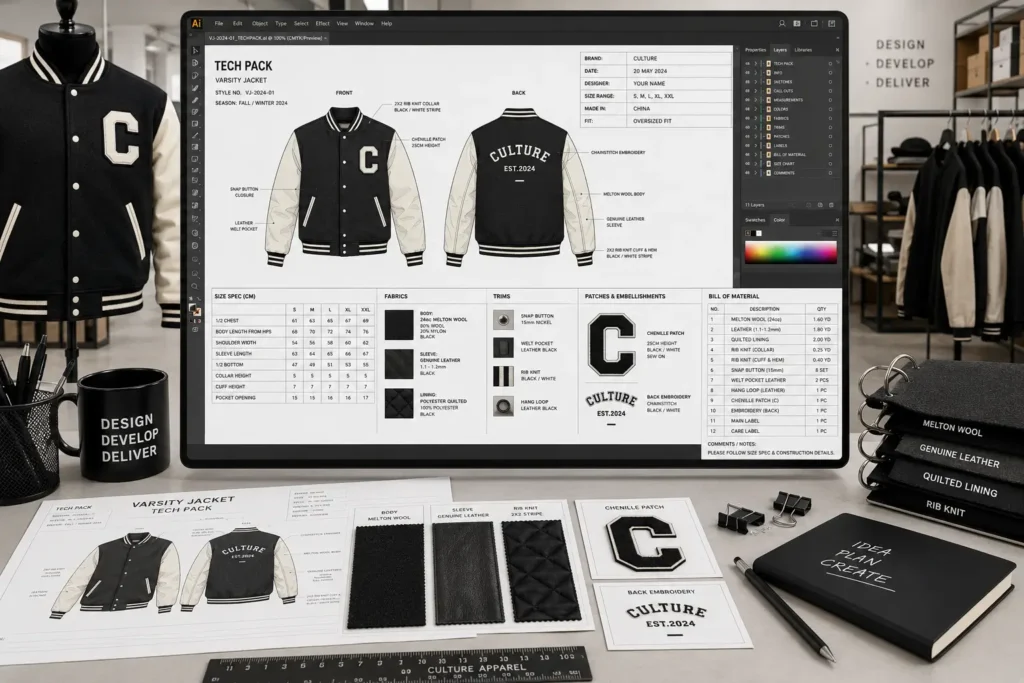
Varsity jackets are having a real moment in streetwear right now, and every season more brands are trying to add one to their lineup. The problem is that a varsity jacket tech pack is one of the harder documents to put together correctly, because letterman jackets mix more materials and trims than almost any other garment category you’ll send to a factory.
If you’ve ever sent a factory a Pinterest mood board and a couple of reference photos instead of a real varsity jacket tech pack, you already know how that story ends: a sample that’s close but wrong, a wool body in the wrong weight, ribbing that puckers, chenille patches placed half an inch off, and another two to three weeks added to your timeline while you wait for round two.
This guide walks through what actually belongs in a professional tech pack for a letterman jacket, where most DIY specs fall apart, and which resources (templates, software, freelancers, or factory in-house design) make sense depending on your budget and timeline. By the end, you’ll know exactly what your factory needs to cut a correct sample on the first attempt, instead of paying for sampling mistakes that should never have happened.
💡 Quick Answer: The fastest, most reliable way to get accurate letterman jacket manufacturing specs is to start from a pre-built, industry-tested template rather than building one from a blank page. A template that already accounts for wool body panels, leather sleeve grading, rib trims, and chenille patch placement saves you the trial-and-error that usually costs $200–$500+ in wasted samples.
What Is a Varsity Jacket Tech Pack?
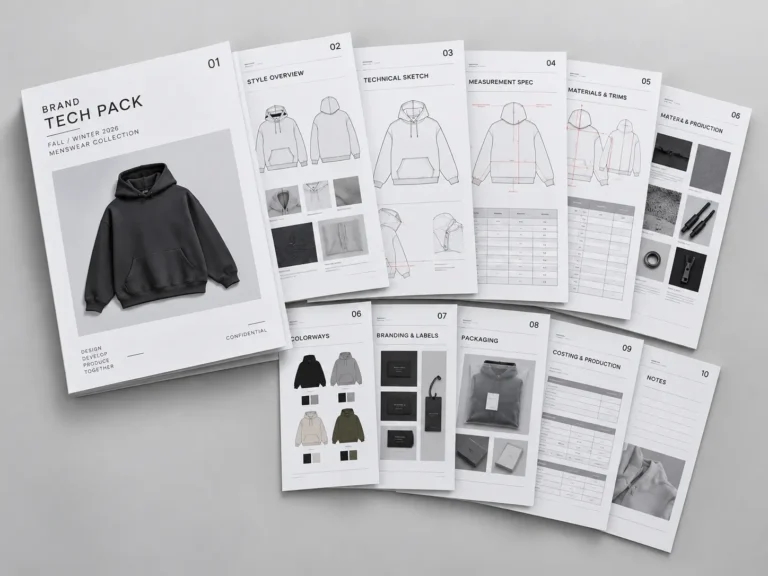
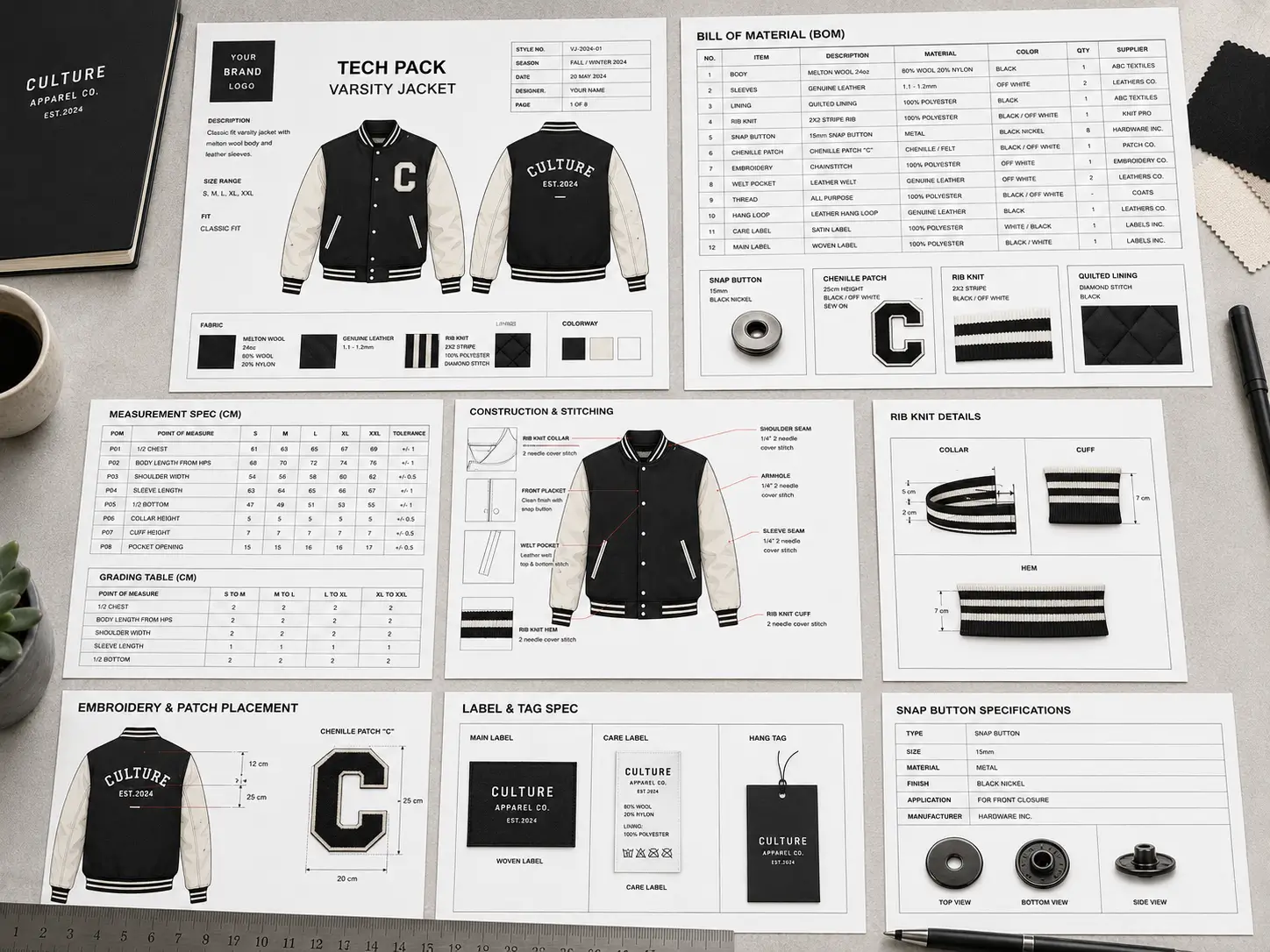
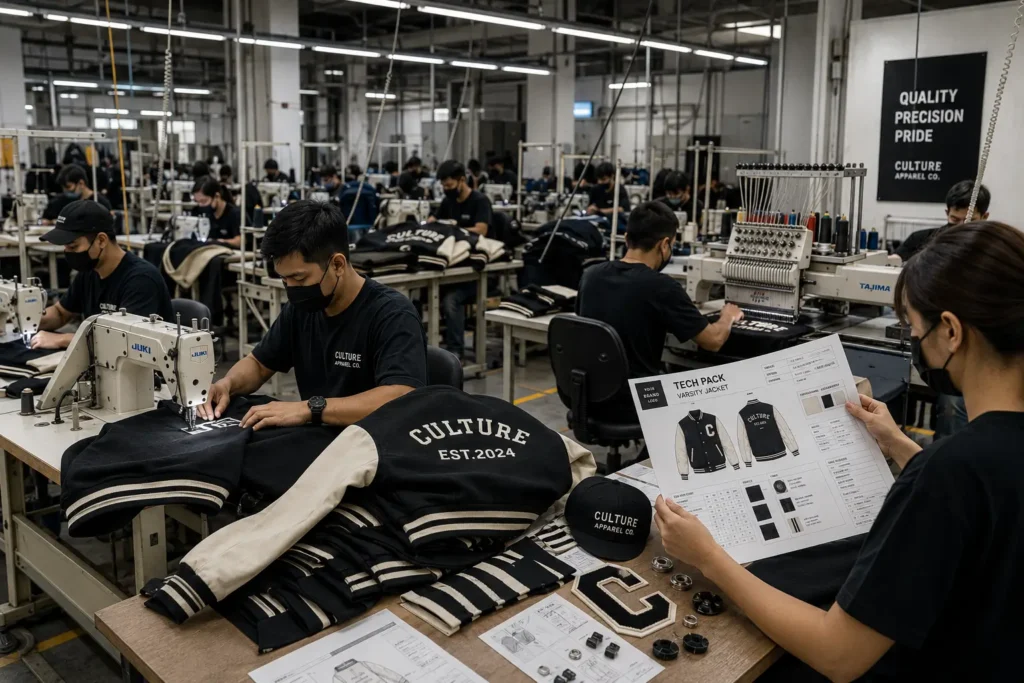
A tech pack is the technical blueprint you hand to a factory so they can manufacture your garment without guessing. In one sentence: a varsity jacket tech pack is a multi-page spec document containing flat sketches, a bill of materials, graded measurements, and construction callouts that tells a cut-and-sew factory exactly how to build your letterman jacket.
It’s the difference between “make it look like this picture” and “cut the wool body at 24oz Melton, attach a 1×1 acrylic rib knit collar, and place the snap closures at these exact intervals.” Factories — especially overseas ones — don’t speak in vibes. They speak in measurements, material codes, and labeled diagrams.
A complete tech pack typically includes:
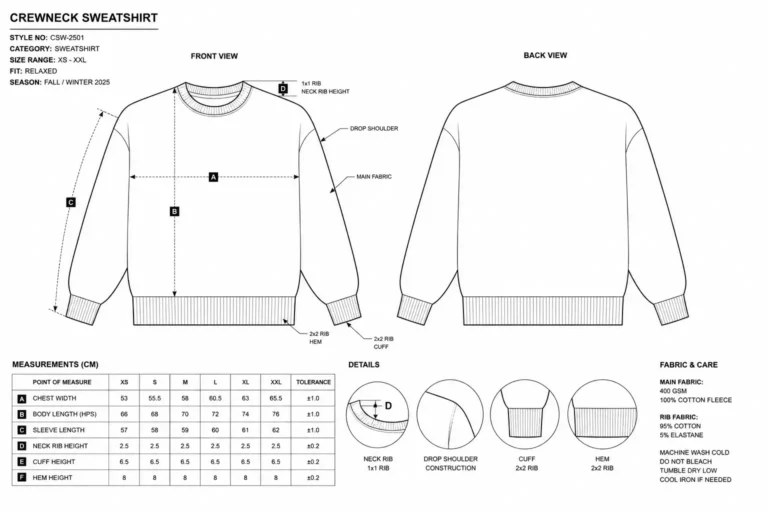
- Flat sketches (front, back, and sometimes side views) showing construction lines
- Bill of materials (BOM) listing every fabric, trim, and notion with supplier specs
- Graded measurement charts across your full size run
- Patch and embroidery placement diagrams with exact coordinates
- Construction and stitch callouts (seam types, topstitching, reinforcement points)
- Colorway pages with Pantone references
Letterman jackets specifically need more detail than a basic tee or hoodie because you’re combining melton wool body panels, leather or vegan leather sleeves, ribbed knit trims at the collar, cuffs, and waistband, metal snap closures, and often chenille patches that require their own callout page. Miss a spec on any one of those and the factory will make an assumption — and it’s rarely the one you wanted.
A solid varsity jacket tech pack prevents that guesswork, which is what keeps your sampling costs down and your timeline on schedule.
DIY Specs vs. Professional Varsity Jacket Clothing Templates
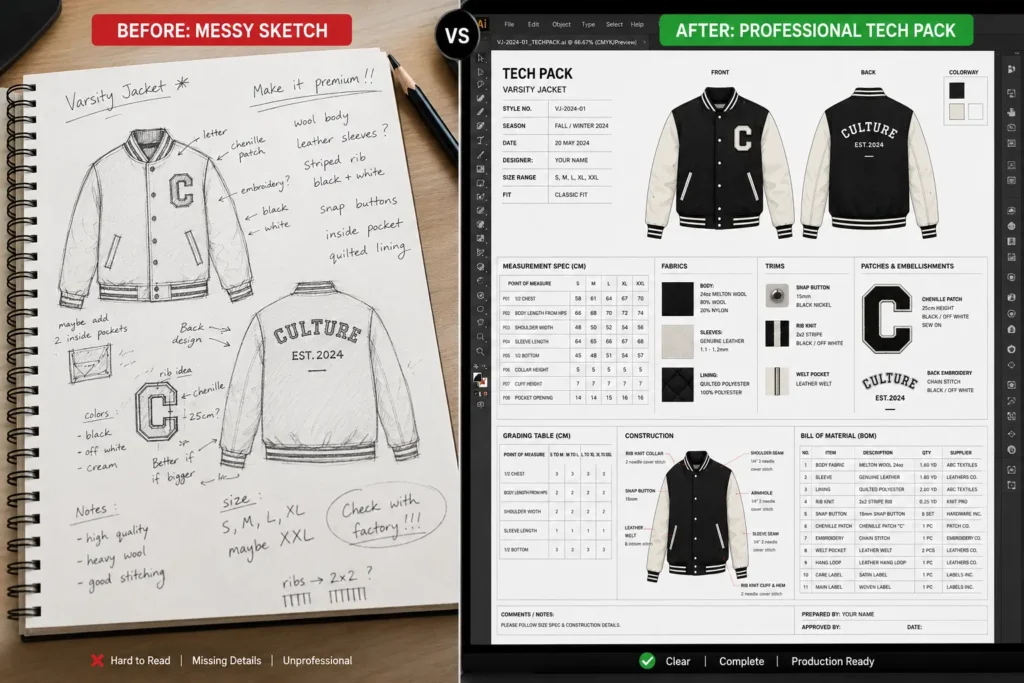
Most first-time brand owners try to build their own spec sheet before realizing how deep the rabbit hole goes. It’s worth being honest about both paths.
Building specs from scratch works fine if you have formal technical design training — pattern grading experience, knowledge of seam allowances, and familiarity with how factories read callouts. If that’s you, skip ahead; you probably don’t need a template.
For everyone else, a pre-made varsity jacket clothing template is the more reliable starting point. You’re not starting from a blank Illustrator file trying to reverse-engineer how to label a drop-shoulder seam — you’re editing fields in a document that’s already been accepted by manufacturers before.
| Factor | DIY From Scratch | Freelance Designer | $14.99 S.i. Graphics Template |
|---|---|---|---|
| Cost | Free (your time) | $50–$150+ per design | $14.99 |
| Turnaround Time | Days to weeks | 3–10 business days | Instant download |
| Accuracy | Variable, depends on skill | High, depends on designer | High, pre-tested format |
| Factory Ready | Often needs revisions | Usually yes | Yes |
💡 Pro Tip: Always specify exact Pantone colors for your chenille patches and ribbing on a dedicated colorway page — factories will substitute the “closest match” in their own swatch book if you leave it ambiguous, and that’s almost never the shade you pictured.
Top 7 Tech Pack Options & Manufacturing Resources
Here’s a full breakdown of the resources available right now, ranked by what they’re actually best for.
1. S.i. Graphics Varsity Letterman Jacket Tech Pack Template — Best Overall Value
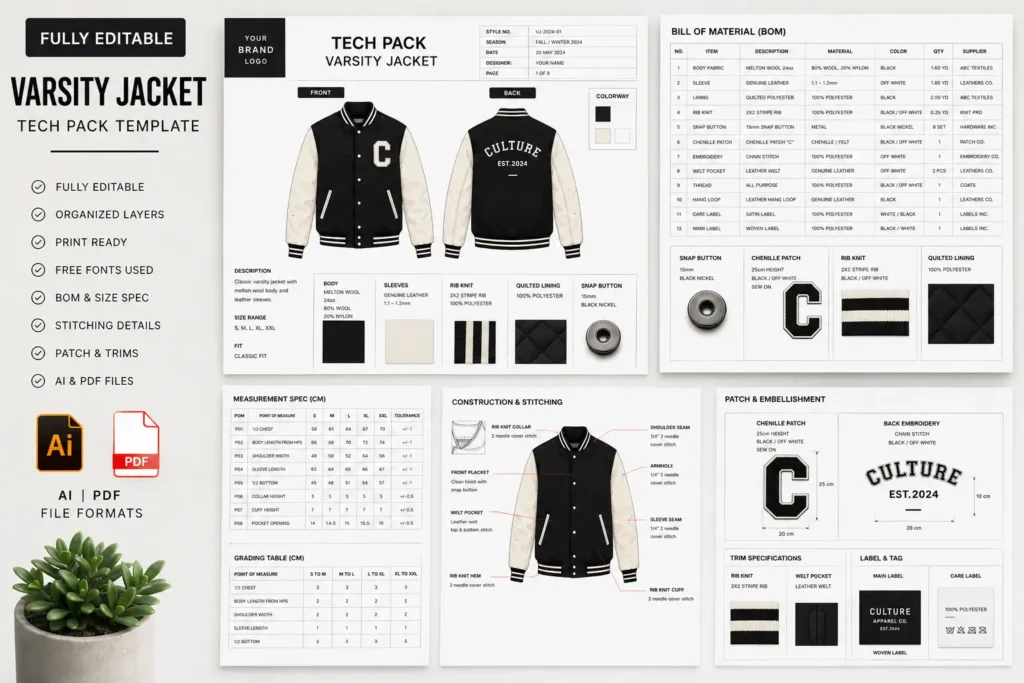
This is a fully built-out varsity jacket tech pack covering flat sketches, a complete BOM, graded measurements, and dedicated patch/chenille callout pages — built specifically around standard letterman jacket construction (Melton wool body, leather sleeves, rib trims, snap closures).
Price: $14.99
What’s included: Editable AI and PDF files, front/back flat sketches, full BOM, size grading chart, patch placement diagram, construction notes
Best for: Streetwear brand owners and apparel startups who need factory-ready letterman jacket manufacturing specs without hiring a technical designer
Pros:
✓ Industry-standard layout factories already recognize
✓ Fully editable in Illustrator — drop in your own logo, colors, and patch art
✓ Instant download, no waiting on a freelancer’s queue
✓ Covers the trim-heavy details (snaps, ribbing, chenille) most generic templates skip
✓ Massive cost savings versus a $150+ custom freelance design
Cons:
✗ Requires basic Illustrator familiarity to customize fields
✗ Not a substitute for a fit sample — you’ll still want to review your first physical sample
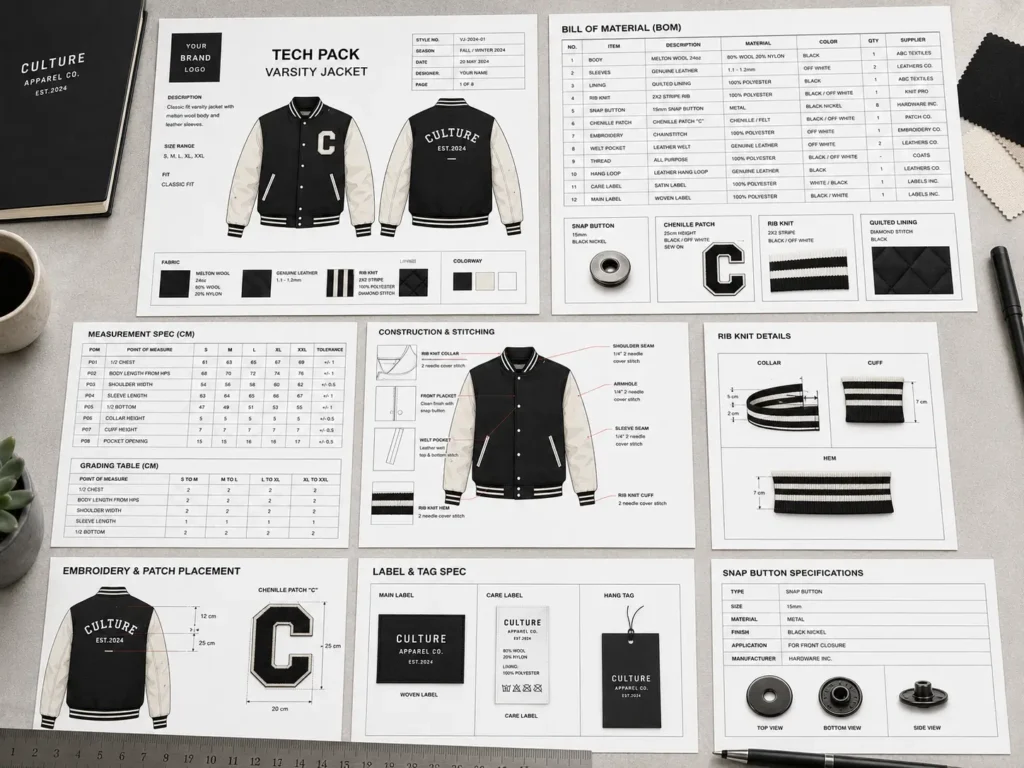
2. S.i. Graphics Complete Tech Pack Library — Best for Complete Brand Scaling
If the varsity jacket is just one piece of a bigger drop, the Mega Bundle includes tech packs for hoodies, tees, joggers, and more alongside the letterman jacket template, all built in the same consistent factory-ready format.
Price: $69.99
What’s included: Varsity jacket tech pack plus a full library of streetwear staple templates (hoodie, crewneck, tee, joggers, cargo pants)
Best for: Brands launching a full collection, not just a single product
Pros:
✓ One consistent spec format across your whole product line
✓ Significant savings versus buying each template individually
✓ Keeps your factory communication uniform across SKUs
✓ All files editable and reusable for future seasons
Cons:
✗ More than you need if you’re only launching one jacket style this season
3. Techpacker (Software) — Best PLM Software for Large Teams
Techpacker is a dedicated PLM (product lifecycle management) platform built for teams managing tech packs across many styles and seasons, with built-in factory collaboration tools.
Price: Monthly subscription
What’s included: Cloud-based tech pack builder, version history, factory comment threads, BOM libraries
Best for: Established brands with a design team managing dozens of SKUs simultaneously
Pros:
✓ Strong for teams collaborating across time zones with factories
✓ Built-in BOM and measurement libraries speed up repeat work
✓ Version control prevents factories from working off outdated specs
Cons:
✗ Recurring cost adds up fast for a single-product launch
✗ Steeper learning curve than a fill-in-the-blank template
4. Fiverr/Upwork Technical Designers — Best for Custom Done-For-You Services
Freelance technical designers will build a tech pack to your exact specifications from a sketch or reference photos.
Price: $50–$150+ per design
What’s included: Custom flat sketches, BOM, and measurements built around your specific design (varies by freelancer)
Best for: Brands with a unique silhouette that doesn’t fit a standard template, and the budget to pay for custom work
Pros:
✓ Fully custom to your exact design vision
✓ Good option for non-standard cuts or hybrid styles
Cons:
✗ Quality varies enormously by freelancer — vetting takes time
✗ 3–10 business day turnaround versus instant template access
5. Adobe Illustrator (DIY) — Best for Trained Technical Designers
If you already have formal technical design experience, Illustrator alone is enough to build flat sketches and callouts from scratch.
Price: $20.99/mo
What’s included: Vector design software (no templates or guidance included)
Best for: Designers who already know seam allowances, grading rules, and factory callout conventions
Pros:
✓ Total creative control
✓ Industry-standard software factories expect files in
Cons:
✗ Steep learning curve if you don’t already have technical design training
✗ No built-in guardrails — easy to miss a required callout
6. Generic Free Tech Pack Templates — Best Free Bare-Bones Option
Free templates exist scattered across design blogs and forums, usually built for basic tees or hoodies.
Price: $0
What’s included: Generic flat sketch layout and a barebones measurement table
Best for: Very early-stage testing where you just need a rough visual reference, not a factory-ready document
Pros:
✓ Zero cost to get started
✓ Fine for internal concept review
Cons:
✗ Almost never include letterman-specific details like snap closure placement or rib trim specs
✗ Most factories will send these back asking for missing information
7. Reputable Cut-and-Sew Factory In-House Design — Best if Money Is No Object
Some factories offer in-house design services and will build the tech pack themselves based on your reference materials.
Price: Usually $150–$300 fee
What’s included: Factory-built spec sheet, often tailored to that specific factory’s production capabilities
Best for: Brands with budget to spare who want the factory itself to own the spec accuracy
Pros:
✓ Built by people who already know that factory’s exact production process
✓ One less handoff between designer and production floor
Cons:
✗ Highest cost option on this list
✗ Specs may be tied to that one factory, less portable if you switch manufacturers later
How to Choose the Right Manufacturing Approach
The right path depends on four things: your budget, your timeline, your skill level, and what your factory actually requires.
Choose the $14.99 template if:
✓ You want industry-standard letterman jacket manufacturing specs instantly ✓ You have (or can learn) basic Adobe Illustrator to drop in your logo and colors ✓ You want to avoid paying $150+ for a freelancer when a proven template covers the same ground
Choose a freelancer if:
✓ Your jacket has a non-standard silhouette a template won’t cover
✓ You have a flexible timeline (one to two weeks)
✓ Budget isn’t the deciding factor
Choose PLM software if:
✓ You’re managing a full product catalog, not a single launch
✓ You need ongoing factory collaboration tools, not a one-time document
Choose factory in-house design if:
✓ You’ve already locked in your manufacturer
✓ You’d rather pay extra for them to own spec accuracy on their own production line
If budget and speed matter most → start with the template. If your design is highly unconventional → go custom with a freelancer. If you’re scaling a full collection → the Complete Tech Pack Library or a PLM tool makes more sense long-term.
Frequently Asked Questions
Do I really need a tech pack to manufacture a varsity jacket?
Yes. Without a tech pack, factories fill in gaps with assumptions — wrong wool weight, wrong rib stretch, misplaced patches. A proper varsity jacket tech pack removes that guesswork and is usually the difference between a correct first sample and a costly second or third round of revisions.
What is included in a letterman jacket manufacturing specs sheet?
A complete spec sheet includes a bill of materials (BOM), graded measurements across your size run, flat sketches, trim callouts (snaps, ribbing, leather sleeve specs), and patch/embroidery placement diagrams. Each element answers a specific question the factory’s pattern maker and cutter will otherwise have to guess at.
How do I specify chenille patches and embroidery in a tech pack?
Use a dedicated callout page with a flat sketch showing exact patch placement measured from a fixed reference point (like the center front seam), paired with vector artwork of the patch design and Pantone color codes. This prevents the factory from eyeballing placement or guessing at thread colors.
What file format do clothing manufacturers need?
Most factories want both an editable AI (Adobe Illustrator) file and a flattened PDF for review and printing. The AI file lets the factory’s team make adjustments if needed, while the PDF is what typically gets printed and pinned at the cutting table.
Can I customize the colors and materials in a pre-made tech pack template?
Yes. A well-built varsity jacket clothing template is fully editable in Illustrator, so you can swap in your own colorways, change body fabric specs, and update trim details without rebuilding the document from scratch.
What’s the difference between a clothing mockup and a tech pack?
A mockup is a marketing visual — it shows what the jacket looks like for social media or a pitch deck. A tech pack is the manufacturing blueprint — it tells the factory how to actually build it. You typically need both, but only the tech pack gets sent to production.
How much does it cost to get a varsity jacket manufactured?
Sampling typically runs $80–$200 per sample depending on materials and factory minimums, while bulk production costs vary widely based on quantity, but commonly land somewhere between $35–$70 per unit for mid-volume runs. Get a quote based on your specific tech pack rather than relying on rough averages.
What are standard materials for a letterman jacket?
Classic letterman construction uses a melton wool body (commonly in the 20–24oz range), genuine or vegan leather sleeves, 1×1 acrylic rib knit trims at the collar, cuffs, and waistband, and metal snap button closures down the front placket.
How do I measure a varsity jacket for sizing?
Key measurement points include chest width, body length, sleeve length, shoulder width, and rib trim width at the collar, cuffs, and waistband. These should be graded across your full size run (typically XS–XXL) and presented in a measurement chart with point-of-measure (POM) codes the factory can reference directly.
Can I use tech packs for local vs. overseas manufacturing?
Yes, the same tech pack format works for both, though overseas factories typically rely more heavily on the written document since there’s less opportunity for in-person clarification. Domestic factories may allow more back-and-forth, but a complete tech pack still speeds up the process either way.
Conclusion
Varsity jackets aren’t slowing down as a streetwear staple, and getting one manufactured correctly comes down to one thing: giving your factory a complete, accurate varsity jacket tech pack instead of a vague reference photo.
A few takeaways to carry forward:
- Letterman jackets need more detail than a basic tee or hoodie because of the material mix — wool body, leather sleeves, rib trims, and chenille patches all need their own callouts
- A pre-made varsity jacket clothing template gets you factory-ready specs in minutes instead of days
- Clear letterman jacket manufacturing specs are what separate a correct first sample from an expensive round of revisions
- Your approach should match your budget and timeline — template, freelancer, software, or factory in-house design all have a place depending on your situation