Design - Create - Grow


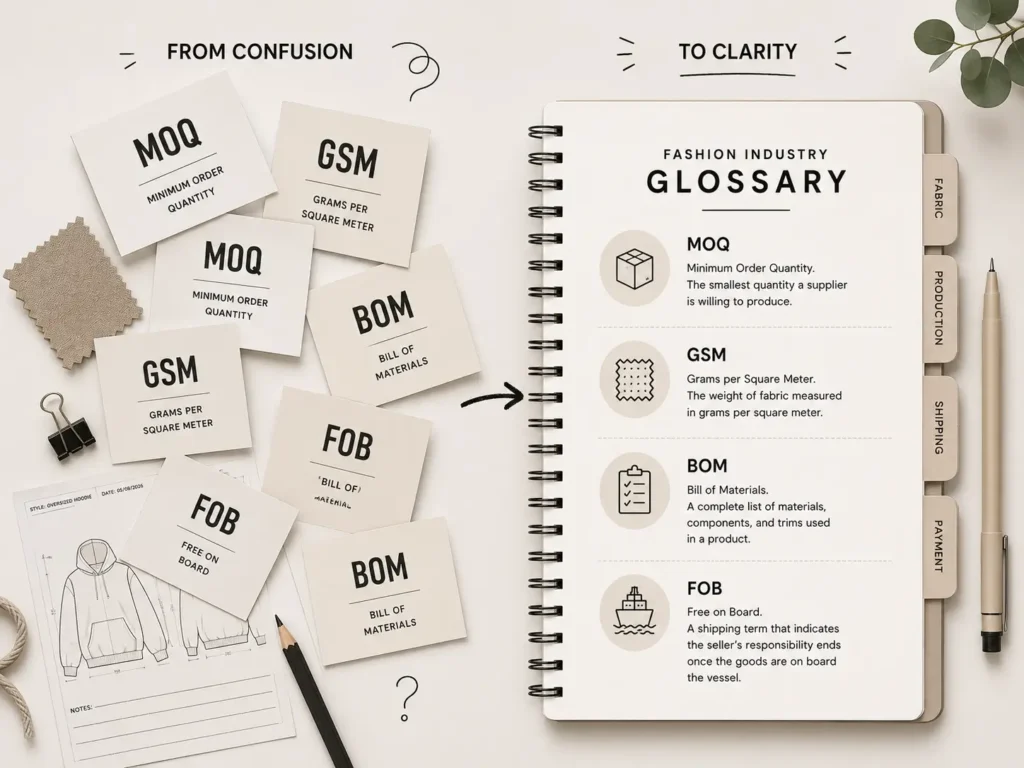
Are you feeling lost in translation when you email a factory? You ask a simple question and get back a reply full of acronyms — MOQ, FOB, CMT — and you have no idea what any of it means. You’re not alone, and it’s not a sign you’re in over your head. It’s a sign nobody handed you a clothing brand terminology guide before you started.
Here’s the expensive part: misunderstanding factory jargon doesn’t just cause confusion. It causes wasted samples, blown timelines, and quotes that don’t mean what you thought they meant. A factory tells you “MOQ is 500 per colorway” and you think that means 500 units total. Now you owe for 1,500.
This clothing brand terminology guide exists so that doesn’t happen to you. Below, you’ll find 50+ terms every founder, designer, and print-on-demand seller moving into cut-and-sew needs to know — from GSM and tech packs to BOMs and grading. Bookmark it. Share it with your team. Pull it up every time a factory email makes your stomach drop.
⚡Quick Bookmark: Press Ctrl+D (or Cmd+D) to bookmark this page! This apparel manufacturing glossary is continually updated as a reference guide for clothing brand founders.
Why Understanding Manufacturing Jargon Matters
When I first started, I lost thousands of dollars because I didn’t understand what CMT meant. I assumed a quote covered fabric. It didn’t. That single misunderstanding ate my entire sample budget for the month.
That’s the real cost of skipping an apparel manufacturing glossary: it’s not academic, it’s financial. Every term you misread becomes a line item you didn’t budget for.
There’s also a respect factor. Factories work with hundreds of brands. When you use the right vocabulary, production managers stop explaining basics and start treating you like a serious client — which means faster replies and more attention to detail.
Here’s what a solid grasp of fashion industry terms for beginners actually buys you:
- ✓ Fewer sampling errors — you specify GSM, colorway, and trims correctly the first time
- ✓ Faster production timelines — factories don’t have to pause and ask clarifying questions
- ✓ Accurate quotes — you know exactly what FOB or CMT pricing does and doesn’t include
- ✓ Stronger negotiating position — you can push back on MOQs or lead times with confidence
- ✓ Fewer wasted samples — clear specs mean the first sample is closer to what you actually wanted
💡 Pro Tip: Keep a running document of every new term a factory uses that you don’t recognize. Look it up immediately. Within two or three projects, you’ll have your own working glossary.
The Most Critical Acronyms
Before the full A-Z list, let’s slow down on the acronyms that trip up almost every new founder. If you only remember three things from this fashion industry terms for beginners crash course, make it these.
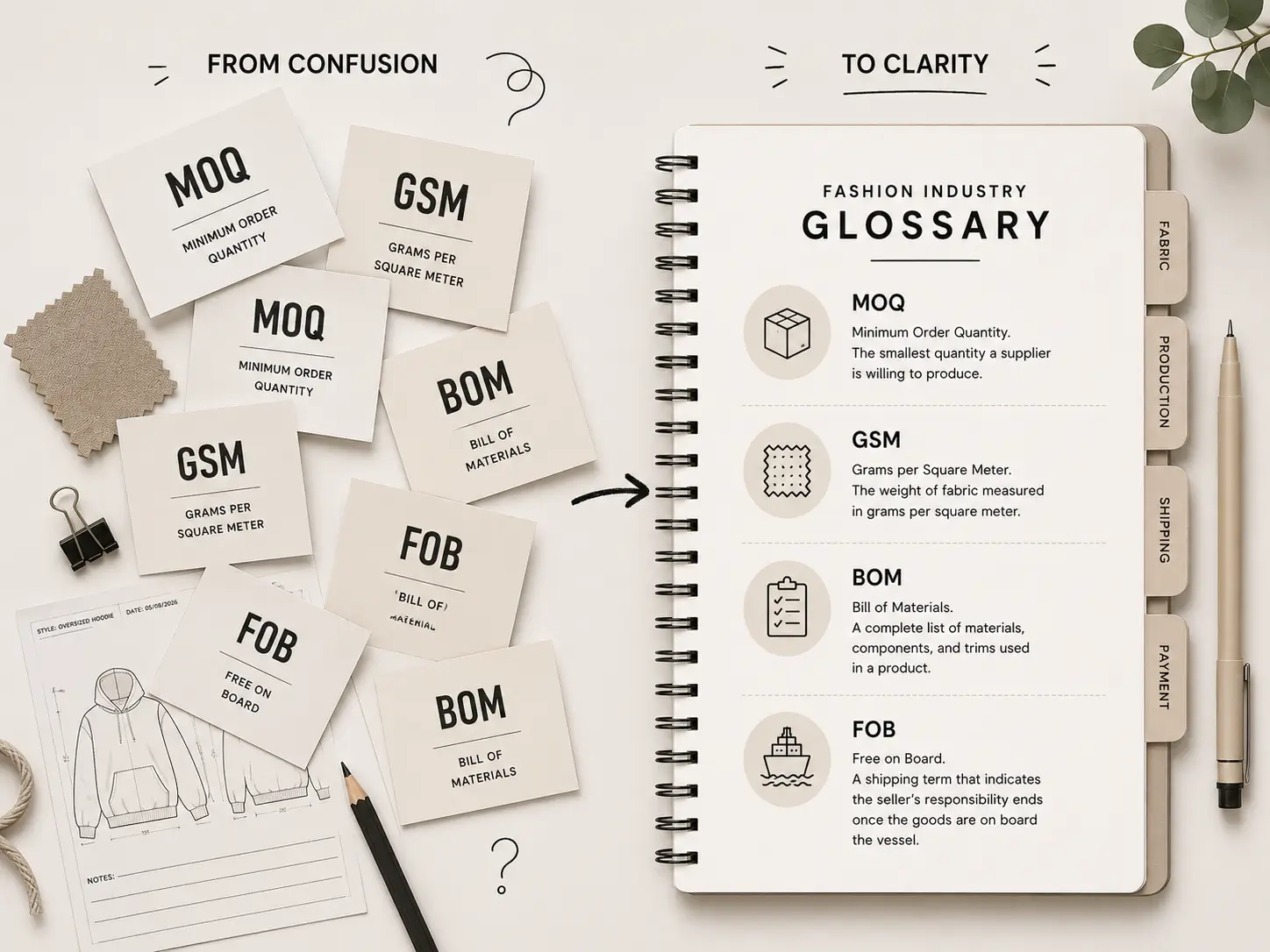
MOQ (Minimum Order Quantity) is the smallest amount a factory will produce per style, and often per colorway. MOQs vary wildly — domestic cut-and-sew shops might run as low as 25-50 units, while overseas factories often start at 300-1,000+. Always ask “is that MOQ per style or per colorway?” before you commit.
BOM (Bill of Materials) is the itemized list of every component in a garment: shell fabric, lining, thread, zippers, labels, trims, packaging. If you ask for a sample without providing a BOM, factories will guess your fabric and trims, which almost always leads to wasted time and a sample that doesn’t match what’s in your head.
GSM (Grams per Square Meter) measures fabric weight and density. A 180 GSM cotton tee feels light and drapey; a 240 GSM tee feels structured and substantial. Get this wrong and your “premium heavyweight hoodie” comes back feeling like a beach cover-up.
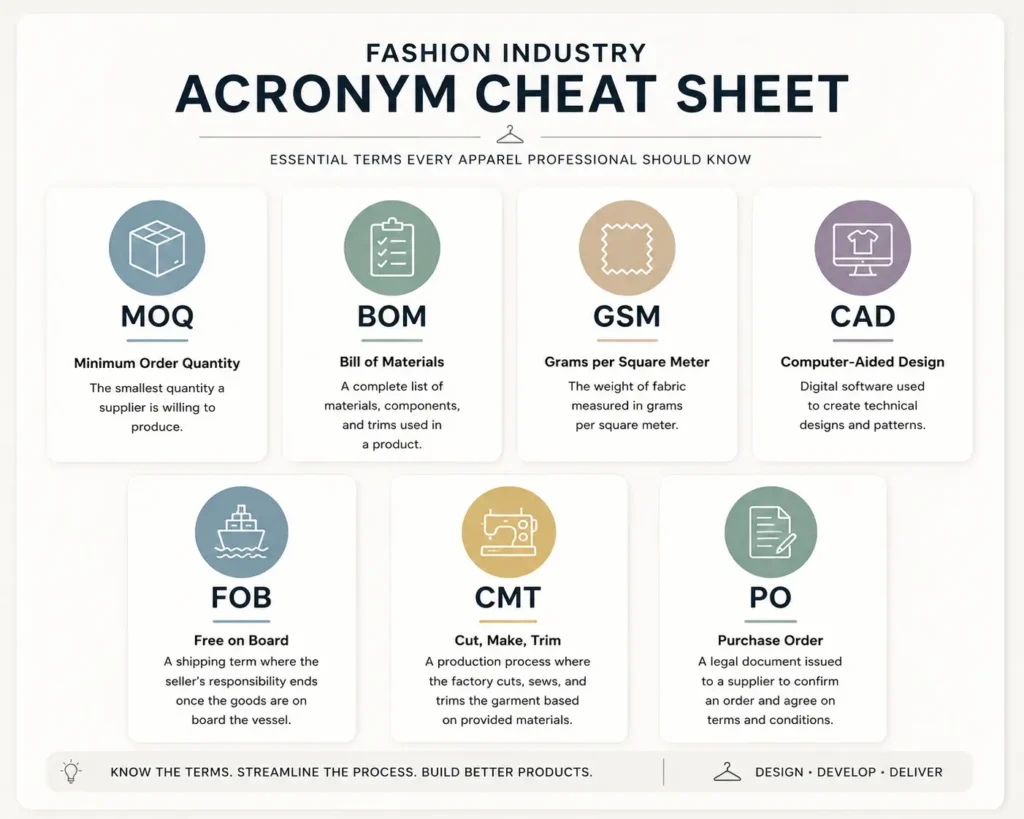
Other acronyms — CAD, FOB, CMT, PO — show up constantly too, and mixing them up is one of the fastest ways to misread a quote. Here’s a cheat sheet to keep handy.
Acronym Cheat Sheet
| Acronym | Full Term | Layman’s Translation |
|---|---|---|
| MOQ | Minimum Order Quantity | The smallest amount the factory will make for you |
| BOM | Bill of Materials | Full ingredient list for the garment |
| GSM | Grams per Square Meter | How heavy/thick the fabric is |
| CAD | Computer-Aided Design | The digital pattern/design file |
| FOB | Free on Board | Price covers production; you pay shipping after it leaves port |
| CMT | Cut, Make, Trim | Factory only charges labor — you supply the fabric |
| PO | Purchase Order | The official, binding order document |
With those fundamentals locked in, here’s the full reference list.
The Ultimate Glossary for Clothing Brands
Terms are grouped by where they show up in the production process: Design, Sourcing & Materials, and Manufacturing & Production. Every entry strictly explains the term in plain language first.
Design Phase
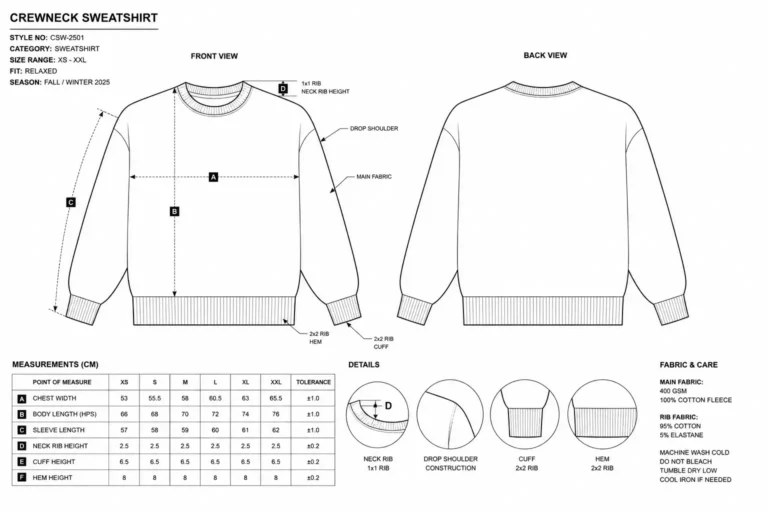
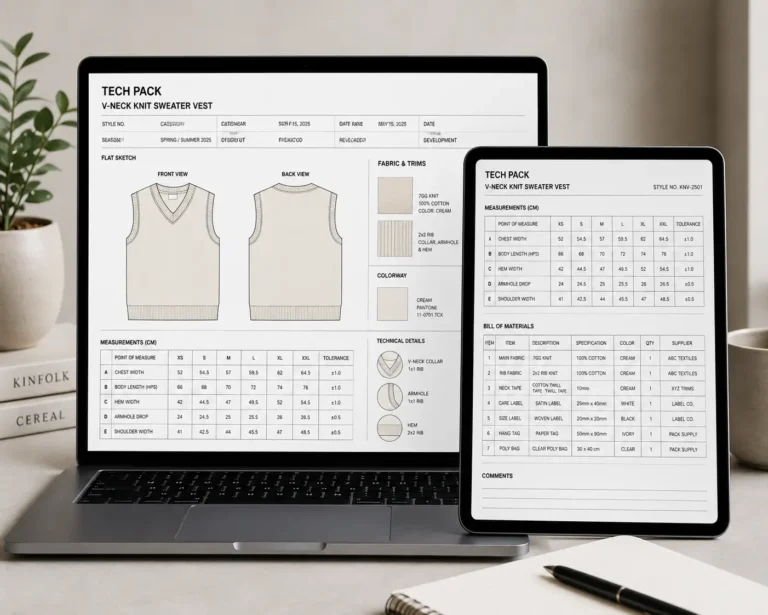
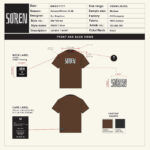
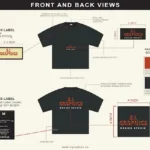
Tech Pack (Technical Package): A tech pack is the master document that tells a factory exactly how to build your garment — measurements, materials, construction details, trims, and artwork placement, all in one file. Without one, a factory builds from guesswork, and guesswork is where your budget disappears.
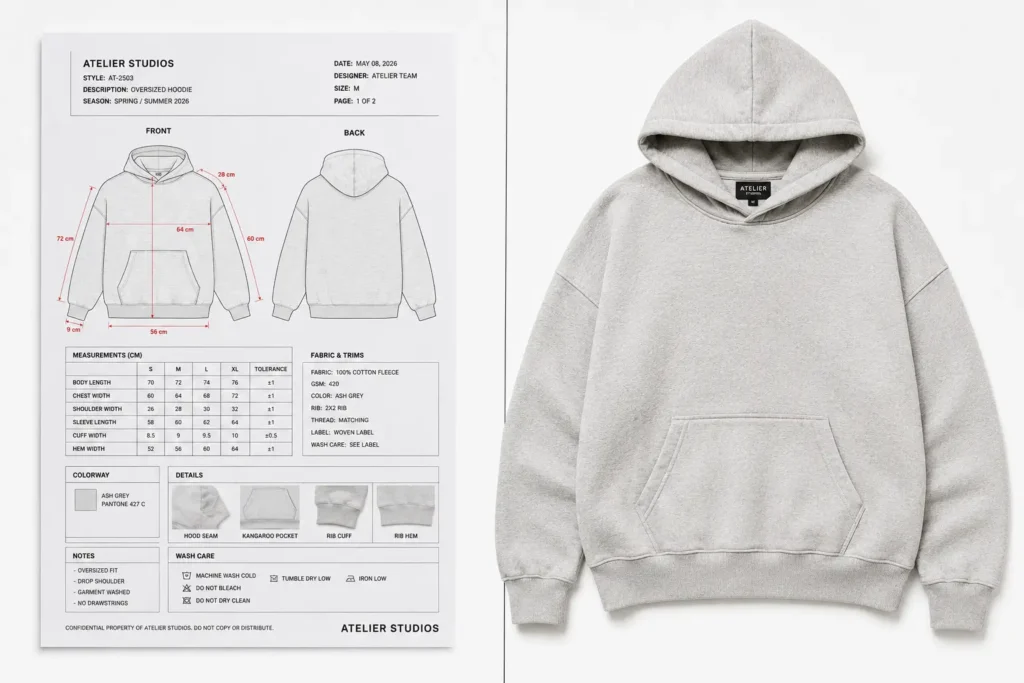
💡 Pro Tip: Never assume a factory knows your sizing. Always include a graded measurement spec sheet inside your tech pack.
A complete, factory-ready tech pack is genuinely the single highest-leverage document you can hand to a manufacturer — it’s the difference between three rounds of confused sample revisions and getting it right the first time. If building one from scratch feels overwhelming, the Techpack Mega Bundle gives you pre-built, editable templates so you’re not starting from a blank page. Grab the Techpack Mega Bundle and skip the blank-page problem.
CAD (Computer-Aided Design): This is the digital flat sketch or pattern file used to communicate a garment’s exact shape, seams, and proportions before it’s cut. Factories use CAD files alongside your tech pack to set up cutting patterns.
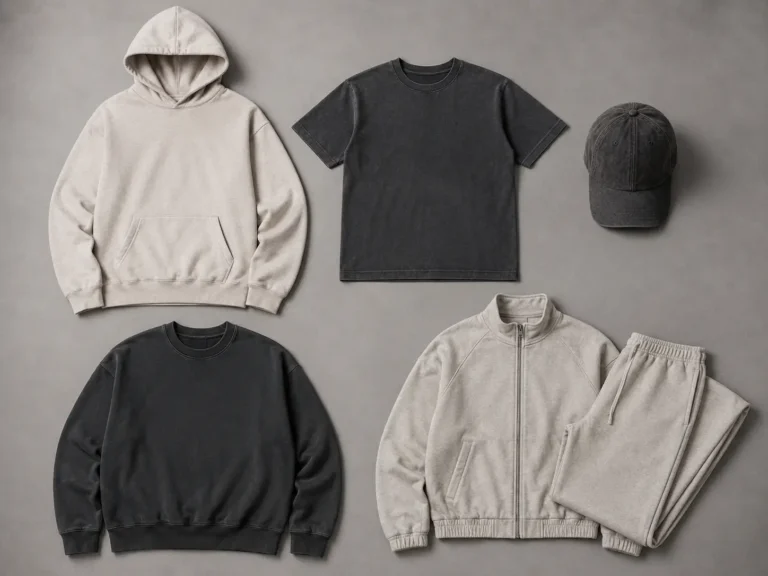
Mockup: A mockup is a digital, photorealistic preview of your design rendered onto a flat or 3D garment template — it shows colors, placement, and print scale without anything being physically sewn. Mockups let you test a dozen design directions in an afternoon instead of waiting weeks for physical samples of each one.
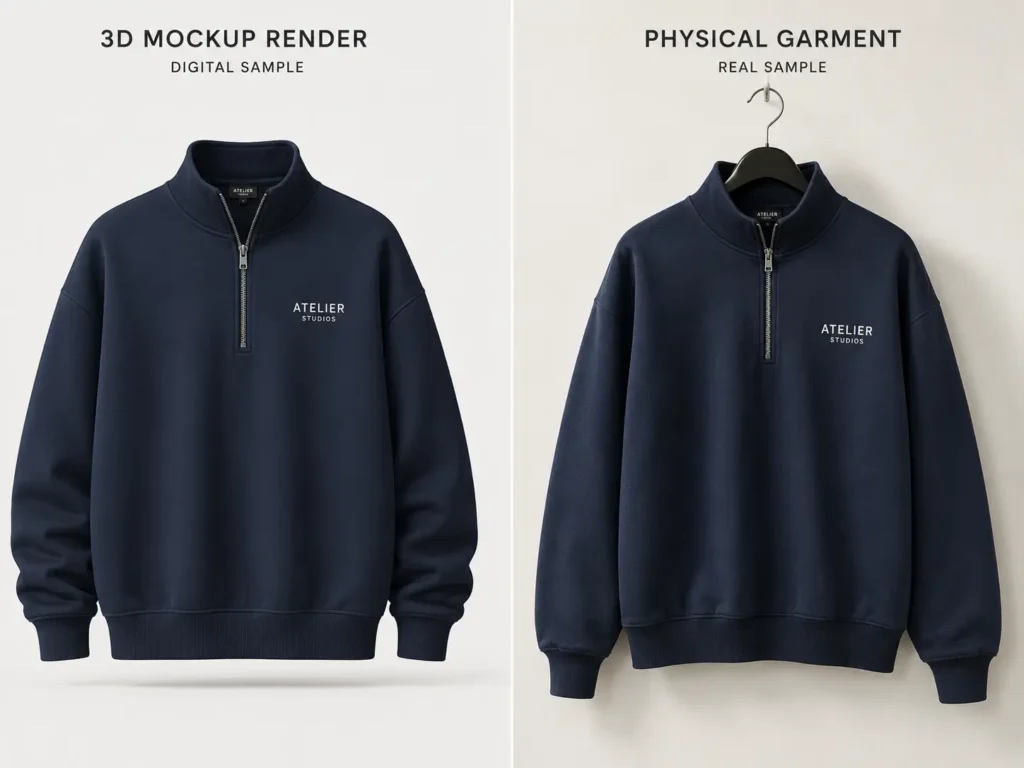
💡 Pro Tip: Send your factory both the flat mockup AND the tech pack — mockups show what it should look like, tech packs show how it should be built. They’re not interchangeable.
Before you spend a single dollar on physical samples, a clean mockup tells you whether a design is even worth producing. The Starter Bundle is built exactly for this — ready-to-use mockup templates so you can visualize designs and get buy-in before committing to real fabric. Download the Starter Bundle to mockup designs before you spend on samples.
Flat Sketch: A simple line drawing showing the garment from front and back, used as the base reference inside a tech pack.
Colorway: A colorway is a specific combination of colors applied to one design — the same hoodie style might come in a black/white colorway, a navy/cream colorway, and so on. Each colorway can affect your MOQ, since some factories require a minimum per colorway, not just per style.
Repeat (Print Repeat): In all-over print design, the repeat is the pattern unit that tiles seamlessly across fabric. Get the repeat size wrong and you’ll see visible seams or pattern breaks at the shoulder and side seams.
Croquis: A basic body template used as tracing paper for fashion sketches, helping designers keep proportions consistent across a collection.
Mood Board: A curated collage of colors, textures, and references used to communicate the aesthetic direction of a collection to a design team or factory.
Spec Sheet (Specification Sheet): The measurement chart inside a tech pack listing exact dimensions — chest width, body length, sleeve length — for every size in your range. This is what a factory grades from.
Trim: Anything that isn’t the main fabric: zippers, buttons, drawcords, woven labels, hang tags. Trims are listed individually in your BOM.
Sourcing & Materials
GSM (Grams per Square Meter): Covered above — this is the standard unit for fabric weight. Lighter fabrics (under 150 GSM) suit summer tees; midweight (180-220 GSM) suits everyday basics; heavyweight (280+ GSM) suits structured hoodies and outerwear.
BOM (Bill of Materials): Covered above — your itemized component list. Think of it as the recipe; without it, nobody can cook the dish you have in mind.
Fabric Composition: The percentage breakdown of fibers in a fabric, like 100% cotton or 80% cotton/20% polyester. This affects shrinkage, drape, durability, and printability — always confirm it before approving fabric.
Swatch: A small physical fabric sample sent for approval before bulk fabric is purchased. Always request swatches before committing to yardage; photos online rarely match real color and hand-feel.
MOQ (Minimum Order Quantity): Covered above — the floor for how much a factory will produce.
Lead Time: The total time from order confirmation to finished goods being ready to ship. Lead times vary by factory load and season — always get this in writing, not verbally.
Sourcing Agent: A third party who finds and vets factories on your behalf, often for a commission or flat fee. Useful for new founders without existing factory relationships, especially overseas.
Vertical Integration: When a single factory handles multiple stages in-house — knitting, dyeing, cutting, sewing — instead of outsourcing each step. Vertically integrated factories often offer better quality control and shorter lead times.
Greige Fabric: Unfinished, undyed fabric straight off the loom or knitting machine, before dyeing or treatment. Greige goods are typically cheaper but require extra processing steps.
Deadstock Fabric: Leftover fabric from other brands’ production runs, often sold at a discount. Great for small-batch or sustainable lines, but quantities are limited and rarely repeatable.
Manufacturing & Production
Cut and Sew: Cut and sew refers to producing a garment entirely from your own custom patterns and fabric, rather than starting from a blank existing blank garment. This is the natural next step for print-on-demand sellers who want true ownership of fit and silhouette instead of decorating someone else’s blank.
CMT (Cut, Make, Trim): A pricing model where the factory only charges for labor — cutting, sewing, and trimming — while you supply the fabric and trims yourself. CMT quotes are often lower, but you take on the sourcing work and risk.
FOB (Free on Board): A pricing model where the factory’s quote covers the finished product up to the point it’s loaded onto a shipping vessel at the port. Once it’s “on board,” shipping, duties, and insurance become your responsibility.
Tech Fit / Grading: Grading is the process of scaling a base pattern up or down across a size range while keeping proportions consistent. A “tech fit” session is where you and the factory review a sample on a fit model and adjust the pattern before grading begins.
Sample: A physical, sewn garment made to test fit, construction, and fabric before bulk production. Unlike a mockup, a sample is real — you can touch it, try it on, and wash-test it.
Proto Sample (Prototype): The very first physical version of a new design, usually rough, used to confirm the silhouette works before investing in pattern grading.
Fit Sample: A sample made specifically to evaluate how a garment fits on a body, usually in one middle size before grading to the full range.
Pre-Production Sample (PP Sample): The sample made right before bulk production starts, using the final approved fabric, trims, and construction — your last checkpoint to catch errors before hundreds of units are cut.
Top of Production Sample (TOP Sample): A sample pulled from the very first units of the actual bulk run, sent for your final sign-off that production matches what was approved.
Pattern Maker: The person (or factory department) who translates your design and measurements into the actual paper or digital pattern pieces used for cutting fabric.
Marker: The layout plan showing how pattern pieces are arranged on fabric to minimize waste during cutting. An efficient marker can meaningfully lower your per-unit fabric cost.
Cutting Ticket: Factory paperwork specifying how many layers of fabric to cut, in which sizes, and in which colorway, generated directly from your spec sheet and order quantities.
Bulk Production: The full manufacturing run after samples are approved — this is when your actual order quantities get cut, sewn, and finished.
QC (Quality Control): Inspection of garments at various stages — often during production (in-line QC) and before shipping (final QC) — to catch defects before they reach you or your customers.
AQL (Acceptable Quality Limit): A statistical standard used during QC inspections that defines how many defects in a sample batch are acceptable before an entire shipment is rejected.
PO (Purchase Order): The official, binding document confirming what’s being made, in what quantities, at what price, and by what date. Nothing should go into production without a signed PO.
Deposit / Balance Payment: Most factories require a deposit (often 30-50%) to start production, with the balance due before or after shipping. Always confirm payment terms in writing before sending a deposit.
Incoterms: Internationally standardized shipping terms (like FOB, EXW, DDP) that define exactly where responsibility for cost, risk, and logistics shifts from seller to buyer.
EXW (Ex Works): A pricing model where the factory’s price covers only the goods themselves, picked up at their door — you arrange and pay for all shipping from that point.
DDP (Delivered Duty Paid): A pricing model where the factory’s quote includes everything — production, shipping, customs, and duties — delivered to your door.
Private Label: Manufacturing a product using a factory’s existing base design or pattern, then branding it as your own — faster and cheaper than cut and sew, but less differentiated.
White Label: Similar to private label, but typically refers to a generic, unbranded product you customize with your own labels and packaging without altering the design at all.
Hang Tag: The printed tag attached to a finished garment (usually with a string) showing branding, size, and price — distinct from the sewn-in care label.
Care Label: The small fabric label sewn inside a garment listing fabric composition and washing instructions — often a legal requirement, not just a branding choice.
Poly Bag: The individual plastic packaging a finished garment is folded and sealed into before shipping, often printed with your logo.
Packing List: A shipment document listing exactly what’s inside each box or carton — styles, sizes, colors, and quantities — used by customs and your warehouse to verify the order.
Shrinkage: The percentage a fabric contracts after washing, which pattern makers must account for when grading so finished garments still fit correctly after the customer’s first wash.
Pilling: Small fuzzy balls that form on fabric surface from friction and washing — a common quality complaint, especially with lower-GSM or loosely-knit fabrics.
Hand Feel: Industry term for how a fabric physically feels to the touch — soft, crisp, stretchy — something photos can never communicate, which is exactly why swatches matter.
Drape: How a fabric falls and moves on the body — fluid and draping versus stiff and structured. Drape affects silhouette as much as the actual pattern does.
Seam Allowance: The extra fabric beyond a stitch line, left so pieces can be sewn together without the finished garment coming out smaller than intended. Pattern makers build this into every piece.
Self Fabric: Refers to using the same main fabric for an additional component, like a self-fabric collar instead of a contrasting trim — common terminology you’ll see in a BOM.
That’s 50+ terms covering design, sourcing, and production — but the list keeps growing as the industry evolves, so bookmark this page and check back.
How to Communicate Effectively With Manufacturers
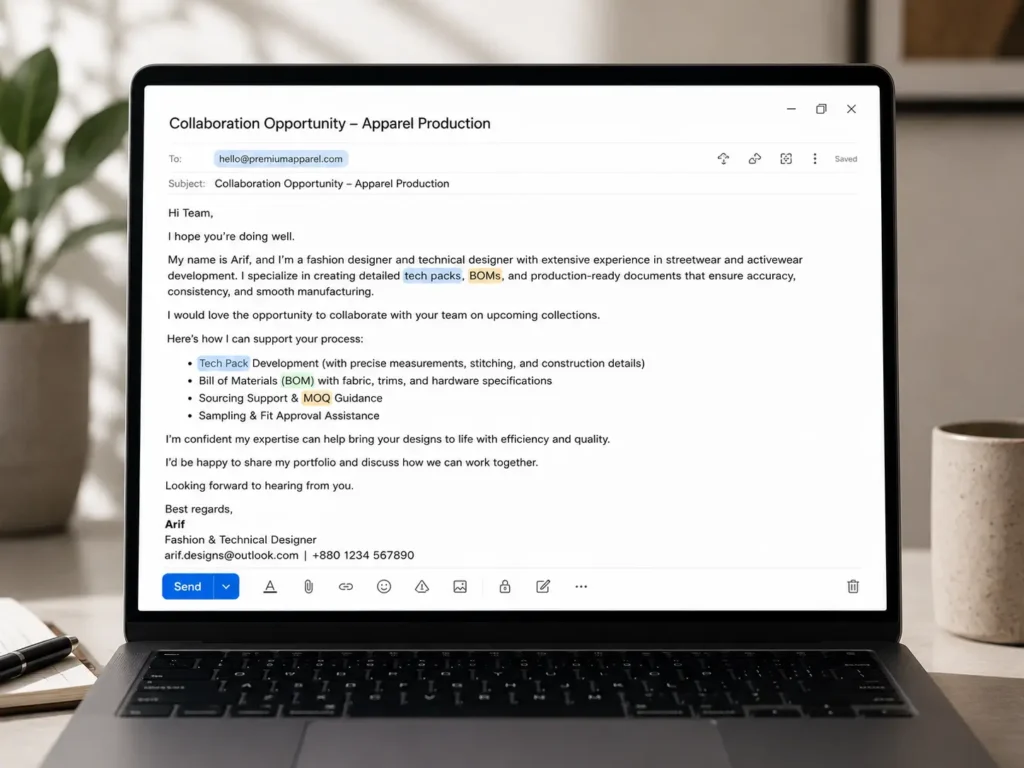
Knowing the terms is half the battle. Using them correctly in your first email is what actually gets you a fast, accurate reply instead of a week of back-and-forth.
Here’s what every first outreach email to a factory should include:
- ✓ Your product type and rough order quantity range
- ✓ A tech pack (even a rough one) attached, not just described
- ✓ A BOM specifying fabric composition and GSM
- ✓ Your target MOQ and whether that’s flexible per colorway
- ✓ Timeline — when you need a sample and when you need bulk production
- ✓ Your location, for shipping/Incoterm context (FOB vs. DDP, etc.)
💡 Pro Tip: Attach files instead of describing them in the email body. A factory rep reading “200gsm cotton, navy and black colorways” in plain text will interpret it differently than seeing it laid out in a BOM. Don’t make them guess.
Here’s a mini-template you can adapt:
Subject: Production Inquiry — [Your Brand] Custom Hoodie
Hi [Factory Name],
We’re a new apparel brand looking to produce a custom cut-and-sew hoodie. I’ve attached our tech pack and BOM, which include our target GSM (280), fabric composition (80/20 cotton-poly fleece), and two initial colorways (black, heather grey).
Could you confirm:
- Your MOQ per colorway
- Estimated FOB pricing at 300, 500, and 1,000 units
- Lead time from PO confirmation to bulk shipment
- Your standard payment terms (deposit %, balance due date)
Happy to send swatches or samples for reference if helpful. Looking forward to your quote.
Best, [Your Name]
Notice how that email uses BOM, GSM, MOQ, and FOB naturally and specifically — not as buzzwords, but as precise asks. That’s the difference between a factory treating you as a serious client versus a hobbyist tire-kicker.
Frequently Asked Questions
What is the most important document to give a clothing manufacturer?
The tech pack is the single most important document — it’s the blueprint that tells a factory exactly how to build your garment, including measurements, materials, and construction details. Without one, factories guess and guessing leads to costly sample revisions. If you don’t have one yet, the Techpack Mega Bundle gives you ready-to-edit templates so you’re not building from a blank page.
What does MOQ mean and can it be negotiated?
MOQ (Minimum Order Quantity) is the smallest quantity a factory will produce for a given style or colorway. Yes, it’s often negotiable — especially if you’re willing to pay a higher per-unit price, reduce your colorway count, or work with a smaller domestic factory. Always ask directly rather than assuming the first number quoted is final.
How do I know what GSM fabric to choose?
GSM depends on the garment type and season. Lightweight tees typically run 140-180 GSM, everyday basics sit around 180-220 GSM, and heavyweight hoodies or outerwear often start at 280+ GSM. The best approach is requesting swatches at a few different GSMs and physically comparing hand-feel before committing.
What’s the difference between a mockup and a sample?
A mockup is a digital, photorealistic preview of your design — useful for visualizing colors and placement before spending money. A sample is a physical, sewn garment you can touch and try on. Use mockups (like those in the Starter Bundle) early to test ideas cheaply, then move to physical samples once a direction is locked in.
Why is a Bill of Materials (BOM) necessary?
A BOM itemizes every component in your garment — fabric, trims, labels, zippers — so a factory doesn’t have to guess. Without one, factories fill in the blanks themselves, and what comes back rarely matches what you pictured. It also makes costing and re-orders far more accurate down the line.
How long does it typically take to get a sample from a factory?
Sample turnaround typically ranges from 1-3 weeks domestically and 3-6 weeks overseas, depending on fabric availability and factory workload. Lead times stretch significantly during peak seasons, so always ask for a current estimate rather than relying on a number from months ago.
Do I need a sourcing agent to work with overseas factories?
Not always, but a sourcing agent can be valuable if you have no existing factory relationships, don’t speak the local language, or want someone vetting quality on the ground. Many founders start without one and bring an agent on once order volume justifies the cost.
Conclusion
Mastering this clothing brand terminology guide is your first real step toward building a brand that factories take seriously — and stop guessing on your behalf.
A few things worth remembering:
- ✓ A complete tech pack and BOM prevent the vast majority of sampling mistakes
- ✓ GSM and colorway specifics should always be confirmed before fabric is cut
- ✓ MOQ, FOB, and CMT define what you’re actually paying for — read your quotes carefully
- ✓ Mockups save money before samples; samples confirm what mockups can’t
Bookmark this page — apparel manufacturing terminology evolves, and you’ll want a fast reference the next time a factory email leaves you stuck.
Ready to put this into practice? Start with the Techpack Mega Bundle to build a factory-ready tech pack without starting from scratch or grab the Starter Bundle to mock-up your designs before spending a dollar on physical samples.