Design - Create - Grow


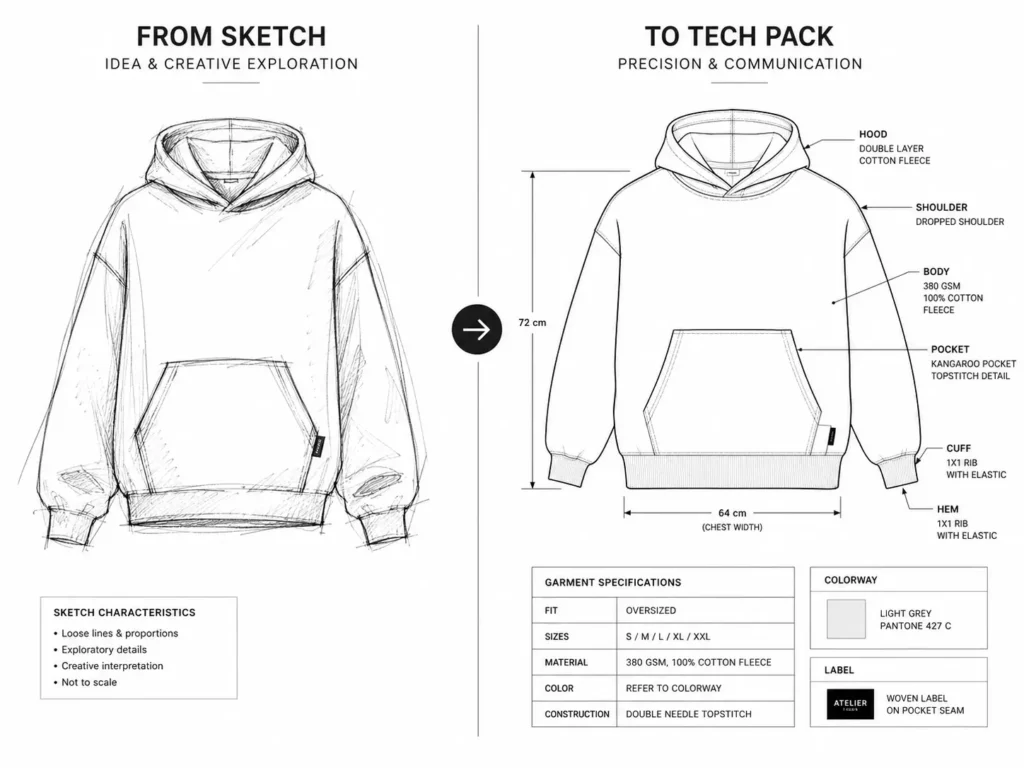
If you’re preparing to send your designs to a manufacturer, you’re probably asking yourself one question on repeat: what is included in a fashion tech pack, exactly? You’re not alone. Most first-time founders learn the hard way — after a $400 sample comes back in the wrong color, with the wrong stitch type, missing the label entirely.
That single miscommunication can cost weeks of production time and hundreds of dollars in wasted sampling fees. Multiply that across three or four “fix it and resend” rounds, and a small collection can rack up thousands of dollars in avoidable rework before a single unit ships.
So exactly what is included in a fashion tech pack that prevents this? In short: every technical detail a factory needs to build your garment correctly on the first attempt — sketches, measurements, materials, construction notes, and more.
In this guide, we’ll walk through the complete page-by-page breakdown of a professional tech pack, so you know precisely what to include, what factories expect to see, and where most DIY tech packs fall apart.
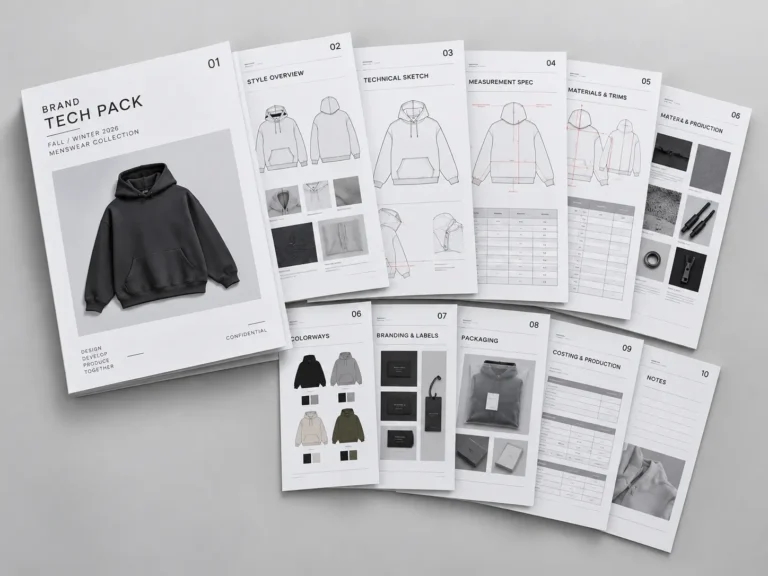
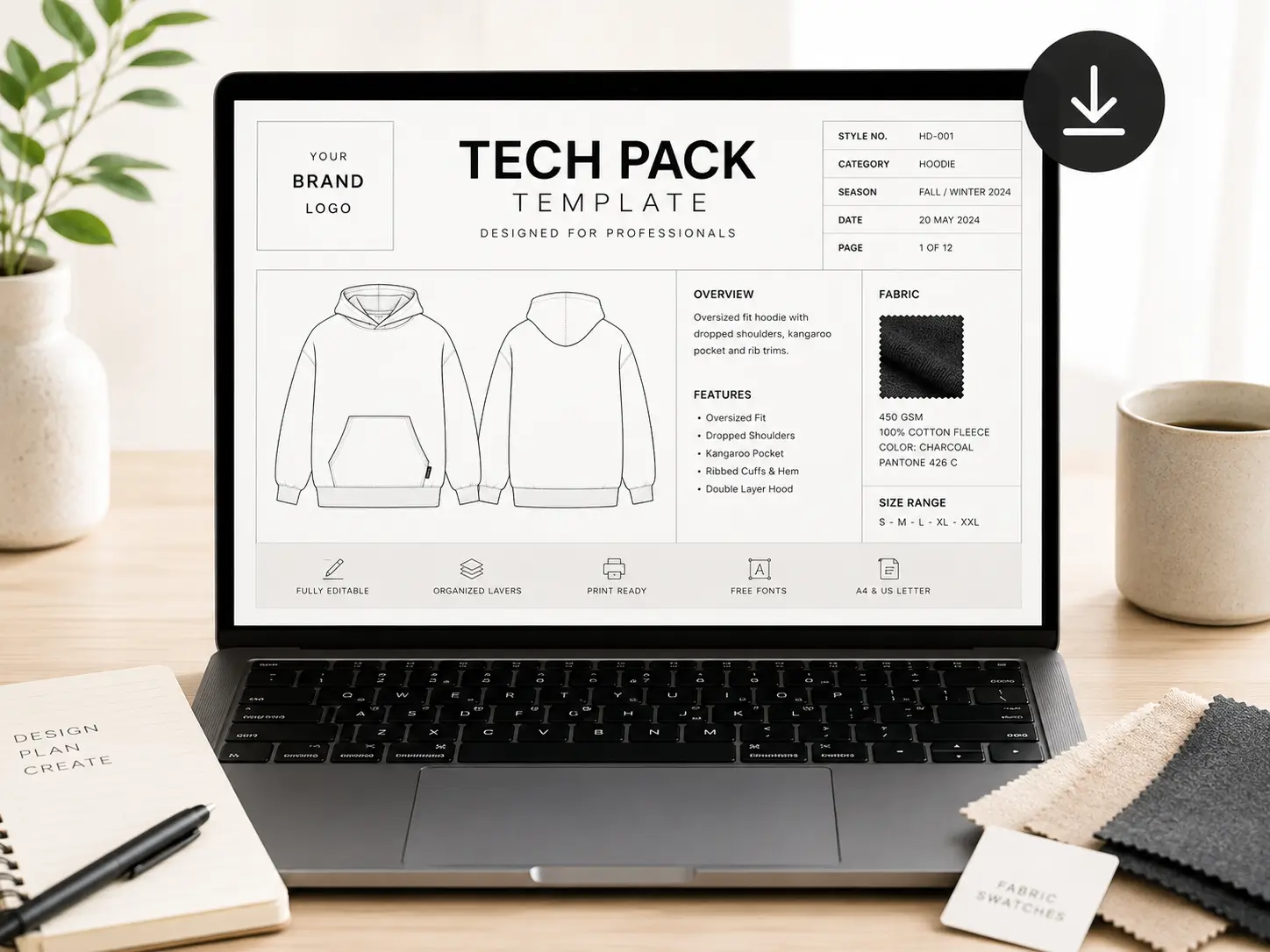
Quick Answer: A standard professional tech pack includes a cover page with technical flat sketches, a Bill of Materials (BOM) listing every fabric and trim, a graded measurement spec sheet with Point of Measure (POM) callouts, construction and stitch detail pages, colorway and artwork specs, labeling/packaging placement, and a fit comment/revision history log. Each page answers a specific question the factory will otherwise have to guess at.
Table of Contents
Why Your Brand Needs a Fashion Tech Pack
A fashion tech pack is the technical document set that translates your design idea into instructions a factory can actually produce — think of it as the blueprint for your garment. Without it, your manufacturer is left guessing at measurements, materials, and construction details.
If you’re new to the concept, start with our complete beginner’s guide to what a tech pack is before diving into the individual sections.
A complete tech pack isn’t optional paperwork — it’s risk management for your production budget. Brands that submit thorough, professional tech packs consistently see:
- Fewer sampling rounds — clear specs mean the factory gets closer to your vision on round one instead of round three.
- Thousands of dollars saved in wasted fabric, shipping, and labor on rejected samples.
- Accurate cost quoting — factories price based on what’s written down, not what you meant to say.
- Faster turnaround times — no back-and-forth emails clarifying basic construction questions.
- Consistent quality across every production run and every reorder.
Once your tech pack is ready, the next step is knowing exactly what to send and how to communicate your specifications to the factory. See our guide to communicating with clothing manufacturers for the complete process.
💡 Pro Tip: Always send your tech pack as a locked PDF alongside an editable source file. Factories print and annotate PDFs on the floor — if your file shifts or reflows, your callouts can end up pointing at the wrong seam.
The Page-by-Page Breakdown: What Is Included in a Fashion Tech Pack
This is the tech pack pages breakdown every founder needs before approaching a factory. Each page below carries its own weight — skip one, and you’re opening the door to a specific, predictable type of factory error.
1. Cover Page & Technical Sketch (Flats)
The cover page is the factory’s first impression of your garment, and it needs to communicate the silhouette instantly — no guesswork.
What must be on this page:
- Front and back technical flat sketches (not fashion illustrations — flat, proportionally accurate line drawings)
- Style name and style number
- Season/collection name
- Fabric swatch or fabric name reference
- Designer and date of last revision
Why it’s critical: Without accurate technical sketches, factories default to interpreting your design from a flat photo or rough drawing. Proportions get distorted, seam placement gets guessed, and you receive a sample that resembles your idea but isn’t actually it.
2. Bill of Materials (BOM)
The Bill of Materials (BOM) is the single most expensive page to get wrong, because it directly determines your production cost and sourcing accuracy.
What must be on this page:
- Every fabric, with composition, weight (GSM), and supplier reference
- All trims: zippers, buttons, elastic, drawcords, interfacing
- Thread type and color codes
- Placement notes for each material (main body vs. lining vs. binding)
- Consumption estimates per component
Why it’s critical: A missing trim entry means the factory substitutes whatever is on hand — often a lower-quality button or a mismatched zipper pull. An incomplete BOM is also why so many founders get cost quotes that balloon later; the factory simply didn’t know about a material until production was underway.
3. Colorways & Print/Artwork Specifications
This page tells the factory exactly which colors go where, and how any prints, embroidery, or graphics should be applied.
What must be on this page:
- Pantone or fabric-specific color codes for every colorway
- Placement diagrams for prints, embroidery, or screen-print artwork
- File format and resolution requirements for any artwork
- Print method specified (screen print, DTG, embroidery, sublimation)
Why it’s critical: “Navy” means something different to every dye lot. Without exact Pantone references, you’ll receive samples in colors that are close but commercially unusable — especially across multi-factory production runs.
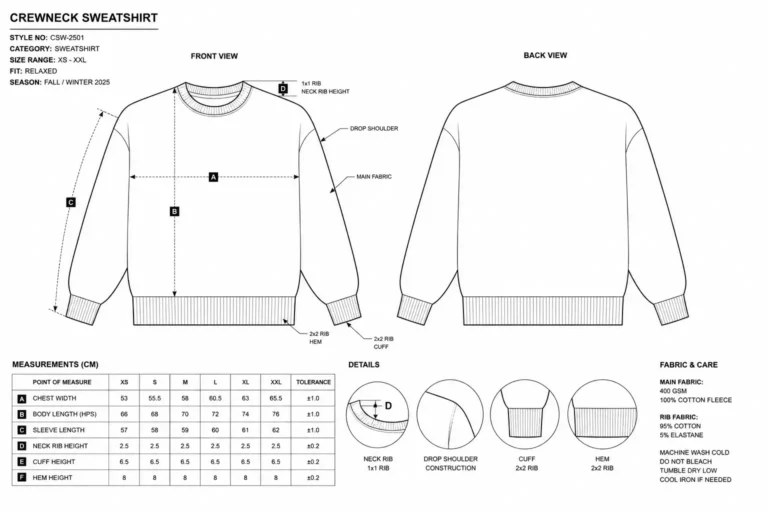
4. Graded Measurement Specs & Point of Measure (POM)
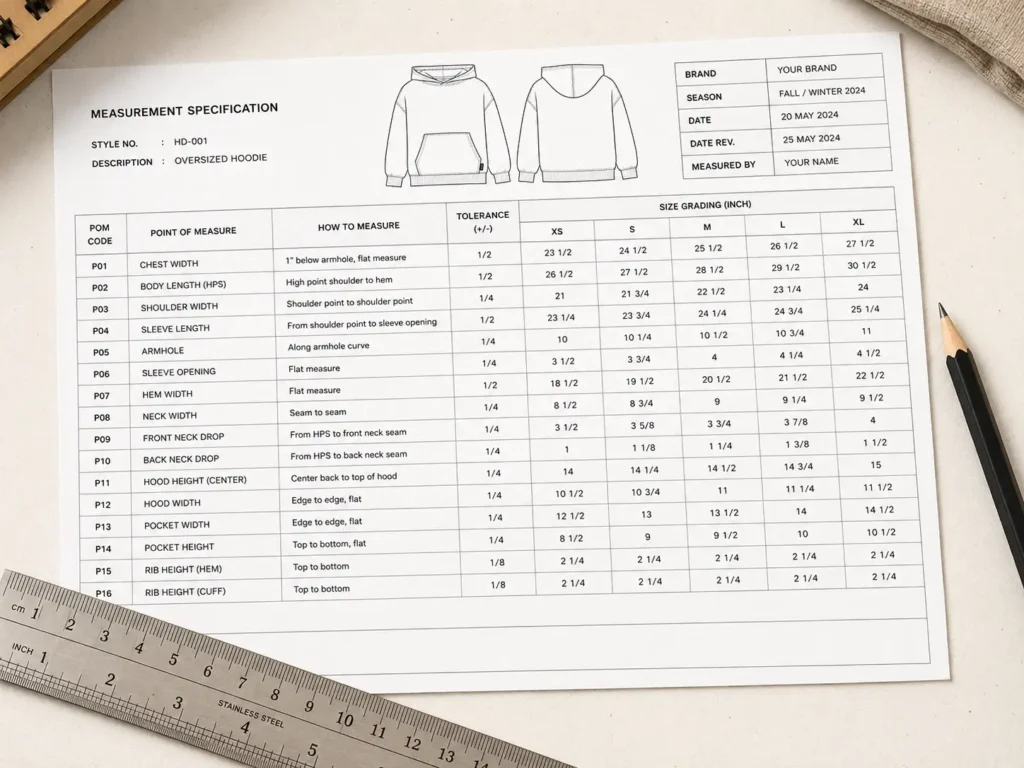
This is the technical heart of the tech pack, covering the garment measurement chart and every individual Point of Measure (POM).
What must be on this page:
- A measurement chart with every POM (chest width, shoulder seam, sleeve length, etc.) listed by code
- Base size measurements plus a full grading chart across the entire size run
- Tolerance allowances (e.g., +/- 0.25″)
- A labeled diagram showing exactly where each measurement is taken on the garment
Why it’s critical: Without graded specs, you only have one size dialed in — every other size in your range is the factory’s best guess at scaling. This is the single biggest cause of fit inconsistency across a size run.
These specifications are not only for completing the document—they are also the information a manufacturer uses when reviewing your file. See how factories read tech packs for the factory-side perspective.
5. Construction & Callouts
Construction pages detail exactly how the garment is built — not just what it looks like.
What must be on this page:
- Seam type for every seam (French seam, flat-fell, overlock, etc.)
- Stitch type and stitches-per-inch (SPI) where relevant
- Seam allowance measurements
- Callout arrows pointing to specific construction details on the flat sketch
- Topstitching width and placement
Why it’s critical: Seam allowances and stitch types directly affect how a garment drapes, stretches, and holds up to washing. Leave this page out, and the factory applies its standard default — which may not match your design intent at all.
The same production-document structure can be adapted to accessories and headwear. For a garment-specific example, see our Cap Tech Pack Template and Mockups guide.
6. Labeling & Packaging Placement
Easy to overlook, this page determines whether your branding actually shows up correctly on the finished product.
What must be on this page:
- Main label placement and size (with exact distance-from-seam measurements)
- Care label content and placement
- Hang tag placement
- Folding and polybag specifications for shipping
Why it’s critical: Labels placed even half an inch off-center look unprofessional and can trigger an entire round of corrections after the garments are already sewn — a far more expensive fix than catching it on paper.
7. Fit Comments & Revision History
This page is your paper trail — and factories rely on it heavily across multiple sample rounds.
What must be on this page:
- Dated fit comments from each sample round
- Specific POM adjustments requested (e.g., “shorten sleeve by 0.5 inch”)
- Approval status for each revision
- Names/initials of who approved each change
Why it’s critical: Without a revision history, nobody — including you — can track what’s already been corrected. Factories often revert to an earlier, unapproved version simply because there was no documented record of the latest changes.
Once you understand what each section contains, the next step is putting those sections together into a usable production document. For the step-by-step process, see our guide on how to create a tech pack for clothing brands.
DIY vs. Professional Tech Pack Templates
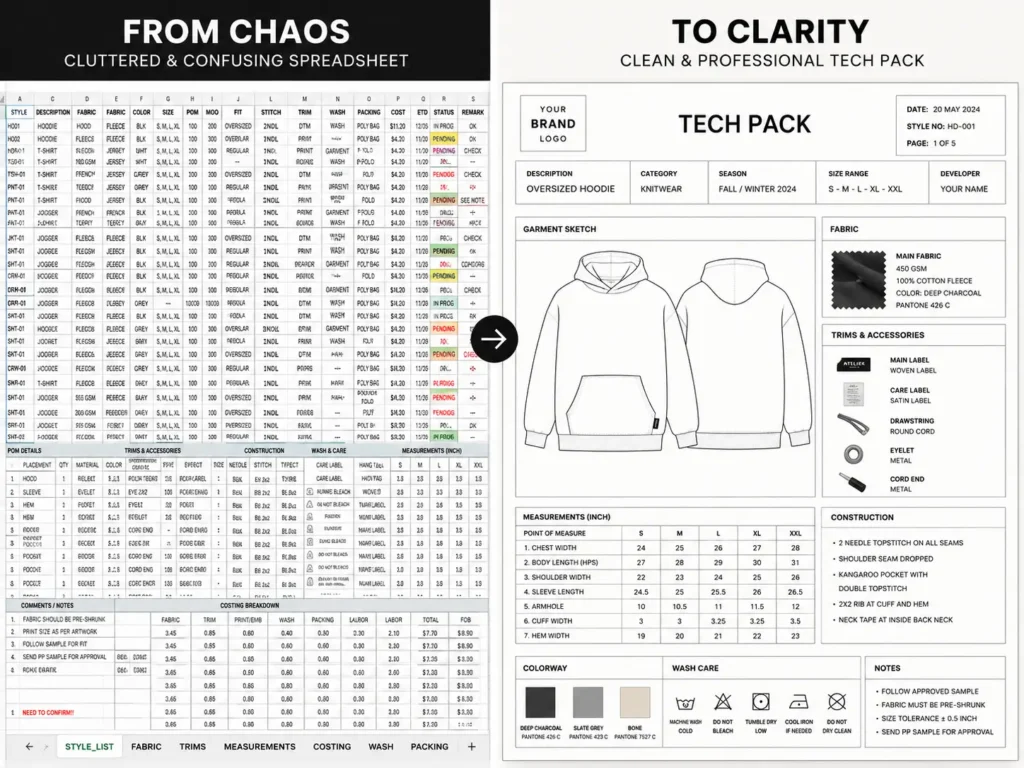
Building all seven of these pages from scratch in Excel or Illustrator is technically possible. It is also, for most founders, a multi-day project with a steep learning curve.
Founders attempting a DIY approach typically run into the same walls:
- Formatting POM charts that factories can actually read at a glance.
- Manually grading measurements across a full size run without a single error.
- Building accurate technical flats without prior patternmaking or CAD experience.
Each of these fashion tech pack layout sections has its own formatting conventions that factories expect — conventions that took the industry years to standardize. Reinventing them from a blank spreadsheet means relearning lessons that ready-made templates have already solved.
A professional template gives you all of these fashion tech pack layout sections pre-built, pre-formatted, and tested against real factory expectations — you fill in your specs instead of designing the page architecture from zero.
💡 Pro Tip: Even experienced designers reuse a base template across collections. Rebuilding the same page structure for every new style is time better spent on design, not formatting.
DIY vs. Templates: Quick Comparison
| Feature | DIY (Excel/Illustrator) | Basic Template ($9.99) | Techpack Mega Bundle |
|---|---|---|---|
| Time Required | 8–20+ hours | Under 1 hour | Under 1 hour per style |
| Layouts Included | Build every page yourself | All 7 essential pages | All 7 essential pages + multi-garment variations |
| Professionalism | Inconsistent, DIY look | Industry-standard formatting | Industry-standard formatting |
| Factory Compatibility | Varies — risk of confusion | Built to factory expectations | Built to factory expectations |
| Best For | Highly experienced technical designers only | Single garment projects, beginners | Multi-style brands, serious production |
The Best Tech Pack Templates for Fashion Founders
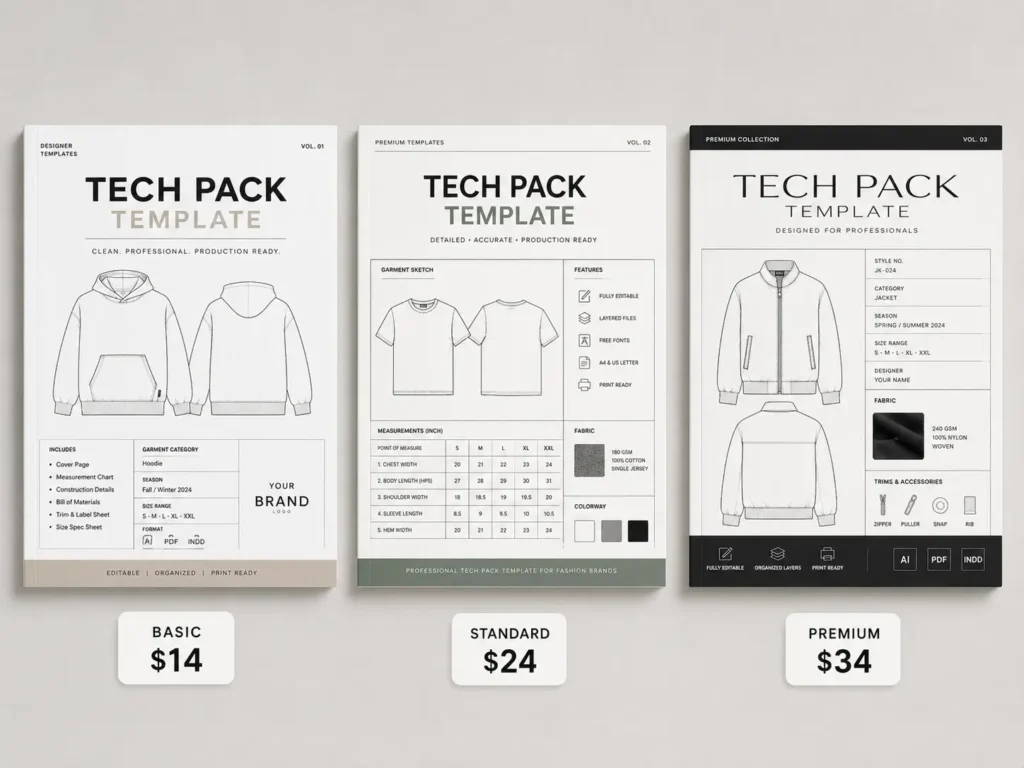
Once you know what is included in a fashion tech pack, the fastest path forward is starting from a structure that’s already correct. Here’s how to choose between our three options.
Fashion Tech Pack Template — $9.99 (Best for Beginners & Lowest Barrier to Entry)
This is the most accessible entry point for founders launching their first garment. It includes the essential layouts — cover page, BOM, measurement spec, and construction callouts — fully formatted and ready to customize.
Highlights:
- All essential tech pack layouts included
- Extremely affordable for first-time founders
- Perfect for a single garment or capsule project
Adobe Illustrator Tech Pack Template (Best for Experienced Designers & Adobe Users)
Built fully in vector, this template slots directly into an Illustrator-based design workflow — no converting or rebuilding sketches in another program.
Highlights:
- Fully vector-based for clean scaling and editing
- Seamless integration with your existing Illustrator files
- Ideal for designers who already sketch flats in Illustrator
Complete Tech Pack Library (Best Overall Value for Serious Brands)
For brands managing multiple styles, garment categories, or an entire collection, the Mega Bundle is the most comprehensive option — covering every layout section across multiple garment types in one purchase.
Highlights:
- Ultimate comprehensiveness across garment categories
- Covers every essential tech pack layout section
- Best long-term value for brands scaling past a single style
Frequently Asked Questions
Can I make a tech pack in Excel?
Yes, Excel can technically hold a Bill of Materials and a basic measurement chart. However, it struggles with technical sketches, callout diagrams, and the visual layout factories expect. Most founders end up combining Excel with a separate design program, which adds time and increases the chance of mismatched files. A dedicated template avoids this entirely.
What is a BOM (Bill of Materials) in fashion?
A Bill of Materials is the complete list of every fabric, trim, and component used to build a garment, including composition, supplier, color code, and consumption amount. It’s the page your factory uses to source materials and quote production costs, so accuracy here directly affects your final price per unit.
Do I need a different tech pack for every size?
You don’t need a separate tech pack, but you do need a graded measurement chart within it. Grading means calculating how each Point of Measure changes from your base size across the rest of your size run, all displayed in one chart on the same spec page.
What’s the difference between a tech pack and a pattern?
A pattern is the actual template pieces used to cut fabric. A tech pack is the broader technical document that includes specs, materials, and construction notes — it often references the pattern but isn’t a substitute for it. Factories typically need both, especially for first-time production.
How many pages should a fashion tech pack be?
Most professional tech packs run 7–12 pages per garment style, depending on complexity. A simple t-shirt might need closer to 7 pages, while a structured jacket with multiple closures and linings may need additional construction or hardware detail pages.
Do factories require technical sketches or can I send photos?
Factories strongly prefer technical flat sketches over photos. Photos can’t clearly show internal construction, seam placement, or proportions the way a flat sketch with callouts can, which leads to more misinterpretation during sampling.
What software do professional designers use for tech packs?
Many technical designers use Adobe Illustrator for sketches paired with Excel or specialized tech pack software for spec charts. According to apparel manufacturing standards, factories generally expect vector-quality sketches regardless of which program produced them.
Can one tech pack cover multiple colorways?
Yes — most tech packs include a single colorway page listing all approved color combinations rather than duplicating the entire document per color. This keeps the file manageable while still giving the factory every approved option.
Conclusion
Knowing what is included in a fashion tech pack is the difference between a smooth production run and a string of expensive, frustrating samples. To recap:
- A complete tech pack covers seven essential pages: cover/sketch, BOM, colorways, graded measurements, construction, labeling, and revision history.
- Missing even one page creates a specific, predictable type of factory error.
- DIY tech packs are possible but time-intensive and prone to formatting issues factories aren’t used to seeing.
- A ready-made, professionally structured template solves this instantly.
Ready to get your designs manufactured correctly the first time? Skip the headache of building every layout section from scratch.
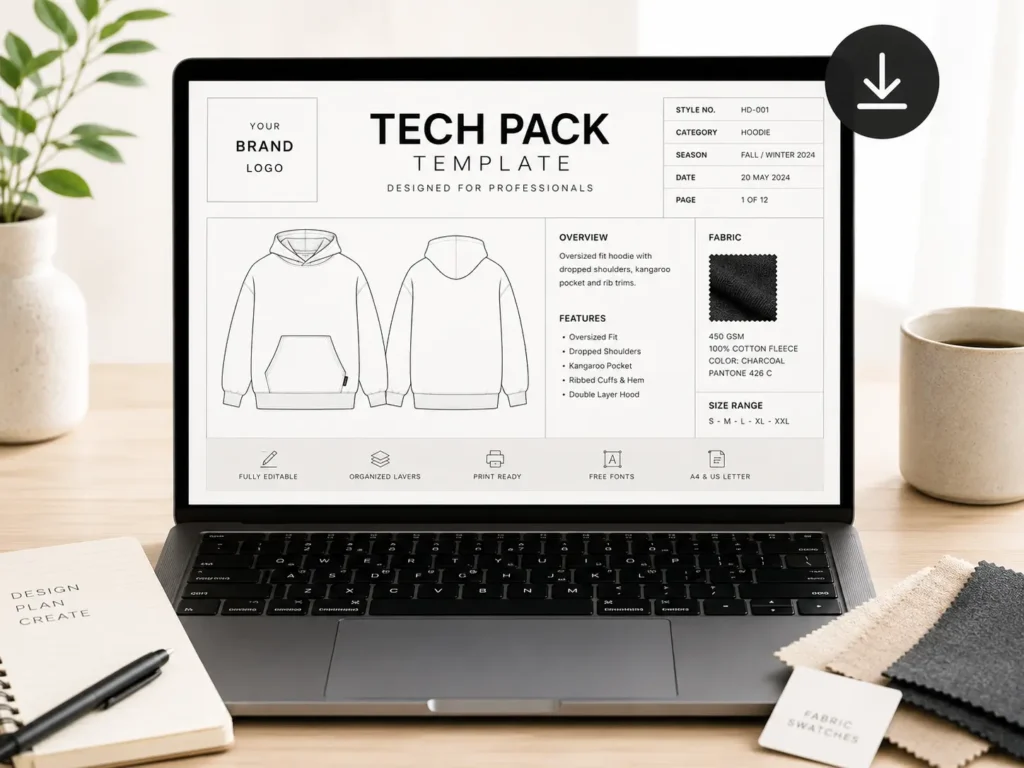
- Start with our $9.99 Fashion Tech Pack Template
- Edit in vector with the Adobe Illustrator Tech Pack Template
- Get everything you need with the Complete Tech Pack Library