Design - Create - Grow


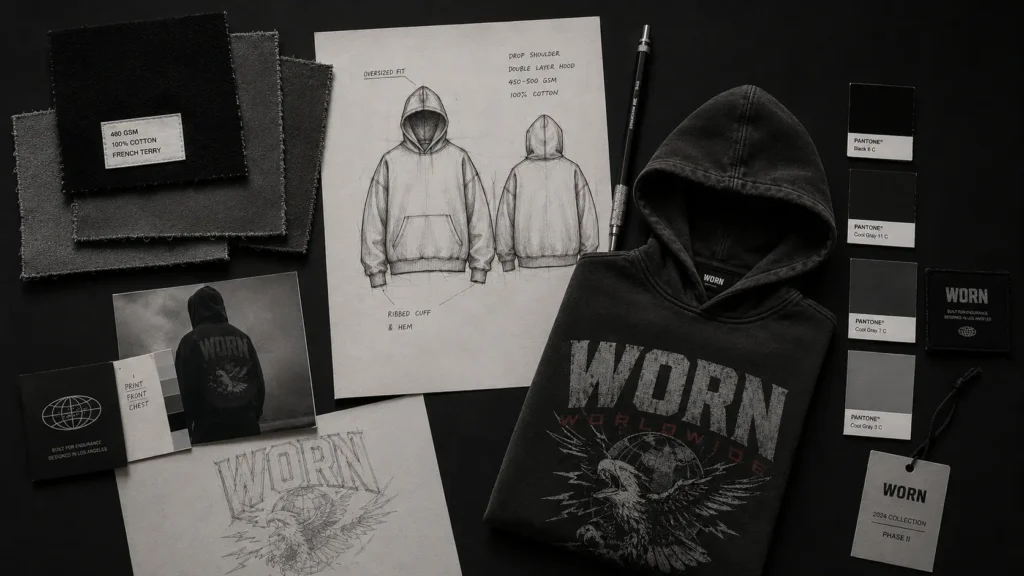
Have you ever looked at a brand like Fear of God, Corteiz, or Madhappy and thought, “I could build something like that”? You’re not alone — and you’re probably not wrong. But here’s the honest truth: most people who want to know how to start a streetwear brand never actually launch because they don’t know where to begin, what to spend money on, or how to look professional without a big budget.
Learning how to start a streetwear brand in 2026 is more accessible than ever — but the bar for quality has never been higher.
Consumers can smell a half-baked brand from a mile away. The brands that win aren’t just the ones with the best designs. They’re the ones who prepared properly: nailing their identity, designing with intention, and building hype before a single stitch is sewn.
This guide covers the full journey — from finding your niche and designing your first collection, to manufacturing, marketing, and launching. Whether you’re starting with $500 or $5,000, you’ll walk away with a clear roadmap and know exactly which tools will save you money, time, and embarrassment.
Before deciding how much to invest, it helps to understand where your money actually goes. Our guide on how much it costs to start a clothing brand in 2026 breaks down design, sampling, manufacturing, marketing, website, and other startup expenses.
⚡ Quick Answer: Starting a successful streetwear brand in 2026 requires a defined brand identity and niche, professional design assets (mockups + tech packs) to communicate your vision clearly, and a smart manufacturing strategy that fits your current budget. Preparation — not just creativity — is what separates brands that launch from brands that linger in a Google Doc forever.
Defining Your Brand Identity & Niche — The Foundation of Your Clothing Line Startup Guide 2026
Here’s what separates a brand from a t-shirt business: identity.
In 2026, slapping a logo on a blank tee and calling it a streetwear brand won’t cut it. Consumers — especially in the streetwear space — are buying into a world, a story, and a community. They need to feel something when they see your brand.
Every serious clothing line startup guide 2026 starts here. Before you design a single piece, answer these foundational questions:
- Mission: What does your brand stand for? (Skate culture? Underground music? Immigrant hustle? Mental health awareness?)
- Aesthetic: What does your visual world look like? (Gritty and distressed? Clean and minimal? Oversized Japanese workwear? Bold graphics?)
- Target Audience: Who exactly are you designing for? (Age, lifestyle, location, what they listen to, what they wear now)
- Unique Angle: What do you do that no one else does? (The specific tension you’re tapping into)
You don’t need to have all the answers on day one. But you need a strong point of view. Ask yourself: “If my brand were a person, what would they look like, talk like, and stand for?”
💡 Pro Tip: Study 3-5 brands you respect and identify what makes each one feel different. Then map out where your brand fits — and where it consciously diverges.
Designing Your First Streetwear Collection — Mockups, Tech Packs & the Design Process
This is where most new founders either get it right or waste thousands of dollars. Let’s break the design process down step by step.
Step 1: Sketching Your Concepts
You don’t need to be a professional illustrator. Start with rough sketches — even stick-figure quality works — just to get your ideas out of your head and onto paper. The goal is to visualize placement, proportions, and graphic ideas.
Do I need to know how to draw to start a clothing line? Not at all. Plenty of founders sketch a rough idea and hand it off to a graphic designer on Fiverr or Upwork to digitize it. The concept is yours — the execution doesn’t have to be.
Step 2: Going Digital
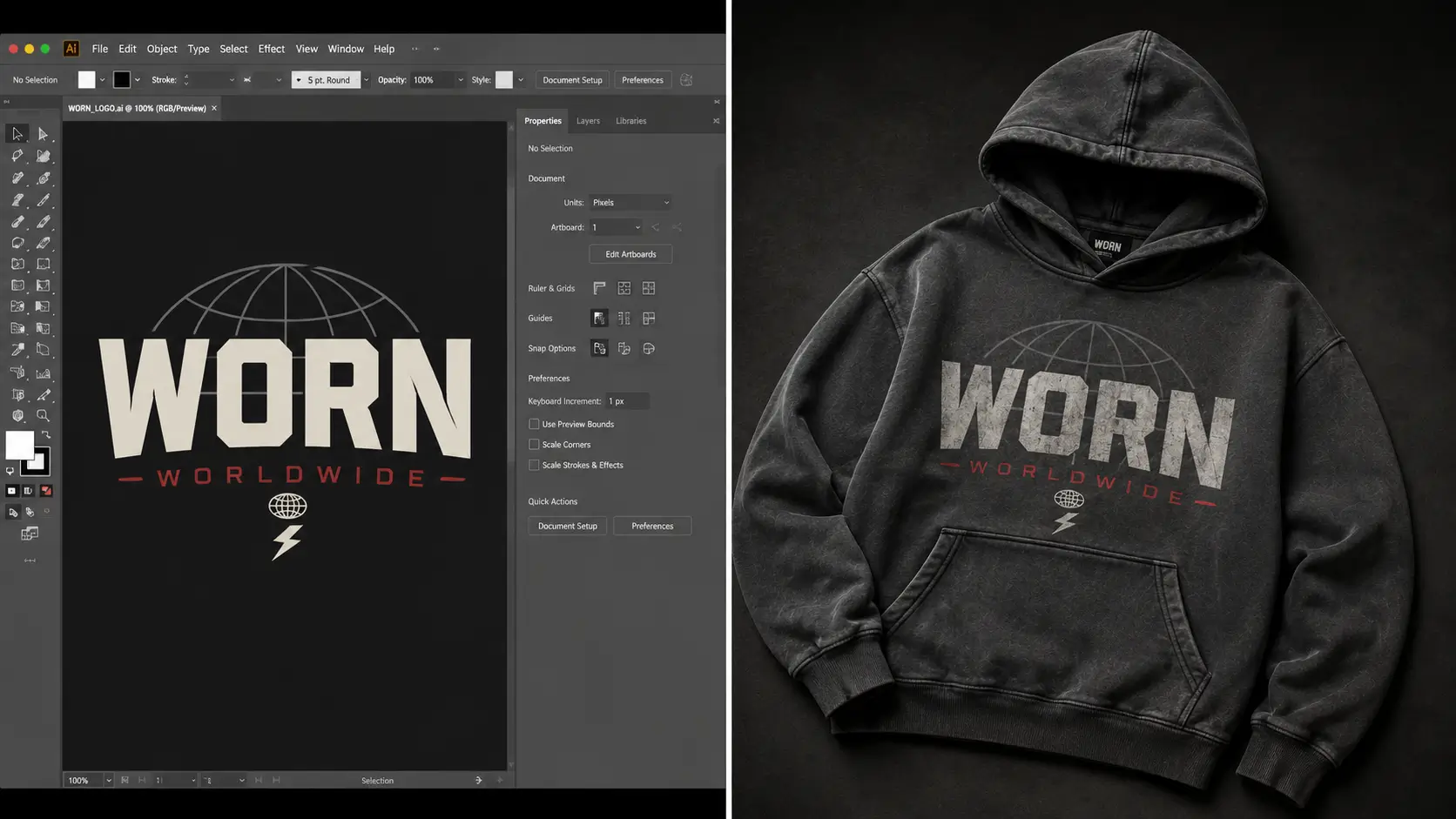
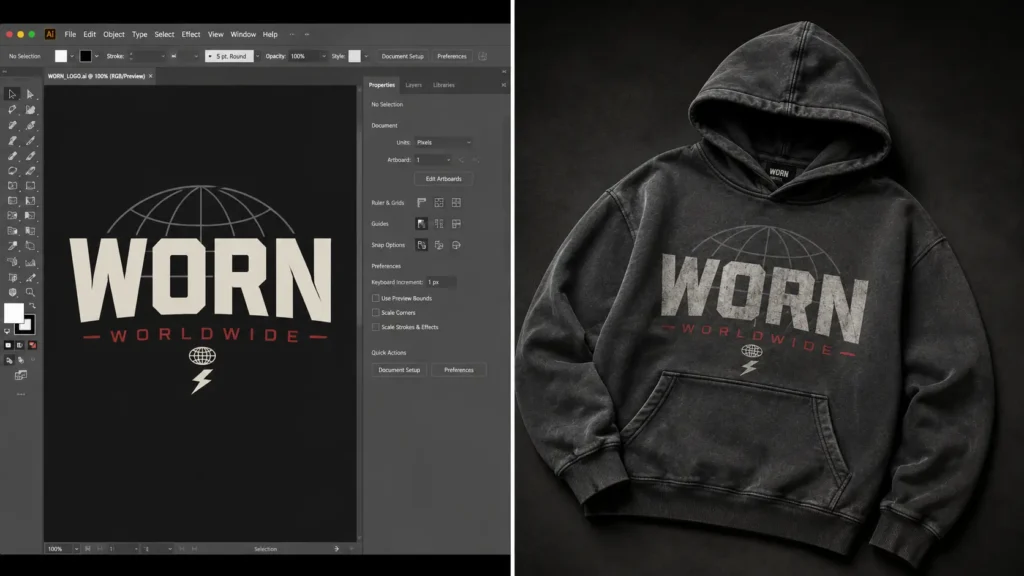
Once your sketch is refined, you’ll move it into Adobe Illustrator or Photoshop to create a clean vector graphic or digital design file. This is what actually gets applied to your garments.
If you’re unsure which programs you actually need at this stage, our guide to the software you need to start a clothing brand explains what Illustrator, Photoshop, Canva, and other tools are best used for.
Step 3: Using Clothing Mockups to Visualize Before You Spend
Here’s something every experienced brand owner will tell you: never spend money on samples until you’ve visualized your design on a realistic mockup.
Clothing mockups are high-quality digital templates that let you see exactly how your design will look on an actual garment — hoodie, tee, cargo pants, whatever you’re working on — before production. They’re essential for:
- Getting honest feedback from your audience before you commit to inventory
- Creating professional marketing content for Instagram and TikTok before the product even exists
- Catching design problems (wrong scale, awkward placement, poor colorway) that would cost you money if you only caught them at the sample stage
If you want to explore the different types of garment mockups and how to choose the right ones for your designs, see our guide to the best clothing mockups for fashion designers.
If you’re just getting started, download our FREE Streetwear Clothing Mockups Pack. It’s a zero-risk way to start building and presenting your designs professionally, right now.
Step 4: Tech Packs — Your Blueprint for Manufacturers
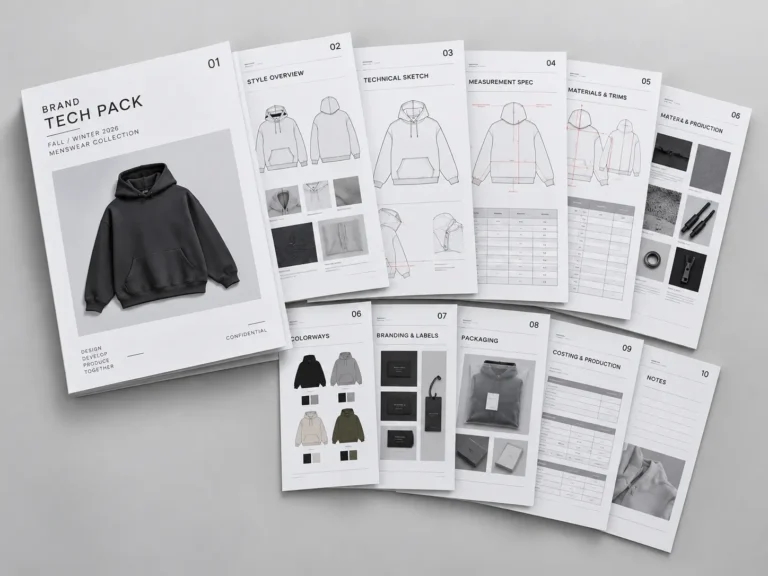
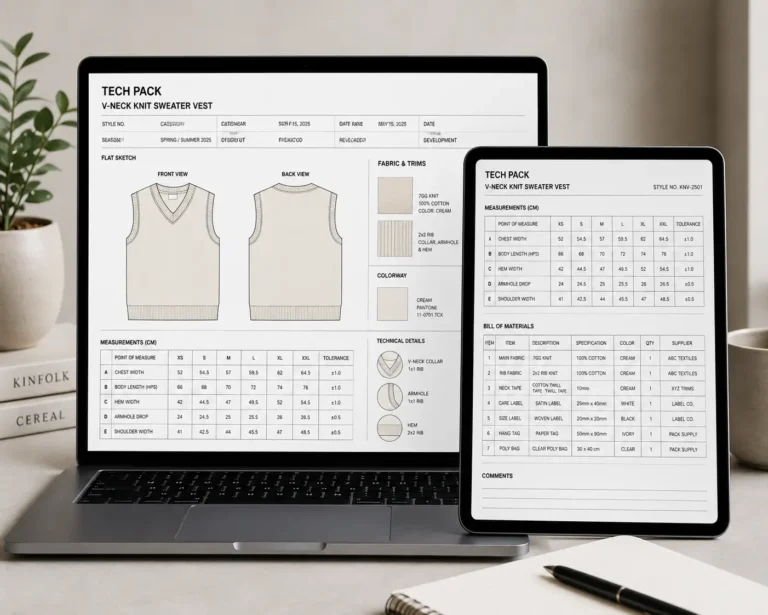
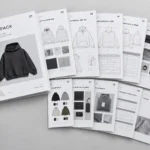
Once your design looks right on a mockup, you need to communicate that design to a manufacturer. This is where tech packs come in. For a complete beginner-friendly explanation of what a fashion tech pack contains and how it is used, see our complete guide to fashion tech packs.
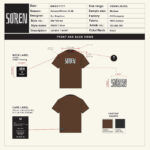
A tech pack is a detailed technical document that contains:
- Front and back flat sketches of the garment
- All measurements and sizing specs
- Fabric type, GSM weight (e.g., 380 GSM for a heavyweight hoodie), and construction details
- Graphic placement measurements (in inches from collar, side seam, etc.)
- Color codes (Pantone, CMYK, hex)
- Print method specifications (screen print, puff print, embroidery, plastisol vs. DTG)
- Label and tag specifications
💡 Pro Tip: Never send a manufacturer just a sketch. Always use a professional tech pack to avoid getting samples back with wrong sizing, off-placement prints, or completely different construction than you intended.
Creating tech packs from scratch is complex. That’s exactly why the S.i. Graphics Starter Bundle was built. It includes both editable AI vector mockups AND pre-built tech pack templates — everything a beginner needs to design, present, and communicate their collection professionally, without needing a design degree or a big agency budget.
For new founders, it’s the lowest-risk, highest-leverage starting point available.
The Ultimate Streetwear Brand Checklist
Use this streetwear brand checklist as your go-to reference during launch prep. Bookmark it. Check items off as you go.
🏢 Business & Legal Setup
- Register your business (LLC is recommended for liability protection)
- Secure your brand name as a trademark via the USPTO (or local equivalent)
- Purchase your domain name (use your brand name exactly, if available)
- Set up a business bank account to separate personal and business finances
💻 Digital Presence
- Claim all social media handles (@yourbrand on Instagram, TikTok, X, Pinterest) before you announce
- Set up your Shopify store (even as a “Coming Soon” page to capture emails)
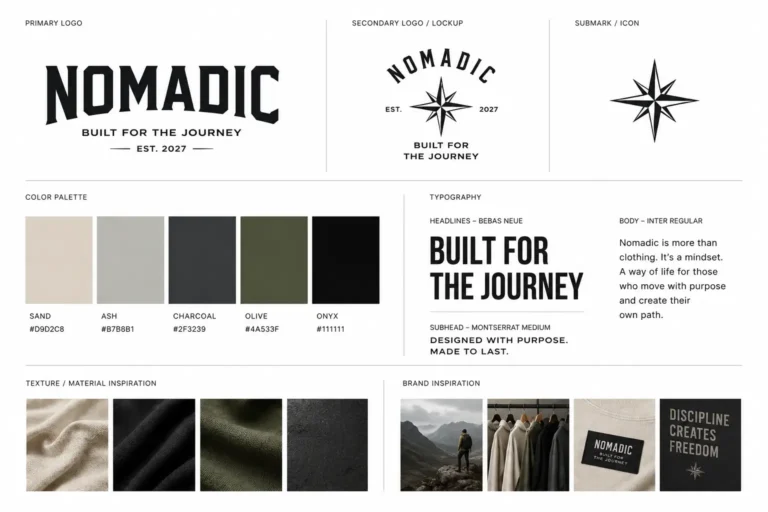
- Create a basic brand kit (logo, color palette, fonts)
🎨 Design Assets
- Define your first collection (3-5 SKUs is a solid start — tee, hoodie, maybe a hat)
- Design all graphics and digitize them
- Create clothing mockups for every piece in the collection
- Build tech packs for all garments going into production
💰 Budget & Operations
- Allocate budget across: design assets, samples, production run, marketing, and contingency
- Research and shortlist 2-3 manufacturers for sampling
- Set your retail pricing (cost of goods × 2.5–3x minimum for healthy margins)
📣 Pre-Launch Marketing
- Start teasing content 4-6 weeks before launch (use your mockup visuals)
- Build an email list (even 100 people who want your product before launch is powerful)
- Plan your launch “drop” date and stick to it
If you want a more detailed step-by-step version of the process, see our clothing brand launch checklist, which takes you from the initial idea through design, sampling, manufacturing, and your first production run.
Sourcing & Manufacturing Your Streetwear Brand
Once your designs are locked and your tech packs are ready, it’s time to talk production. You have three main paths:
Print-on-Demand (POD) vs. Wholesale Blanks vs. Cut & Sew
| Feature | Print-on-Demand (POD) | Wholesale Blanks + Local Print | Custom Cut & Sew |
|---|---|---|---|
| Startup Cost | Low ($0–$50 setup) | Medium ($300–$2,000) | High ($2,000–$10,000+) |
| Profit Margins | Low (30–40%) | Medium (45–60%) | High (55–70%) |
| Customization Control | Low | Medium | Full |
| MOQ (Min. Order) | 1 unit | 12–50 units | 50–200+ units |
| Shipping Speed | Slow (5–14 days) | Fast (1–7 days) | Slowest (8–16 weeks) |
Which path is right for you?
- 🔹 If your budget is under $500 and you want to test demand → Start with Print-on-Demand using providers like Printful or Printify. Margins are slim, but risk is minimal.
- 🔹 If your budget is $500–$2,000 and you want better quality → Source heavyweight blanks (brands like Gildan Heavy, Bella+Canvas, or niche options like Comfort Colors and AS Colour) and work with a local print shop for screen printing or embroidery.
- 🔹 If your budget is $2,000+ and brand identity is everything → Go Custom Cut & Sew for full control over construction, fabric, fit, and labeling. This is where real brands are built.
The Sampling Process
Before placing a full production order, always request samples. Sampling can become one of the most expensive stages of a clothing launch when designs or specifications are unclear. See our guide on how to save money on clothing brand sampling for practical ways to reduce unnecessary sample rounds and costs. A sample run typically costs $50–$300 per piece depending on complexity and manufacturer location.
This is where a solid tech pack saves you money. Manufacturers overseas — particularly in Portugal, Turkey, China, Pakistan, and Bangladesh — work from your tech pack like a blueprint. If the document is vague or missing specs, you’ll get back something that doesn’t match your vision. You’ll pay for another round of samples, waste 4–6 weeks, and lose momentum.
The S.i. Graphics Starter Bundle, tech pack templates are designed to be manufacturer-ready right out of the box, so you’re not starting from a blank page.
💡 Pro Tip: Always request a size set sample (at least S, M, and L) before approving a production run. A design that looks perfect on a medium might have proportion problems on an XL.
Marketing, Hype & The Drop Model
The biggest mistake new streetwear brands make? Treating their launch like a traditional retail release — making inventory, then telling people about it.
The drop model flips this entirely.
What Is a Drop?
A “drop” is a limited, date-specific product release — announced in advance, hyped intensely beforehand, and sold in a short window (sometimes hours). Supreme built its entire empire on this model. So did Palace, Kith, and now hundreds of independent brands doing the same on a smaller scale.
The psychology is simple: scarcity creates urgency. When something might sell out, people act.
If you want to sell your designs before committing to a large inventory order, see our guide on how to do pre-orders for a clothing brand, including how to structure the pre-order window, create product visuals, and manage production after orders come in.
How to Build Hype Before You Have Product
Here’s the key: you don’t need physical product to start marketing. This is exactly where high-quality mockups and 3D renders do their best work.
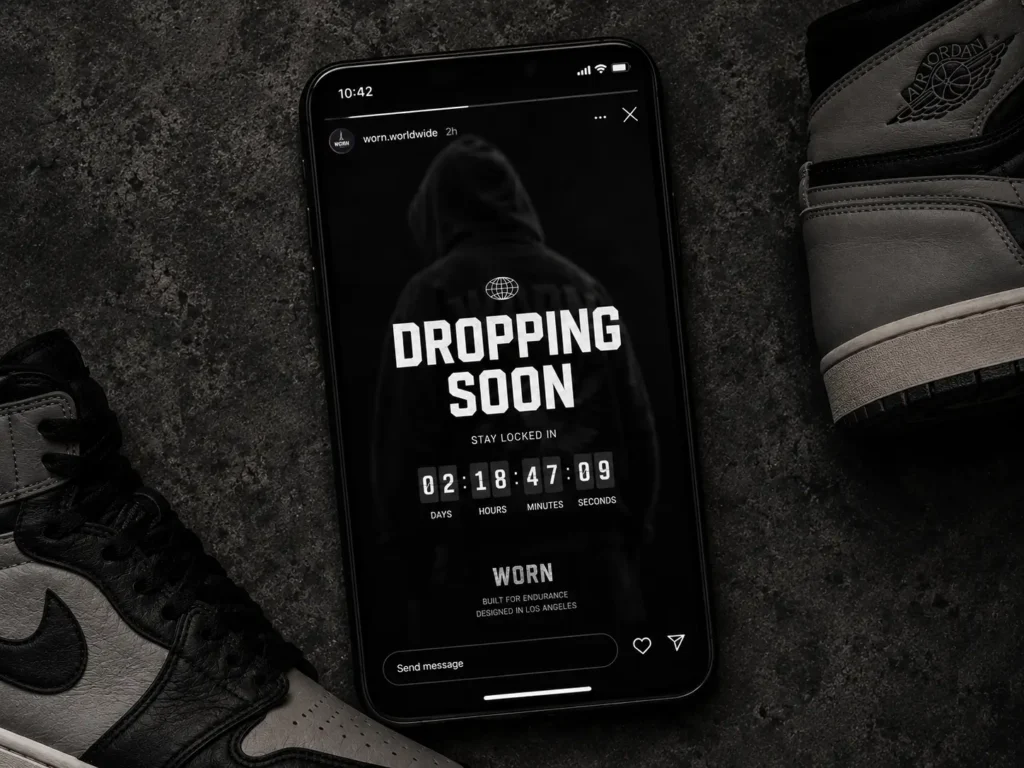
- Post mockup visuals of your upcoming collection on Instagram and TikTok with a “dropping soon” caption
- Run a countdown story series on Instagram
- Ask your audience to vote between colorways or design variations (this creates investment in the outcome)
- Build an email or SMS waitlist with a simple landing page (“Join the waitlist to get early access”)
Community Building Basics
Drop culture lives and dies on community. Start building yours now:
- Engage authentically on platforms where your target audience hangs out (TikTok, Instagram, Discord, Reddit)
- Document your process — people love following the behind-the-scenes journey of a brand being built
- Collaborate early — find other small creators or brands in adjacent niches for cross-promotion
Frequently Asked Questions About Starting a Streetwear Brand
How much money do you need to start a streetwear brand?
Realistically, you can start a brand for as little as $300–$500 using print-on-demand, which requires no upfront inventory. For a proper launch with physical inventory, budget $1,500–$3,000 minimum. Break it down like this:
- Design assets (mockups, tech packs): $0–$200 (use tools like the SiGraphics Starter Bundle)
- Samples: $150–$400
- First production run (50 units): $600–$1,500
- Marketing and photography: $200–$500
Starting lean is smart. Validate demand before scaling your investment.
Do I need to know how to draw to start a clothing line?
No. Most successful brand founders aren’t illustrators. Editable mockup templates bridge the gap entirely — you can place a graphic onto a professional garment template without any drawing skill. For more complex construction ideas, a tech pack template gives you the structured document format; you fill in your specifications. The S.i. Graphics Starter Bundle was specifically designed for founders who want professional results without a design background.
What is the best blank apparel for streetwear?
It depends on the aesthetic you’re going for:
- Heavyweight oversized tees (240–280 GSM): AS Colour Staple, Gildan Heavy Cotton, Comfort Colors 1717
- Boxy fit hoodies (380–420 GSM): Jerzees NuBlend, Carhartt blanks for workwear aesthetic, or custom cut & sew for full control
- Standard fit basics: Bella+Canvas 3001 or Next Level 3600 for a clean, fitted look
GSM (grams per square meter) matters for perceived quality. Anything under 180 GSM feels flimsy. Streetwear consumers expect weight.
What’s the difference between a mockup and a tech pack?
They serve completely different purposes:
Mockups are visual presentation tools. They show what your design looks like on a garment — used for marketing, social media, and getting feedback. They’re for human eyes.
Tech packs are technical blueprints for manufacturers. They contain measurements, materials, construction specs, and print placement. Without a proper tech pack, your manufacturer is guessing — and guessing costs you money.
Learn how to use tech packs effectively
How do I find clothing manufacturers for my brand?
Start with these channels:
- Alibaba (alibaba.com): The largest global supplier marketplace. Filter by “Verified Supplier” and “Trade Assurance” for more reliable partners. Always request samples before committing.
- Local print shops: Great for screen printing and embroidery on blanks. Search locally — personal relationships reduce miscommunication.
- Instagram and TikTok: Many small-batch cut-and-sew manufacturers actively market themselves on social media now
- Maker’s Row: A US-focused manufacturer directory
Critical rule: Always send a complete tech pack with your inquiry. Manufacturers respond more seriously to founders who communicate professionally. A good tech pack signals you’re serious, reduces back-and-forth, and protects you if something goes wrong.
Browse verified suppliers on Alibaba
How long does it take to launch a streetwear brand?
If you move decisively, you can go from idea to first launch in 3–6 months:
- Weeks 1–4: Brand identity, domain, socials, first designs
- Weeks 5–8: Mockups, tech packs, manufacturer sourcing, sample requests
- Weeks 9–14: Sample review, revisions, production run approval
- Weeks 15–20: Production, marketing buildup, pre-launch content, drop day
This timeline assumes you have your design assets ready early. The biggest delays typically come from slow manufacturer communication and poorly written tech packs that require multiple revision rounds.
What print method should I use for streetwear?
Each method has its strengths:
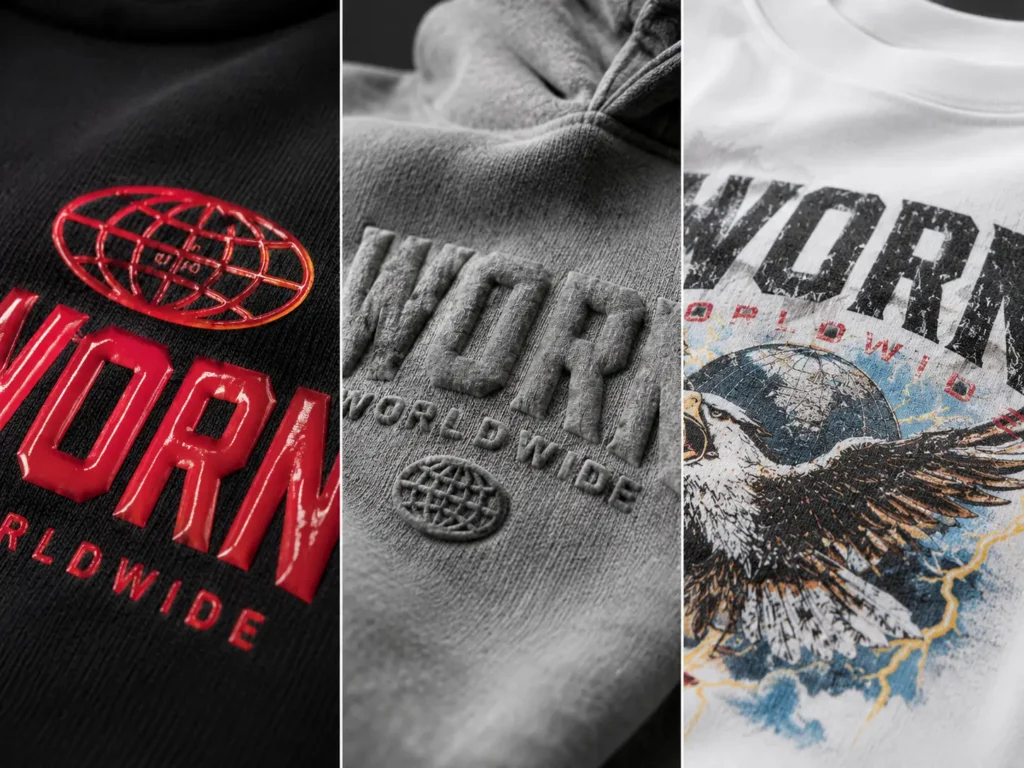
- Screen printing: Best for bold graphics, large runs (50+ units), and crisp results. Cost drops with volume.
- Puff print: A screen-printing variation that creates a raised 3D texture — popular in streetwear for logos and chest hits.
- DTG (Direct-to-Garment): Best for detailed, photo-realistic prints and small runs. Less durable long-term than screen print.
- Plastisol vs. water-based ink: Plastisol is more durable and vibrant. Water-based feels softer and is preferred for “vintage” aesthetics.
Choose your print method before writing your tech pack — it affects placement specs, file format, and color mode requirements.
Conclusion: Your Streetwear Brand Starts with Preparation
Starting a streetwear brand in 2026 is a real opportunity — but it’s not easy, and it’s not instant. The brands that break through are the ones that do the unglamorous preparation work before they ever announce themselves.
Key takeaways from this guide:
- ✓ Brand identity comes first. Know your niche, your audience, and your aesthetic before you design anything.
- ✓ Professional design assets — clothing mockups and tech packs — save you from expensive mistakes at the manufacturing stage.
- ✓ Choose your manufacturing path based on your current budget and long-term goals, not what looks most impressive.
- ✓ Build hype before you have product. The drop model rewards preparation and patience.
Ready to start designing your first collection?
→ Download the FREE Streetwear Mockups Pack — Start practicing with professional templates. Zero cost, zero risk.
→ Upgrade to the S.i. Graphics Starter Bundle — Get editable AI vector mockups and manufacturer-ready tech pack templates in one place. Everything a new founder needs to design professionally from day one.
Your future community is out there. They just don’t know your brand exists yet. Start building today.